
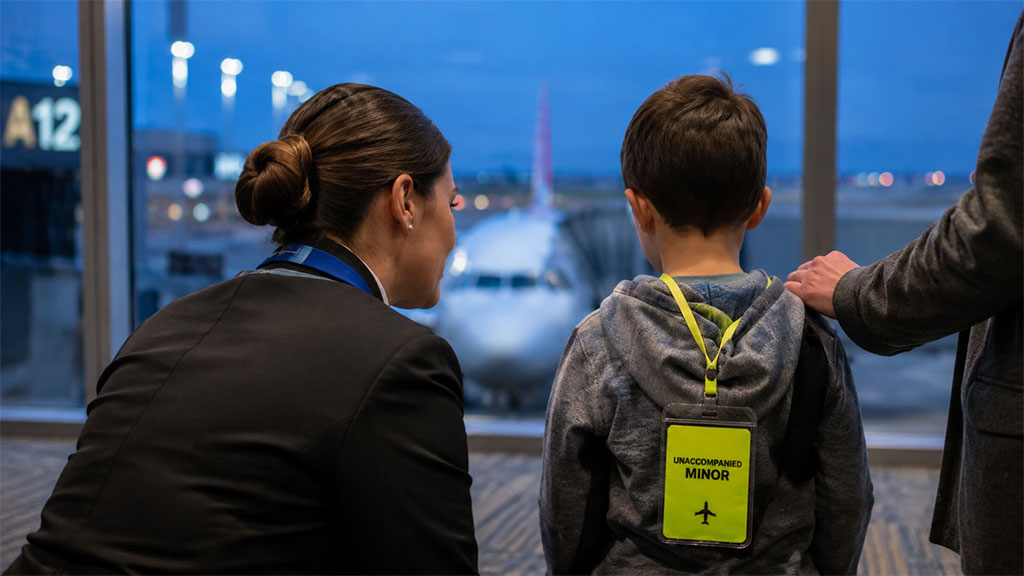
What Your Texas Custody Order Should Say Before the First Unaccompanied Flight
American, Delta, and Southwest all allow some children to travel alone starting at age 5, subject to each airline’s unaccompanied minor rules.
That is the airline’s answer. It is not your custody order’s answer.
Texas possession schedules were written around a parent handing a child over at a front door or a school, not at a gate in Terminal A. If your order does not say who books the flight, who pays for it, which airport, and what happens when the plane gets canceled, you and your ex will be arguing about it in June with a suitcase already packed.
Here is how unaccompanied minor travel actually works, what Texas law does and does not cover, and the specific language a long distance parenting order needs before your child takes the first flight.
What Age Can a Child Fly Alone?
Age 5 is the minimum on American, Delta, and Southwest, but every airline runs its own program with its own rules. The service is not optional for younger kids who fall within the carrier’s mandatory age band.
American Airlines requires its unaccompanied minor service for children ages 5 through 14. Kids 5 to 7 are limited to nonstop flights. Kids 8 to 14 can take a nonstop or connect through one of American’s listed hub cities. The fee is $150 each way, plus tax, on top of the ticket.
Delta’s program is mandatory for children 5 to 14 as well, with 5 to 7 year olds on nonstop flights only and 8 to 14 year olds allowed on connections. Delta’s fee is also $150 each way. Teenagers 15 to 17 can use the service by request, and the fee still applies.
Southwest treats children 5 through 11 as unaccompanied minors and charges a service fee in each direction. Southwest will not put an unaccompanied minor on a flight that requires a change of planes.
Nonstop, Direct, and Connecting Are Three Different Things
This distinction wrecks more summer possession schedules than anything else on the list. A nonstop flight takes off and lands once. A direct flight has the same flight number the whole way but may stop somewhere and pick up passengers, with your child staying in the seat. A connecting flight means changing planes, which is exactly what the youngest travelers are barred from doing.
Southwest allows an unaccompanied minor on a direct flight with a stop, as long as there is no plane change. American and Delta restrict their youngest fliers to nonstop only. If your order says “direct flight” and the other parent books a connection, you now have a fight over what the word meant. Write out what you actually mean.
How the Airport Actually Works on Flight Day
The sending parent does not drop the child at the curb. You go inside, you go through security, and you stay.
Both American and Delta require the accompanying adult to take the child to the departure gate and remain there until the flight has left the ground. To get past the checkpoint, you get a gate pass from the airline ticket counter. Southwest issues that pass on presentation of a valid photo ID and a copy of the child’s itinerary, and you still need a REAL ID compliant license or another acceptable form of identification to clear security.
On the other end, the receiving adult goes through the same process in reverse. They pull their own gate pass, clear security, present photo ID at the gate, and sign for the child. Delta will not issue a gate pass on a digital ID, so a phone wallet is not enough.
Timing rules differ by carrier. Southwest tells adults to be at the gate no later than 45 minutes before the scheduled departure and, on the arrival side, 45 minutes before the flight is scheduled to land. Delta asks the receiving adult to report to the destination airport two hours before the scheduled arrival to get the gate pass. Check the airline you are actually flying, because these are not interchangeable.
One practical detail worth putting in your order: the airline will release the child only to an authorized pickup person who satisfies its identification requirements. If Grandma is supposed to pick up and the paperwork names someone else, follow the airline’s procedure for updating the authorized person before arrival.
What Texas Law Says About Long Distance Possession
Texas has a separate standard possession schedule when the possessory conservator lives more than 100 miles from the child’s residence. Under Texas Family Code Section 153.313, the schedule changes in ways that can make air travel a regular part of possession for families separated by significant distance.
The big one is summer. The long distance parent gets 42 days of summer possession instead of 30. If that parent gives written notice by April 1, they pick the dates, split into no more than two periods of at least seven consecutive days each. Miss the April 1 notice and the statute picks for you: 42 consecutive days running from 6 p.m. on June 15 to 6 p.m. on July 27.
The long distance schedule also gives that parent spring break every single year, not every other year. And instead of first, third, and fifth weekends, they can elect one weekend per month of their choosing with 14 days of written or telephonic notice, if they make that election within 90 days after the parents start living more than 100 miles apart.
For families separated by enough distance to require air travel, each of those periods can turn into another round of flights. Deadlines in a Texas possession order are not suggestions, and April 1 arrives faster than parents expect when flights still have to be booked.
The Standard Possession Order Does Not Mention Airplanes
Read the general terms in Texas Family Code Section 153.316 and you will see the gap. The statute talks about surrendering the child at a residence or at school, returning the child’s personal effects, letting a designated competent adult handle pickup and return, and giving notice when a parent cannot exercise a period of possession. Written notice by email or fax counts, as long as it arrives before the deadline.
What the statute does not say is who buys the ticket, which airport counts as the exchange point, what happens when a flight is canceled at 9 p.m., or who eats the change fee. Texas law leaves that to your order. If your order is silent, the default is whatever the two of you can agree on in the moment, which is not a plan.
The Travel Provisions Your Order Needs
Long distance custody arrangements fall apart on logistics, not on principle. These are the terms worth fighting for on the front end, because every one of them becomes an argument later if the order is quiet about it.
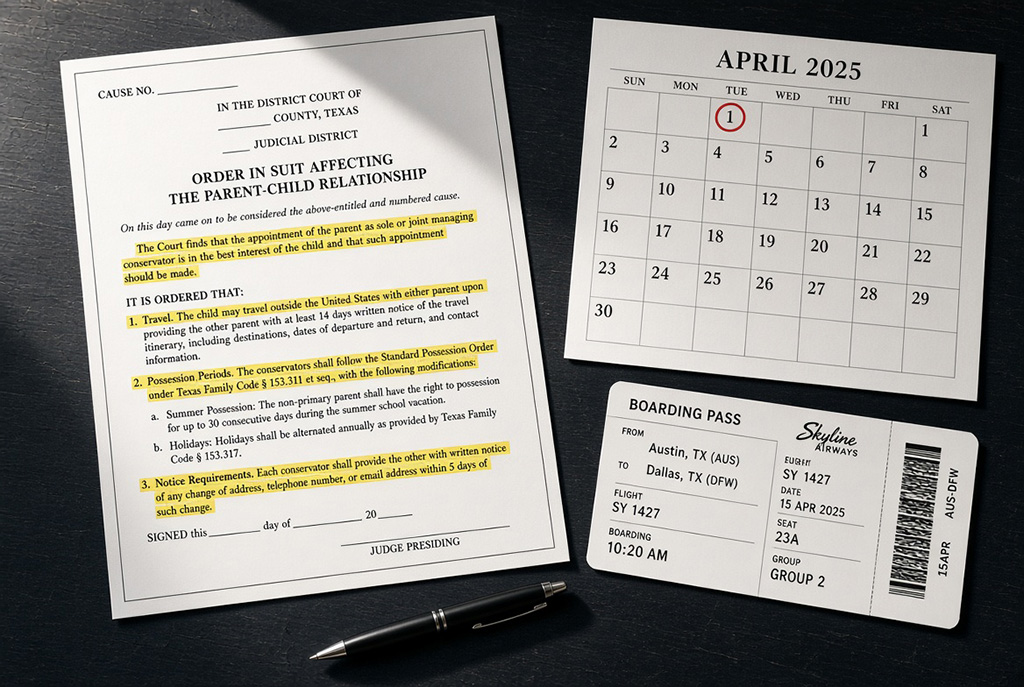
Who books and who pays. Name the parent responsible for booking each leg and set a deadline tied to the notice dates already in the order. Allocate the cost by percentage, by alternating years, or by leg. The unaccompanied minor fee should be addressed by name, not folded into a vague reference to travel expenses.
Which airport, and how far each parent drives. San Antonio families often have a real choice between San Antonio International and Austin-Bergstrom, and the difference is a two hour round trip. Name the airport, or name the conditions under which a different one is acceptable.
Minimum age and flight type. Spell out that the child flies nonstop only until a stated age, and define whether a direct flight with a stop is acceptable. Write the ages in as numbers so nobody has to interpret them.
Itinerary notice. Require the booking parent to send the full itinerary, confirmation number, and airline unaccompanied minor paperwork to the other parent a set number of days before travel. Include how it gets sent, since Section 153.316 already recognizes email as a valid method of notice.
Who is authorized at each end. List the adults permitted to drop off and pick up, and require that the airline forms match that list. This lines up with the designated competent adult language already in the Texas possession statute.
Cancellations, delays, and overnight disruptions. Say what happens when a flight is canceled, who rebooks, who pays for a hotel if the child cannot fly until morning, and how quickly each parent has to be notified.
Make-up time. If a weather cancellation eats two days of a 42 day summer period, does the parent get those days back, and when? Answer it in the order instead of relitigating it in August.
Documents the child carries. TSA does not generally require children under 18 to show identification for domestic travel, but the airline may require proof of age and its own unaccompanied minor paperwork. A copy of the possession order and both parents’ contact information can also be useful to keep with the child’s travel documents.
What This Costs and Who Usually Pays
Run the math before you agree to anything. A 42 day summer period means two flights. At $150 each way in unaccompanied minor fees on American or Delta, the escort service alone runs $300 before you have bought a single seat. Add spring break and any monthly weekends the long distance parent elects, and the annual travel budget for one child can rival a car payment.
Texas courts can address travel expenses as part of the possession arrangement. Who bears those costs can depend on the circumstances, including the reason for the distance between the parents, but there is no automatic rule that one parent always pays.
Travel costs also interact with support. Texas child support runs on statutory guidelines applied to a payor’s income, and a large travel obligation does not simply reduce that number on its own. If travel expense is going to be a serious part of your budget, it belongs in the order as its own term. Our breakdown of what counts as income for Texas child support covers how the guideline calculation actually works.
When the Other Parent Will Not Put the Child on the Plane
A possession order is enforceable. If the other parent refuses to send the child, cancels a required flight, or simply does not show up for an exchange the order requires, that can support an enforcement action, including contempt where the legal requirements are met.
Document it as it happens. Save the itinerary, the cancellation email, the texts, the gate pass receipt, and any proof you were at the airport. A clean paper trail gives the court something concrete to evaluate instead of forcing everyone to reconstruct the dispute from memory.
If the arrangement itself has stopped working, that is a different filing. A modification requires showing a material and substantial change in circumstances since the last order, and a move, a new school schedule, or a child aging out of the unaccompanied minor program can qualify depending on the facts. Our guide to modifying a Texas custody order walks through what that standard requires.
One caution. Do not assume the other parent’s violation automatically gives you the right to ignore your own obligations under the order. If the current arrangement creates a real problem, document it and address it through the proper enforcement or modification process.
Military Families and the Extra Layer
San Antonio is a military town, and long distance possession here often starts with a PCS, not a divorce. When one parent transfers to a base three time zones away, the long distance possession schedule and unaccompanied minor travel can arrive together.
Texas law has provisions built for this. Under Texas Family Code Section 153.705, when a parent without the right to determine the child’s primary residence is ordered to deployment, mobilization, or temporary military duty, the court may award that parent’s visitation to a designated person the parent chooses, if it serves the child’s best interest. That designated person steps into the possession periods the deployed parent would otherwise have exercised and is bound by the applicable surrender and return requirements in Section 153.316.
For a military family, that means the summer flight may not be to the service member at all. It may be to a grandparent or another relative exercising possession during the deployment window, which makes coordinating the authorized adult under the custody arrangement with the airline paperwork even more consequential. If orders are already in motion, our post on handling PCS orders during a Texas divorce covers the timing problems that come with a move. Our San Antonio military divorce page covers the broader picture.
Getting Your Child Ready for the Flight
The legal work sets the rules. The rest is preparation, and it is what actually determines whether your kid gets off that plane calm or rattled.

Walk the child through the sequence before the day arrives: security with you, waiting at the gate with you, boarding early with an airline employee, a flight attendant checking on them, and a named adult meeting them at the gate on the other side. Kids handle the flight fine. What unsettles them is not knowing what comes next.
Pack a carry-on they can manage alone. A charged phone or tablet with a charging cable, headphones, a snack that does not need refrigeration, a water bottle to fill after security, a change of clothes in case a bag goes missing, and something familiar for a younger child. Put a printed card in the front pocket with both parents’ phone numbers, since a dead battery should not cut your child off from reaching either of you.
Then let the trip be a normal thing. A child who watches one parent treat the flight as a crisis learns to treat it as a crisis. Keep the handoff short, keep it warm, and keep your opinion about the other parent out of the terminal.
FAQs about Unaccompanied Minor Travel and Texas Custody Orders
Can I refuse to let my child fly alone?
If the court order specifically requires or authorizes that travel arrangement, do not simply cancel it because you disagree with it. If the order is silent about whether the child must fly alone, or you have a specific safety concern, the answer may depend on the language of the order and the facts. Raise the issue with a family law attorney before the travel date rather than creating an airport-day dispute.
Who pays for the unaccompanied minor fee?
Whoever the order says pays. If the order is silent, you are negotiating it every trip. Texas courts can allocate travel costs between the parents, and the circumstances that created the distance can matter when the court decides how those costs should be allocated.
What if my ex books a connecting flight and my child is only 6?
The airline may refuse to transport the child on that itinerary because major carriers commonly restrict the youngest unaccompanied minors to nonstop flights. That is exactly why the flight type belongs in the order in writing. Send the itinerary problem to the other parent in writing as soon as you spot it, so the record shows you flagged it before travel day.
Can my custody order require a specific airline?
It can name a preferred airline or a required flight type. Naming a single carrier gets risky if that airline drops the route, so a better approach is often to require a nonstop or direct flight on a carrier that offers the unaccompanied minor service the child’s age requires.
Does my child need an ID to fly domestically?
TSA does not generally require children under 18 to show identification for domestic travel, but an airline may ask for proof of age and will require its own unaccompanied minor paperwork. The adults on both ends need acceptable identification to obtain gate access and receive the child.
What happens if the flight is canceled and my child is stranded overnight?
The airline’s unaccompanied minor policy governs what it will do operationally, but your custody order should still say who rebooks, who pays for the disruption, where the child stays if an overnight delay occurs, and how quickly each parent must be notified. Without that language, you are improvising during the worst possible hour to improvise.
Can a grandparent pick my child up at the gate?
Yes, if the grandparent is properly authorized under the airline’s unaccompanied minor procedures and presents the identification the airline requires. Texas law also allows a parent to designate a competent adult to handle pickup and return in appropriate circumstances, so make sure the adult authorized under your custody arrangement is also properly listed with the airline before the flight.
At what age can my child stop using the unaccompanied minor service?
It varies by carrier. American and Delta stop requiring it at 15, while Southwest stops requiring it at 12. The service stays available by request for teenagers on some airlines, and a fee may still apply when you request it. Build the age cutoff into the order so the requirement ends on a date, not on an argument.
Ready to Put Real Travel Terms in Your Custody Order?
A long distance possession schedule can work well for a child, but only if the order answers the practical questions before the first flight instead of after the first cancellation. Brandi Wolfe Law helps San Antonio and Bexar County parents build custody orders that address flight type, booking deadlines, travel costs, authorized adults, and what happens when a plane does not take off. If you are drafting a new order, responding to a move, or enforcing travel terms the other parent keeps ignoring, we can help you get it in writing correctly.
Call (210) 571-0400 or get a free strategy session to talk through your San Antonio child custody options before the next travel deadline hits.
This article is general information, not legal advice for your specific case. If your child’s travel, custody rights, or court orders are at risk, talk to a Texas family law attorney before you act.