

One Year to File a Deemed Election, and Missing It Can Be Extremely Hard to Fix
If your divorce order requires your former spouse to provide Survivor Benefit Plan coverage, you generally have one year from the relevant court order or filing to submit a deemed election to DFAS. Miss that deadline, and getting the coverage fixed later can become extremely difficult.
That is the whole problem in two sentences. The deadline is easy to miss because nothing about it necessarily announces itself. The decree gets signed, everyone moves on, and a potentially valuable survivor benefit can be lost before anyone realizes another filing was required.
The order gets signed, everyone moves on, and twelve months later a right worth hundreds of thousands of dollars over a lifetime is simply gone.
Here is what the Survivor Benefit Plan does, both ways the election can be made, what to file and where, and the decree language that makes any of it work.
What the Survivor Benefit Plan Actually Does
Military retired pay stops when the retiree dies. It is not an account with a balance. It is a monthly payment for a life, and when that life ends, so does the payment, including the portion a Texas court awarded to a former spouse.
The Survivor Benefit Plan is what keeps money flowing after that. It is an annuity paid to a designated beneficiary, funded by premiums taken from the retiree’s pay while they are alive.
Under Title 10 of the U.S. Code, Section 1451, the Survivor Benefit Plan annuity is generally 55 percent of the base amount the retiree elected. The base amount can be the full amount of retired pay or a smaller elected amount, so the amount of coverage matters just as much as making the election itself.
A settlement that secures former spouse coverage without specifying the base amount can produce a technically valid election that pays a fraction of what the former spouse expected.
Reserve Component members have their own version of the program with its own election timing tied to qualifying for reserve retired pay. If your ex serves in the Guard or the Reserve, confirm which program applies to your case rather than assuming the active duty rules carry over unchanged.
The One Year Deadline, and the Two Ways to Meet It
Federal law creates two separate paths to former spouse coverage, and both close after a year.
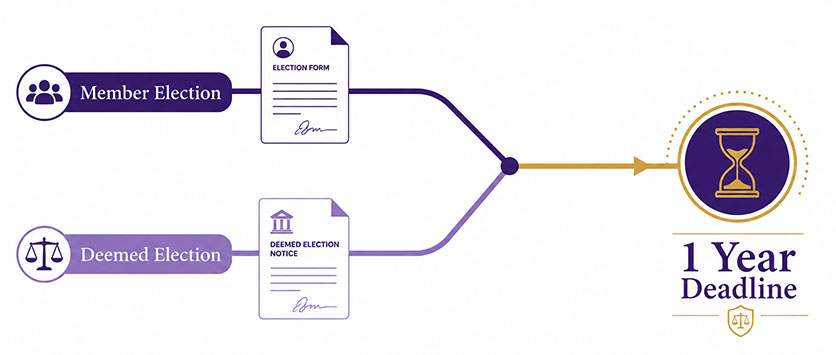
The member’s election. Under Section 1448, an election to provide former spouse coverage must be written, signed by the person making it, and received by the Secretary concerned within one year after the date of the decree of divorce, dissolution, or annulment. The retiree does this on DD Form 2656-1.
The deemed election. Under Section 1450, if the retiree was required to elect former spouse coverage and did not, the former spouse can file their own written request and have the election treated as though the retiree made it. The statute is blunt about the window: an election may not be deemed to have been made unless the Secretary receives the request from the former spouse within one year of the date of the court order or filing involved. That request goes in on DD Form 2656-10.
The deemed election exists because Congress understood exactly what happens in practice. It is the backstop, and it only works if you use it in time.
Do Not Rely on Your Ex to File It
A retiree who is ordered to elect former spouse coverage will pay premiums out of their own retired pay for the rest of their life to fund a benefit that goes to the person they just divorced. Some of them file immediately. Some do not.
You do not have to prove bad faith, and it does not matter whether the failure was deliberate or a form that sat in a drawer. The result is the same. File the deemed election yourself, on your own timeline, and let your ex’s filing be redundant.
The right time to do it is within days of the decree being signed, not in month ten.
What the Court Order Has to Say
A deemed election is not self-executing. DFAS requires a court order that requires former spouse SBP coverage. An order that is silent on survivor benefits gives you nothing to deem.
This is where a lot of Texas decrees fall short. The property division section handles the retirement award carefully, and then survivor benefits get one vague sentence or no sentence at all. A decree that says the parties “may” address survivor coverage is not an order requiring it.
If your divorce is still pending, this is fixable right now with a few sentences in the decree. If your decree is already signed and says nothing about SBP, talk to a Texas family law attorney immediately. A Texas court can clarify or enforce an existing property division, but it generally cannot use a clarification order to create a new substantive property award that the final decree never made. What remedies remain depends on the language of the decree, any incorporated agreement, the timing, and the procedural history.
What to File and Where to Send It
The deemed election package is short. Getting it to the right place, with proof of the date, is the part that matters.
- DD Form 2656-10. The former spouse SBP deemed election request, completed and signed.
- The court order requiring former spouse SBP coverage. The provision DFAS is relying on has to be in there.
- A copy of the divorce decree. Even where the coverage requirement sits in a separate order or agreement.
DFAS accepts the package by mail at the Garnishment Law Directorate, PO Box 998002, Cleveland, OH 44199, by fax at 1-877-622-5930, or through the Garnishment askDFAS portal online.
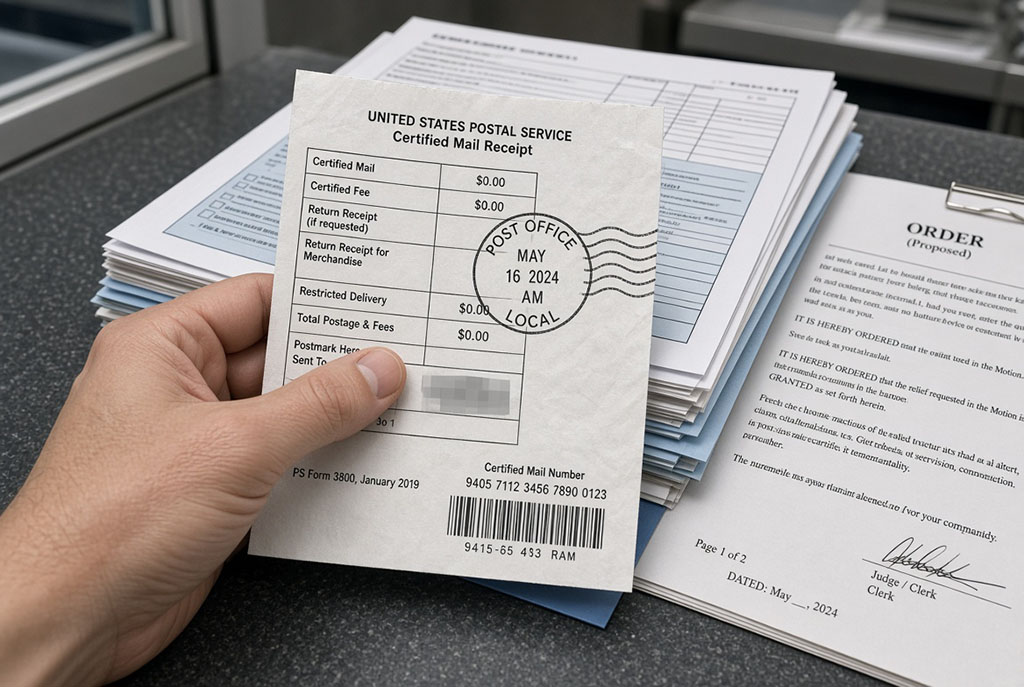
Send it in a way that proves the date. Certified mail with a return receipt, or a fax confirmation page you save, or a portal submission receipt you print. The statute turns on when the request was received, so the date of receipt is the only fact that will matter if the filing is ever questioned.
Then follow up. A submission that sits in a queue and gets rejected for a missing page in month thirteen is functionally the same as never filing.
If You Think You Already Missed the Deadline
Call DFAS and confirm your actual dates before you accept that answer. The deadline runs from the date of the court order or filing involved, and in cases with an agreed decree, a later clarifying order, or a separate property settlement, the operative date is not always the one you assume.
What you should not do is wait, or write it off quietly. The statute sets the limit and DFAS applies it, so time spent hoping does nothing but shorten whatever options remain.
At the same time, look at the rest of your protection. If survivor coverage is truly gone, life insurance on the retiree, an offsetting share of another asset, or a change to your own post-divorce estate plan may be the practical response. None of those replace the annuity, but a plan built around the gap is better than one that ignores it.
Who Pays the Premium
SBP premiums are deducted from the retiree’s pay. That is how the program works mechanically, whatever a decree says about who bears the cost.
A Texas decree can allocate that cost between the parties, and many do, by requiring the former spouse to reimburse some or all of the premium or by accounting for it in the percentage awarded. What a decree cannot do is change where the deduction comes from.
Address the allocation in the order in plain numbers. A retiree who feels ambushed by a deduction they did not expect is a retiree who starts looking for ways to fight it, and premium disputes have a way of turning into enforcement litigation over a relatively small monthly figure.
Remarriage Changes the Annuity, and It Can Change Back
A former spouse annuity is paid while the beneficiary is living, but if that beneficiary remarries before reaching age 55, the annuity stops at the remarriage.
It is not necessarily permanent. If the later marriage ends by death, annulment, or divorce before the beneficiary turns 55, payment resumes the first day of the month in which that marriage terminates.
Remarry at 55 or older and the annuity continues. This is worth knowing before setting a wedding date, and it is a different rule than the one governing TRICARE, where remarriage ends former spouse eligibility permanently even if the remarriage later ends. Two benefits, two rules, and people routinely apply the wrong one to the wrong benefit.
Decree Language That Actually Holds Up
Survivor coverage lives or dies on drafting. These are the provisions worth insisting on before anyone signs.

Use mandatory language. The order should require the member to elect former spouse coverage, naming the former spouse. “Shall elect,” not “may elect” and not “the parties agree to consider.”
State the base amount. Coverage can be elected on less than the full retired pay, and a lower base amount produces a smaller annuity. If the intent is full coverage, the order should say so.
Allocate the premium. Say who bears the cost and how it gets handled, in numbers.
Include a deadline and a consequence. Require the election to be filed within a set number of days after the decree, with proof of filing delivered to the other side. That gives a Texas court something concrete to enforce well before the federal year runs out.
Preserve the deemed election. Include language confirming the former spouse’s right to file a deemed election and requiring the member to cooperate with documentation.
None of this is exotic drafting. It is a handful of sentences that almost nobody thinks about while the fight is over the house and the possession schedule. Our post on estate planning mistakes people make during divorce covers the other documents that quietly stop working once a decree is signed.
Where This Fits With the Rest of the Retirement Award
Survivor coverage and the retirement division are two halves of the same asset, and treating them separately is how one of them gets lost.
The division decides what you receive while the retiree is alive. Texas courts treat the portion of military retired pay earned during the marriage as community property subject to a just and right division, the same as other retirement assets divided in a San Antonio divorce. Survivor coverage decides what you receive after.
A settlement that trades away survivor coverage in exchange for a slightly larger percentage of retired pay can be a reasonable deal or a terrible one, depending on ages, health, and how long the retiree is likely to draw the benefit. Run the comparison before you agree to it, not after.
It also helps to understand what survivor coverage is not. It is not a beneficiary designation you can update online, and changing your will does not touch it. The election is made with the government on a specific form inside a specific window, which puts it in the same category as the other post-divorce paperwork that only counts once it is actually filed.
FAQs about Survivor Benefit Plan Elections After a Military Divorce
Does my divorce decree automatically give me SBP coverage?
No. A decree can require the election, but somebody still has to file it with the government within one year. If your ex does not file, you have to submit a deemed election request yourself using DD Form 2656-10.
When exactly does the one year start?
The statute runs the deadline from the date of the court order or filing involved, and DFAS describes it as one year from when the order was issued. Where a case involves an agreed decree plus a later clarifying order, confirm the operative date with DFAS instead of assuming.
What if my ex is not retired yet?
The election requirement and the deadline still apply after a divorce, so do not wait for a retirement date years in the future. File within the year and let the coverage be in place when retirement arrives.
How much is the annuity worth?
For a beneficiary under 62, the annuity is 55 percent of the base amount the retiree elected. If the election was made on a reduced base amount rather than full retired pay, the annuity is calculated on that smaller figure.
Can I file the deemed election if my decree does not mention survivor benefits?
DFAS requires a court order that requires former spouse SBP coverage, so a silent decree is a problem. Talk to a Texas family law attorney right away about whether a clarification or enforcement filing is available in your case, because the clock does not pause while you sort it out.
Who pays the premium after the divorce?
Premiums come out of the retiree’s pay by law. A Texas decree can shift the economic cost between the parties through reimbursement or by adjusting the percentage awarded, but the deduction itself happens on the retiree’s side.
What happens if I remarry?
Remarrying before age 55 stops the annuity, and it resumes if that marriage ends before you turn 55. Remarrying at 55 or older does not stop it. This rule is specific to the Survivor Benefit Plan and does not carry over to other military benefits.
My ex says they filed. Should I file anyway?
Do not rely only on your ex’s word that the election was filed. Get proof that DFAS received and processed the election. If the decree requires former-spouse coverage and you are still inside the one-year deemed-election window, talk to your lawyer about submitting DD Form 2656-10 yourself rather than letting the deadline expire based on an assurance you cannot verify.
Do Not Let a One Year Deadline Erase a Lifetime Benefit
Survivor coverage is the difference between a retirement award that pays for your life and one that ends with your ex’s. It hinges on a single filing inside a single year, and there is no routine fix once that window closes. Brandi Wolfe Law helps San Antonio and Bexar County clients get survivor benefit language into the decree before it is signed, file deemed elections on time, and pursue clarification when an existing order left the issue out. If your decree is already final and you are not sure where you stand, we can look at it and tell you straight.
Call (210) 571-0400 or schedule a free consultation about your San Antonio military divorce while there is still time on the clock.
This article is general information, not legal advice for your specific case. Deadlines turn on the exact dates in your order, so confirm your dates with DFAS and talk to a Texas family law attorney before you rely on any of it.