

The 20/20/20 and 20/20/15 Rules That Decide What a Former Military Spouse Keeps
Whether you keep TRICARE, commissary access, and your base ID after a military divorce comes down to three numbers: how long you were married, how long your spouse served, and how much of that marriage overlapped the service.
Not how the divorce went. Not what the decree says. Not what your spouse promises.
Federal law sets these thresholds, and a Texas judge cannot move them. A decree that says you keep TRICARE does not make you eligible for TRICARE if the years do not line up.
Below is what each threshold gets you, what remarriage takes away, what happens when you fall short, and the questions military spouses in San Antonio ask us most once they realize the decision was made years ago.
The Three Numbers Behind the 20/20/20 and 20/20/15 Rules
For most former spouses evaluating benefits under these two rules, the same test applies. Count the years of marriage. Count the years of the service member’s creditable service toward retirement. Then count how many of those years happened at the same time.
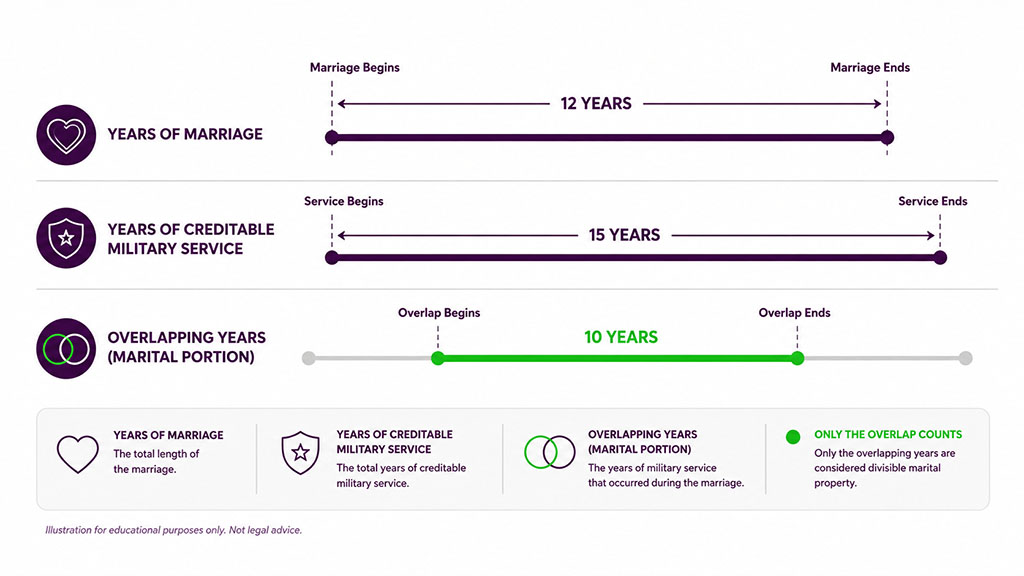
That last number is the one people get wrong. A 22 year marriage to someone with 21 years of service sounds like it clears every bar, but if the marriage started five years after the enlistment and the service member retired two years after the wedding anniversary, the overlap is what controls.
For these two benefit rules, the math produces three practical outcomes:
- 20/20/20. At least 20 years of marriage, at least 20 years of creditable service, and at least 20 years of overlap between the marriage and that creditable service.
- 20/20/15. At least 20 years of marriage, at least 20 years of creditable service, and at least 15 years of overlap between the marriage and that creditable service.
- If neither rule applies. Former-spouse TRICARE and the associated 20/20/20 privileges generally end when the divorce becomes final, although other narrow federal protections can apply in unusual circumstances. A former spouse losing TRICARE may qualify to purchase temporary CHCBP coverage within 60 days.
None of these tiers have anything to do with how the property division turns out. They are a separate federal question with a separate answer.
The documents that settle the math are the marriage license, the service member’s record of entry on active duty and creditable service, and the date the decree is signed. Reserve and Guard service complicates the count, because creditable service there is tracked in retirement points rather than a clean run of calendar years. If your spouse served in the Reserve or the Guard, get the point statements before anyone starts negotiating around a number.
The 20/20/20 Rule: What a Former Spouse Actually Keeps
A former spouse who clears 20/20/20 keeps the closest thing to full benefits that federal law offers after a divorce. Title 10 of the U.S. Code, Section 1072 defines that person as a dependent, which is the door everything else opens through.
The requirements, exactly as the statute frames them: on the date of the final decree of divorce, dissolution, or annulment, the former spouse had been married to the member for at least 20 years, during which the member performed at least 20 years of service creditable toward retired pay. TRICARE states the overlap requirement plainly: at least 20 years of the marriage must overlap at least 20 years of creditable active or reserve service.
Clear that bar as an unremarried former spouse and you keep medical, commissary, exchange, and MWR theater privileges, along with the ID card that gets you through the gate at Joint Base San Antonio or anywhere else. You hold those benefits in your own right, not through your ex, and your ex cannot sign them away in a settlement.
Remarriage Ends It, and It Does Not Come Back
This is the part that catches people, and it is worth reading twice. TRICARE lists remarriage as a loss of eligibility even if the remarriage ends in death or divorce, unless you gain eligibility through the new spouse.
The statute backs that up in the definition itself. It covers the unremarried former spouse. Remarry, and you are no longer the person the statute describes, and getting divorced again does not restore what you gave up.
That is a different rule from the Survivor Benefit Plan, where a remarriage before age 55 suspends the annuity and it can be restored if that marriage ends. Two benefits, two remarriage rules, and mixing them up is expensive.
Employer Coverage Can Also End TRICARE Eligibility
TRICARE also lists purchasing and being covered by an employer-sponsored health plan as a reason a qualifying former spouse can lose TRICARE eligibility. If a new job offers health insurance, confirm the effect with TRICARE before enrolling rather than assuming the two coverages can simply run together.
Talk to TRICARE directly before you enroll in anything at a new job. This is a coverage decision with real money attached, and the answer depends on your specific plan and dates.
The 20/20/15 Rule: One Year of TRICARE Without 20/20/20 Base Privileges
Fall between 15 and 20 years of overlap and the outcome changes sharply. The service member still needs at least 20 years of creditable service and the marriage still needs to have lasted at least 20 years, but only 15 or more of those years need to have overlapped the service.
What that gets you is one year of TRICARE from the date the divorce or annulment is final. Then it ends. The federal statute writes the one year cutoff directly into the definition for divorces in this category, and TRICARE applies the same limit.
What it does not get you is the broader installation privileges available under 20/20/20. Military OneSource is direct about it: under the 20/20/15 rule, the former spouse does not retain military exchange, commissary, or the same continuing installation privileges. The benefit is primarily one year of health coverage.
The same two disqualifiers apply here. Remarry during that year and coverage ends. Employer-sponsored health coverage can also affect eligibility.
Treat that year as a countdown, not a cushion. If you are a 20/20/15 former spouse, the work of lining up civilian coverage starts the week the decree is signed, not in month eleven.
What Happens If You Do Not Meet Either Rule
If you do not clear either threshold, there is no partial credit under the 20/20/20 or 20/20/15 rules. Nineteen years of overlap does not satisfy either threshold any more than two years does.

There may be a bridge, and it has a short fuse. The Continued Health Care Benefit Program may allow a former spouse who loses TRICARE to purchase premium-based temporary coverage, and enrollment is generally required within 60 days of losing TRICARE eligibility. Standard coverage can run up to 36 months, and TRICARE notes that some unremarried former spouses may qualify for additional coverage through the program’s contractor.
Sixty days is not long when you are also moving, changing jobs, and finishing a custody schedule. Put the deadline on a calendar as soon as you know when your TRICARE eligibility will end. Do not assume an extension will be available if you miss it.
Beyond CHCBP, you are looking at employer coverage or a marketplace plan like any other civilian. A divorce is a qualifying life event for enrollment purposes, which is worth confirming with the specific plan you are considering.
Your Children Keep Their Coverage
Whatever happens to your eligibility, your children’s coverage runs on its own track. Unmarried biological and adopted children of the service member stay eligible for TRICARE until age 21, or until 23 if enrolled full time at an approved school and the sponsor still provides more than half of their support. The parents’ divorce does not by itself end that eligibility.
Stepchildren are the exception, and it is a hard one. A stepchild loses eligibility on the date the divorce decree is final. If the service member adopted the stepchild, that child stays covered as an adopted child regardless of what happens to the marriage.
Keep DEERS current for the children. An outdated DEERS record can create coverage problems even when the child remains legally eligible.
Can a Former Spouse Be Buried in a Military Cemetery?
This question comes up more than you would think, usually from someone who spent decades as a military spouse and assumed that part was settled. The VA’s burial eligibility rules answer it clearly, and the answer is no.
A former spouse whose marriage to an eligible veteran or service member ended by annulment or divorce is not eligible for burial in a VA national cemetery, unless that person is a veteran in their own right. There is no exception based on how long the marriage lasted, and 20/20/20 status does not change it.
A surviving spouse is a different category entirely. That person remains eligible even if they remarried after the veteran’s death. The dividing line is whether the marriage ended by divorce or by death.
If military burial matters to you, address it in your post-divorce estate planning rather than assuming an old plan still works.
These Rules Are Not the Same as the Retirement Rules
Benefit eligibility and property division are two separate systems, and conflating them causes real damage in negotiations.
The 20/20/20 and 20/20/15 rules are federal eligibility standards for health care and certain military privileges. They are fixed, and neither spouse nor judge can negotiate around them. Military retired pay, on the other hand, is community property in Texas to the extent it was earned during the marriage, and a Texas court divides it under state law like other retirement assets in a San Antonio divorce.
A spouse with 12 years of overlap gets no TRICARE under these rules and can still be awarded a share of the retirement. A spouse with 21 years of qualifying overlap may keep TRICARE and still has to address the retirement division on its own terms. The two answers do not track each other.
The so-called 10/10 rule belongs in this same pile of things people mix up. It is not a benefits rule and it is not an eligibility rule for retirement. It governs whether a qualifying property-division award can be paid directly by the Defense Finance and Accounting Service under the USFSPA. If 10/10 is not met, the underlying retirement award can still be valid, but it cannot be enforced through that DFAS direct-payment mechanism. Anyone telling you that ten years of marriage decides whether you get retirement at all is repeating a myth.
The same goes for support. Housing allowance and other military pay factor into a Texas support calculation, which our post on BAH and Texas child support covers in detail. Benefit eligibility does not.
What to Do Before You Sign Anything
Run the numbers first. Everything below is work that pays for itself before a decree is final, and gets much harder afterward.

Pull the service record and count in months. Rounding a marriage up to “about twenty years” is how people find out too late that they landed at nineteen years and seven months. Get the dates from the record, not from memory.
Identify the exact overlap window. Marriage date, entry on active duty date, and the date the divorce becomes final. The overlap is measured against the date of the final decree, so the timing of the decree itself can matter.
Look hard at the timing if you are close. Where a couple sits within months of a threshold, the date the divorce is finalized can decide whether a former spouse has continuing 20/20/20 medical coverage, one year of 20/20/15 coverage, or neither. Texas divorces are not finalized overnight, and the calendar between filing and the decree has some flexibility that the federal thresholds do not. That is a conversation to have with your attorney early, not a reason to expect a court to hold a case open indefinitely.
Update DEERS as soon as the decree is signed. Eligibility that exists on paper still has to exist in the system before anyone will honor it at a pharmacy counter or issue the correct post-divorce identification.
Do not let anyone put benefits they cannot deliver into the decree. A promise to “continue TRICARE coverage” from a spouse who has no authority to grant it is not worth the paper. If health coverage is part of the deal, it has to be structured as something the other side can actually perform, such as reimbursing premiums.
FAQs about TRICARE and Base Access After a Military Divorce
Does my divorce decree control whether I keep TRICARE?
No. Eligibility comes from federal law and the years of marriage and service, not from what the parties agree to. A Texas court can order a spouse to pay for your health coverage, but it cannot order the military to cover you when federal eligibility rules say you do not qualify.
I was married 20 years but my spouse only has 18 years of service. Where does that leave me?
Outside both the 20/20/20 and 20/20/15 rules, because each requires at least 20 years of creditable service. You may qualify for Continued Health Care Benefit Program coverage if you enroll within the applicable 60 day window, or you may need civilian coverage. The retirement division question is separate and may still be very much in play.
Can I keep my military ID card after the divorce?
A qualifying 20/20/20 former spouse can receive a military ID reflecting their own former-spouse eligibility. A qualifying 20/20/15 former spouse can also receive a limited ID card for medical benefits during the one-year eligibility period, but that card does not provide the commissary, exchange, and broader installation privileges available under 20/20/20. If you meet neither rule, your former dependent ID does not continue simply because you were previously married to the service member.
What if I remarry and that marriage ends in divorce?
For TRICARE, the coverage does not come back. The rule is written to cover an unremarried former spouse, and a later divorce does not undo the remarriage. Survivor Benefit Plan coverage follows a different rule, so ask about each benefit separately.
Does my ex have to tell me how many creditable years they have?
Service records are discoverable in a Texas divorce, and your attorney can request the documentation showing entry on active duty and creditable service. Do not build a settlement around a number your spouse gave you verbally.
I am the service member. Does any of this affect my retirement?
Not directly. Former spouse medical eligibility and military privileges are federal benefit questions that turn on the years. Whether a Texas court divides your retired pay, and how much, is a state property question decided under Texas community property law.
Do I lose commissary access the day the divorce is final?
Unless you qualify for continuing commissary privileges as an unremarried 20/20/20 former spouse or under another applicable federal exception, those privileges generally end when the divorce becomes final. The one-year 20/20/15 benefit is primarily TRICARE coverage and does not carry the same commissary and exchange privileges.
What if I already missed the 60 day window for bridge coverage?
Contact the Continued Health Care Benefit Program immediately and confirm the date your TRICARE eligibility actually ended rather than assuming the answer from the decree date alone. At the same time, start securing employer or marketplace coverage rather than waiting to see whether CHCBP is still available.
Talk to a San Antonio Military Divorce Attorney Before the Decree Is Final
Benefit eligibility gets decided by dates you cannot change after the fact, which makes the months before a decree especially important when you are close to a federal threshold. Brandi Wolfe Law helps military spouses and service members in San Antonio and Bexar County work through overlap calculations, retirement division, support, and the coverage gap that can open when the divorce is final. If you are close to a threshold, or you have been told something about your benefits that does not sound right, we can tell you straight where you actually stand.
Call (210) 571-0400 or speak with Brandi Wolfe Law about your San Antonio military divorce before you sign anything.
This article is general information, not legal advice for your specific case. Benefit eligibility turns on your exact dates and service record, so talk to a Texas family law attorney and confirm coverage questions with TRICARE directly before you make a decision.