

Who Cares for Your Kids If You Deploy, and What the Plan Has to Say
A Family Care Plan is a Department of Defense requirement that tells your command exactly who takes care of your children when you cannot, how they will do it, and how they will pay for it while you are gone.
If you are a single parent, half of a dual-military couple with kids, or a service member with custody rights when your current spouse is not the child’s other parent, it is not optional. Your command can take administrative action against you for not having a workable one.
Filling out the military form is only one part of the job. A Family Care Plan can satisfy the command requirement while still leaving gaps in custody authority, medical consent, school decisions, or estate planning.
Here is what the plan has to contain, when it is due, where it stops working, and what a Texas family law attorney adds to it.
Who Has to Have One
DoD Instruction 1342.19 sets the requirement across the services, and the categories are broader than most people assume. The plan applies to service members on active duty, Reserve Component members, and Civilian Expeditionary Workforce personnel.
You need a Family Care Plan if you are a single parent, if you and your spouse are both service members with dependents, if you are married with sole or joint custody of a child whose other parent is not your current spouse, or if you are primarily responsible for a dependent family member.
That third category catches a lot of divorced service members off guard. Remarrying does not remove the requirement. If your children from a prior marriage are covered by a Texas custody order and your current spouse is not their parent, the requirement stays.
Commanders are the ones enforcing this. A service member who fails to produce a plan may be subject to disciplinary or administrative action that can lead to separation from the service, which is one of the few places where a family law problem turns directly into a career problem.
What the Plan Has to Contain
The instruction is specific about the contents, and the specificity is the point. A plan that names a caregiver and stops there is not a plan. Each item below has to be documented:
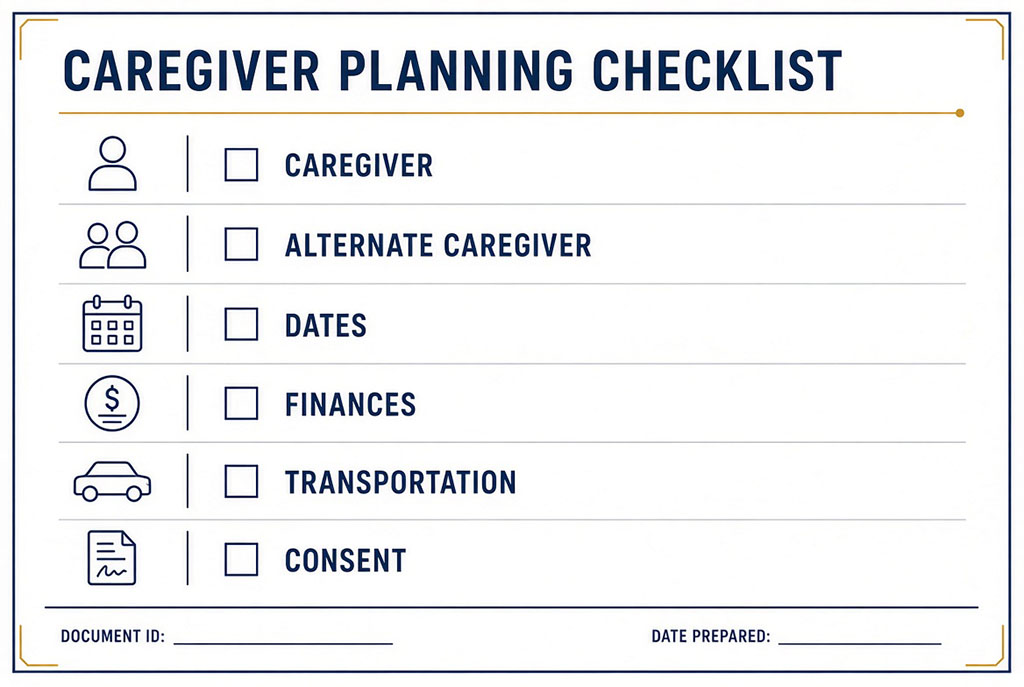
- Caregiver and alternate caregiver. Names and contact information for both, not just one.
- Short-term and long-term absence provisions. With specific dates, not general availability.
- Financial arrangements. Allotments and supporting documentation showing how the caregiver gets money.
- Logistics for moving dependents. How the children get to the caregiver, and who pays for it.
- Non-custodial parent consent information. Where the other parent’s rights are in play.
- Death or incapacity designee. The plan identifies the person who would temporarily take responsibility for your dependents if you die or become incapacitated, until a parent or legal guardian assumes custody.
The alternate caregiver is the line most parents treat as a formality. Name someone who lives three states away and has never had your kids overnight, and you have written down a name, not a backup. Deployments run into hospitalizations, job losses, and family emergencies on the caregiver’s side, and the alternate is what stands between your children and a scramble.
The Deadlines Your Command Enforces
Active duty members and Civilian Expeditionary Workforce members generally have 60 days from the required Family Care Plan discussion with their commander to submit the final plan through the chain of command. Reserve Component members generally have 90 days from alert notification.
The obligation continues after the plan is filed. Members certify annually that the plan is current. Active duty and CEW members must notify the appropriate commander within 30 days after a qualifying change in family circumstances, while Ready Reservists generally have 60 days to notify the authority designated by their Military Department.
After that, the obligation is ongoing. Members have to provide written certification to their commander each year that the plan is current. Active duty and CEW members have to notify the commander no later than 30 days after a change in family circumstances.
A change in family circumstances covers more ground than a birth or a marriage. A new custody order, a caregiver who moves, a divorce that finalizes, an ex-spouse who relocates out of state: each one can break a plan that was accurate when you signed it. Reviewing the plan every time a Texas court signs a new order is the habit worth building.
Where the Family Care Plan Runs Into Texas Custody Law
Here is the gap that costs military parents the most, and almost nobody explains it at the unit level.
A Family Care Plan is a command document. It satisfies a military readiness requirement. It does not grant your caregiver legal authority over your child, and it does not override a Texas custody order. If your child’s other parent holds rights under a court order, naming your sister as caregiver on a DoD form does not put your sister ahead of that parent.
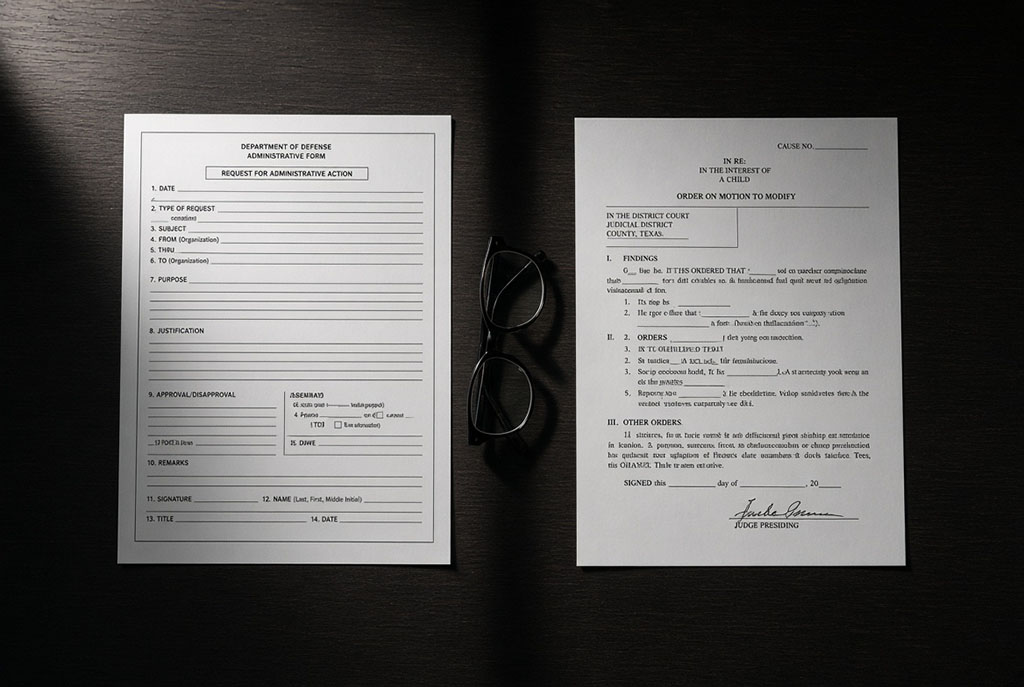
Texas law has a separate process built for exactly this problem. Under Texas Family Code Section 153.705, when a parent who does not hold the exclusive right to determine the child’s primary residence is ordered to military deployment, mobilization, or temporary military duty, the court may award that parent’s visitation to a designated person the parent chooses, if the arrangement is in the child’s best interest.
The temporary order does real work. The designated person steps into the possession schedule the deployed parent would have had, is bound by the surrender and return requirements in Texas Family Code Section 153.316, and holds the rights and duties of a nonparent possessory conservator during the periods they have the child. Any existing restriction in the order barring a specific person from access still applies.
The Plan Names Your Caregiver. The Court Order Controls Legal Possession and Rights.
Run them together and you get a caregiver with your paperwork and no standing. Run them in parallel and you get a caregiver whose authority is enforceable in a Bexar County courtroom.
Which temporary order applies depends on your existing custody rights. If you do not have the exclusive right to determine the child’s primary residence, Texas law allows the court to award your periods of visitation to a designated person when that is in the child’s best interest. If you do hold the exclusive right to determine primary residence, Texas law uses a different process and generally gives the other conservator first preference before a nonparent caregiver is considered.
That means the caregiver named in your Family Care Plan does not automatically become the person a Texas court will place in your role. The military plan and the custody order need to be coordinated, but the court remains bound by Texas law and the child’s best interest.
What a Family Care Plan Cannot Do
The plan is one document doing one job. These are the jobs it does not do, and each one requires its own paperwork.
It is not a will. Naming a caregiver in a Family Care Plan does not say who raises your children if you do not come home, and it does not direct where your property goes.
It does not appoint a guardian. Guardianship of a minor is a court process. A DoD form is not a substitute for the designation a Texas court would look to.
It does not automatically transfer medical or school authority. Depending on the situation, your caregiver may need separate powers of attorney, medical-consent documents, school documentation, or a court order to make decisions and obtain records for the child.
It does not move money on its own. An allotment listed in the plan still has to be set up, and access to an account still has to be arranged through the bank.
It does not survive your divorce automatically. A plan written while you were married may name a spouse who is no longer in the picture and reference custody terms a court has since replaced.
The Estate Planning Gap a Family Care Plan Does Not Fill
Pre-deployment legal work usually happens in a rush at a legal assistance office, and the output is a will, a general power of attorney, and a medical power of attorney signed in the same sitting as fifty other people’s.
Military legal assistance is a real benefit and it is worth using. Federal law authorizes it for active duty members, retirees, certain Reserve members, and their dependents. What it is not built for is a blended family with a Texas custody order, a business interest, a house that was separate property before the marriage, or a child with special needs.
A will also does not automatically control assets that pass through a beneficiary designation. Life insurance, retirement accounts, and military benefits can each operate under different state or federal rules after divorce, so every beneficiary designation should be reviewed individually rather than assuming either the old designation or the will controls. Our estate planning checklist after divorce walks through the documents that get missed.
The pieces worth having in place before orders drop: a will that reflects your current marriage and children, a guardian designation for minor children, a durable power of attorney, a medical power of attorney, a written medical consent authorization for the caregiver, and current beneficiary designations on your life insurance and retirement accounts. Our San Antonio estate planning practice handles these alongside the family law side, which is the point, because they only work when they agree with each other.
How to Build a Plan That Holds Up
Everything below is what separates a form in a personnel file from a plan that works at 3 a.m. on the day orders take effect.

Pick a caregiver who can actually absorb your kids. Willingness is not capacity. Ask about their work schedule, their housing, their own family obligations, and whether their school district would take your children. Have that conversation before you write the name down.
Make the alternate real. Same conversation, same level of detail, different person. If the primary and alternate live in the same house, you do not have two caregivers.
Write the money down. Set up the allotment, document the amount, and give the caregiver written access to whatever they will need to spend on your children. Vague financial arrangements are where deployments turn into resentment.
Get the other parent’s position in writing. If your children have another parent with court-ordered rights, the Family Care Plan does not override those rights. Texas law determines whether your periods of possession can be exercised by a designated person and whether the other conservator has priority during the deployment.
Align the plan with the court order. Read your possession order and your Family Care Plan side by side. If they name different people, describe different schedules, or assume different addresses, fix it now.
Hand the caregiver a real packet. Copies of the custody order, medical authorizations, insurance cards, school contacts, the pediatrician’s information, and your command contact. A caregiver who has to search for documents during an emergency is a caregiver who calls the other parent instead.
Rehearse it. Have the caregiver keep the children for a weekend before you leave. You will find the holes in two days that you would otherwise find in month four.
Dual-Military and Divorced Parents in San Antonio
Joint Base San Antonio puts a large number of dual-military couples and divorced service members in the same city, and both situations make the plan harder rather than easier.
For a dual-military couple, the planning question is not whether one of you deploys. It is what happens if both of you are gone at the same time, or if one deploys while the other is on a temporary duty assignment. The plan has to survive that overlap, and it should account for a PCS on top of it.
For a divorced service member, the other parent’s rights come first as a legal matter, and pretending otherwise creates an enforcement problem while you are deployed and least able to respond to one. If a move is already in motion, our post on PCS orders during a Texas divorce covers how relocation and custody collide. If a divorce is pending when orders arrive, our post on deployment and divorce delays covers the timing protections available to service members.
Either way, the work is the same. Get the Family Care Plan and the Texas court order saying the same thing about the same person before you leave the state.
FAQs about Military Family Care Plans in Texas
Does my Family Care Plan give my caregiver legal custody?
No. It is a command readiness document, not a court order, and it does not displace another parent’s rights under a Texas custody order. If you need your caregiver to have enforceable authority during a deployment, that comes from a temporary order under the Texas Family Code, not from the DoD form.
Can my ex-spouse override my Family Care Plan?
A parent with court-ordered rights generally has priority over a nonparent caregiver, so in a legal dispute the custody order controls. Texas does allow a deploying parent to ask the court to award their visitation periods to a designated person, which is how a caregiver gets standing rather than just a name on a form.
I am remarried. Do I still need a plan?
Yes, if you have sole or joint custody of a child whose other parent is not your current spouse. That category is written into the DoD requirement specifically because a stepparent’s authority over another person’s child is limited.
How often do I have to update it?
You certify in writing to your commander every year that the plan is current, and active duty members have to report a change in family circumstances within 30 days. Treat a new custody order, a caregiver relocation, or a finalized divorce as a change that triggers an update.
What happens if I do not have one?
Failing to produce a workable plan can lead to disciplinary or administrative action, up to separation from the service. This is one of the fastest ways an unresolved family law issue becomes a career issue.
Can the base legal office write my whole plan?
Military legal assistance can help with the wills and powers of attorney and answer questions about the requirement. What they generally are not doing is filing a modification or a temporary order in a Texas district court on your behalf, which is what a plan involving another parent’s rights usually needs.
Do I need a Texas court order if the other parent agrees?
A private agreement may help show what both parents intended, but it does not necessarily have the same enforceability as a court order. If the deployment arrangement changes court-ordered possession or gives a nonparent meaningful authority over the child, getting the arrangement reflected in an appropriate temporary order can prevent a voluntary agreement from becoming a dispute after you leave.
What if I get orders with almost no notice?
Texas provides for expedited hearings in deployment cases, so a short timeline does not automatically shut the door. Call a family law attorney the day you know, because the calendar is the one thing nobody can fix retroactively.
Get Your Family Care Plan Backed by a Court Order
A Family Care Plan satisfies your command. It does not satisfy a Texas judge, and it does not bind the other parent. Brandi Wolfe Law helps San Antonio service members line up the deployment paperwork with the legal authority behind it: temporary orders naming the caregiver, custody terms that work across a deployment, guardian designations, and estate documents that match the family you actually have right now. We can also tell you which parts of your plan are already covered and which parts would fall apart the week you leave.
Call (210) 571-0400 or ask for legal guidance before you make your next move. Our San Antonio military family law team works with deploying parents on the timeline they actually have.
This article is general information, not legal advice for your specific case. Family Care Plan requirements vary by service and by command, so confirm your branch’s rules with your unit and talk to a Texas family law attorney about the custody piece before you deploy.