

No, Ten Years of Marriage Does Not Decide Whether You Get Military Retirement
The 10/10 rule is one of the most misunderstood pieces of military divorce law, and the misunderstanding always runs the same direction. People believe it decides whether a former spouse gets any share of military retirement at all.
It does not. It never has.
The 10/10 rule decides one narrow thing: whether a former spouse can receive a property-division award directly from the Defense Finance and Accounting Service under the USFSPA. If the marriage does not meet 10/10, the retirement award can still be valid, but it has to be paid and enforced outside that DFAS direct-payment mechanism.
The difference matters enormously in a Texas negotiation, because a spouse who believes they get nothing after nine years of marriage will sign something they should not sign.
What the 10/10 Rule Actually Says
The rule lives in the Uniformed Services Former Spouses’ Protection Act, at Title 10 of the U.S. Code, Section 1408. Subsection (d)(2) is the operative language, and it is written as a limit on what the government will do, not on what a court can order.
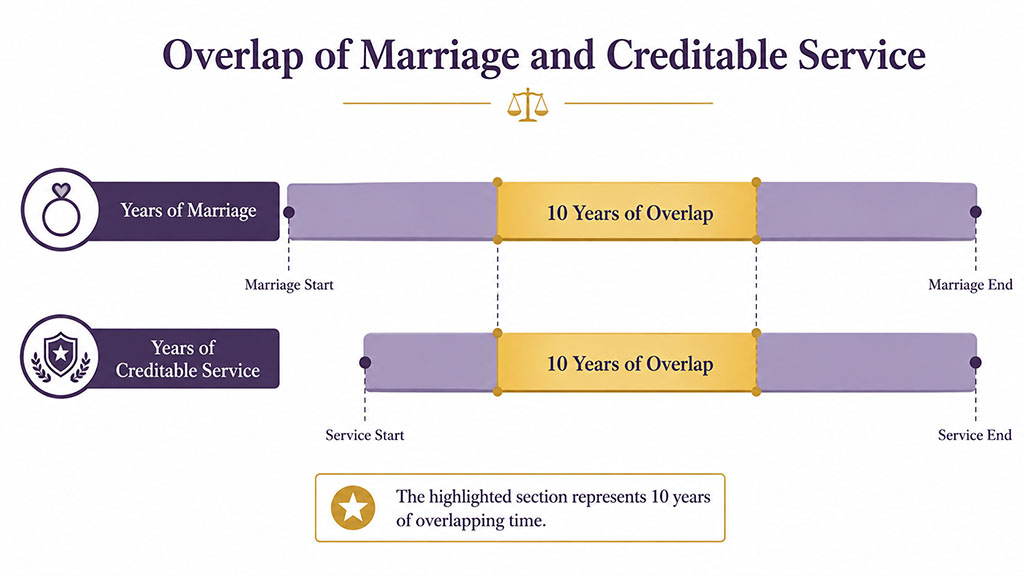
The statute says that if the spouse or former spouse was not married to the member for a period of 10 years or more during which the member performed at least 10 years of service creditable toward retired pay, payments may not be made under that section to the extent they include an amount resulting from the court’s treatment of retired pay as property.
Read that again with the emphasis in the right place. Payments may not be made under that section. The section is the direct payment mechanism. The statute is telling the Defense Finance and Accounting Service when it will and will not act as the payment processor.
DFAS states the same requirement in its own words: a member and former spouse must have been married to each other for 10 years or more during which the member performed at least 10 years of military service creditable toward retirement eligibility. DFAS also notes that the 10/10 rule does not apply at all to enforcement of child support or alimony awards.
What the Rule Does Not Decide
Nothing in the 10/10 rule tells a Texas judge how to divide property. Texas is a community property state, and military retired pay earned during the marriage is part of the community estate that a court divides in a manner it considers just and right.
A marriage of six years, or eight, or nine years and eleven months, still produced community property. A Texas court can award the former spouse a share of the retirement earned during those years. The retiree does not get to keep the whole benefit because a federal payment threshold was not met.
What changes is the enforcement mechanism. If the 10/10 requirement and the other USFSPA requirements are met, DFAS can send the former spouse’s court-ordered share directly. If 10/10 is not met, DFAS cannot enforce the property award through direct USFSPA payments, even though the underlying Texas retirement award may still be valid.
The Jurisdiction Requirement Is the One Worth Worrying About
Buried in the same statute is a limit that actually can stop a court from touching military retired pay, and it gets a fraction of the attention the 10/10 rule gets.
Subsection (c)(4) says a court may not treat disposable retired pay as property unless it has jurisdiction over the member by reason of the member’s residence in the court’s territory for reasons other than military assignment, the member’s domicile there, or the member’s consent to that court’s jurisdiction.
Being stationed at Joint Base San Antonio is not, by itself, residence for this purpose. A service member who is assigned to Texas but domiciled in another state may fall outside a Texas court’s authority over the retirement unless they consent, and consent may be established through affirmative participation in the case. Military families move constantly, so where the divorce gets filed is a decision worth making deliberately rather than by default.
Why the Myth Sticks Around
Three things keep this misconception alive, and none of them are stupid.
First, the military does have a real vesting rule, and it is 20 years. A service member who separates before hitting 20 years of creditable service generally does not draw a traditional retirement. People hear “ten year rule” and file it in the same mental drawer as the twenty year rule, because both sound like thresholds for getting paid.
Second, the number appears alongside other military divorce numbers that are eligibility standards. The 20/20/20 and 20/20/15 rules really do determine whether a former spouse keeps TRICARE and base access. Sitting next to those, the 10/10 rule looks like it belongs to the same category.
Third, it is a useful thing for the higher earning spouse to believe, and to repeat. A service member who is convinced that a nine year marriage means the retirement is untouchable will negotiate that way, and the spouse across the table often has no reason to doubt it.
What Changes When You Do Meet 10/10
Meeting the threshold does not increase the former spouse’s share by a dollar. It changes how reliably that share arrives.
| Question | Does not meet 10/10 | Meets 10/10 |
|---|---|---|
| Can a Texas court award a share of retired pay? | Yes | Yes |
| Is direct DFAS payment under the USFSPA available? | No | Yes, if the other federal requirements are met |
| Does 10/10 change the percentage awarded by the court? | No | No |
| If payment is not made as ordered | State-court enforcement may be required | DFAS can make qualifying direct payments |
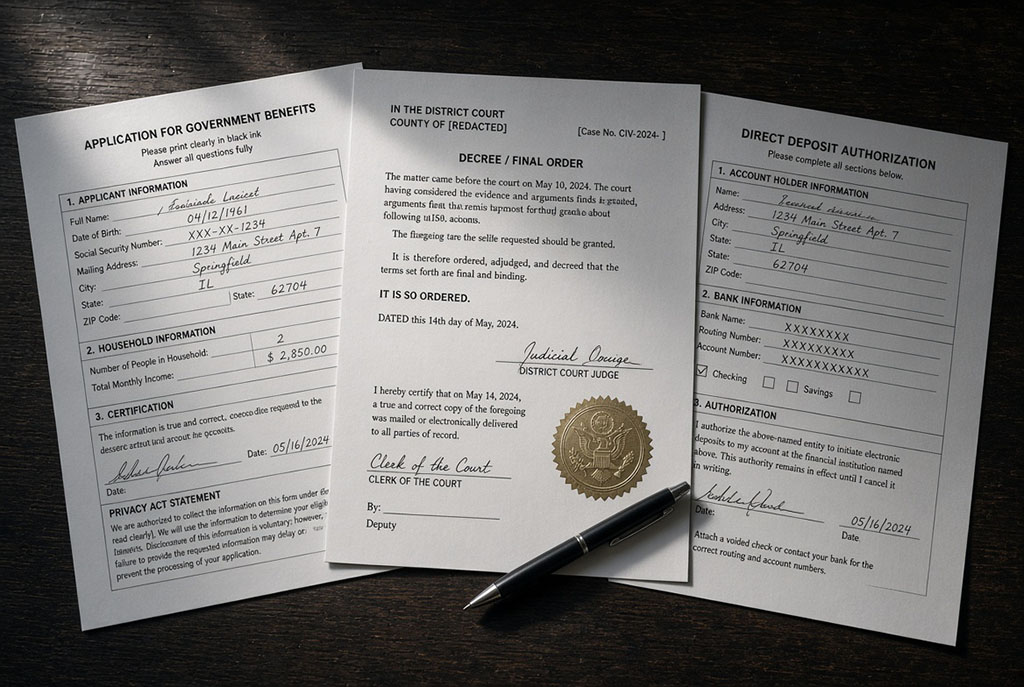
To set direct payment up, the former spouse files an application with DFAS using Form DD 2293, along with a certified copy of the divorce decree, a marriage certificate if the marriage date is not stated in the order, a direct deposit form, and a completed IRS W-4P.
There is a ceiling on what DFAS will send. The maximum payable to a former spouse under the USFSPA for a property division is 50 percent of the member’s disposable retired pay. Where there are payments under the USFSPA and a separate garnishment for child support or alimony, the combined total cannot exceed 65 percent of the member’s disposable earnings for garnishment purposes.
When the Marriage Is Under Ten Years
A shorter marriage does not end the conversation. It moves it from a payment question to a drafting and enforcement question, and that is where the work happens.
Write the award as a formula, not a guess. The decree needs language a court can enforce years later, tied to the community portion of the benefit rather than a dollar figure pulled from today.
Consider trading the retirement instead of dividing it. Where the community estate has a house, brokerage accounts, or a civilian retirement plan, offsetting the military retirement against another asset gives the spouse something they can control today instead of a monthly obligation they will chase for decades.
Build in enforcement teeth. A contractual obligation to pay, a deadline, and clear consequences for missed payments give a Texas court something concrete to enforce. Our post on what to do when a military spouse ignores court orders covers the enforcement side.
Separate support from property. Child support and spousal maintenance run on their own enforcement tracks, including income withholding, and the 10/10 rule does not restrict them. Do not let a property award get quietly bundled into a support number.
Deal with survivor coverage in the same document. A share of retired pay ends when the retiree dies unless Survivor Benefit Plan coverage is in place, and former spouse coverage carries its own filing deadline after the divorce. A retirement award with no survivor provision behind it is worth less than it looks on paper.
Every one of these is easier to build into a decree than to fix afterward. A property division that was drafted loosely is a problem you inherit for as long as the retirement pays out.
One more thing worth saying out loud. If the service member separates before reaching retirement eligibility, there may be no traditional retired pay to divide at all, which is a different problem than a short marriage and calls for a different strategy. A decree written to divide something that never materializes leaves a spouse with a percentage of nothing.
The Other Numbers People Confuse With 10/10
Military divorce runs on a pile of federal thresholds, and almost every one of them gets attached to the wrong question at some point.
20 years of service. This is the member’s own retirement eligibility. It has nothing to do with the former spouse.
20/20/20 and 20/20/15. The 20/20/20 and 20/20/15 rules really do affect post-divorce military benefits, but they do different things. A qualifying 20/20/20 former spouse can retain TRICARE and certain commissary, exchange, and related privileges. A qualifying 20/20/15 former spouse generally receives temporary TRICARE eligibility, not the same full set of privileges.
The one year Survivor Benefit Plan deadline. Former spouse survivor coverage has its own strict filing deadline after divorce, and missing it can be extremely difficult to fix.
The December 23, 2016 line. For qualifying military retired-pay divisions entered after December 23, 2016, where the divorce becomes final before the service member begins receiving retired pay, federal law generally limits the divisible retired-pay calculation to the member’s retired pay base and creditable service as of the divorce, with applicable cost-of-living adjustments afterward.
The Frozen Benefit Rule Most People Have Never Heard Of
For property divisions becoming final after December 23, 2016, the federal statute computes the divisible amount using the member’s retired pay base and years of service as of the date of the divorce decree, with cost of living adjustments applied from that point forward.
In plain terms, when the member is not yet retired at divorce, later promotions and additional years of service generally do not increase the former spouse’s divisible share. The calculation is tied to the member’s pay base or High-3 and creditable service at divorce, depending on the member’s retirement system and service component, with the applicable cost-of-living adjustments added afterward.
That single provision can move the value of a division substantially, and it is a far bigger factor in most cases than whether the marriage hit the ten year mark.
How a Texas Court Divides Military Retired Pay
Texas treats the portion of military retired pay earned during the marriage as community property, subject to a just and right division. That is the same framework applied to civilian pensions, 401(k) accounts, and other retirement assets divided in a San Antonio divorce.

Just and right does not mean automatically equal. A Texas judge can consider the circumstances of the parties, and the outcome depends on the facts presented rather than a fixed percentage.
The service earned before the marriage and after the divorce is separate property. The community portion is the piece that overlapped the marriage, which makes the exact dates as consequential here as they are everywhere else in a military divorce.
Getting the decree language right is its own discipline. The order has to define the award in terms DFAS can process if the case meets 10/10, satisfy the federal calculation requirements, and hold up in a Bexar County court if enforcement is ever needed. Our property division page covers how community and separate property get sorted.
FAQs about the 10/10 Rule and Military Retirement in Texas
We were married eight years. Do I get any of the retirement?
Possibly, because a Texas court can award you a share of the retired pay earned during those eight years as community property. What you will not get is direct payment from DFAS, so your award depends on your former spouse paying it and on the decree being drafted well enough to enforce.
Does the 10 years have to be 10 years of marriage or 10 years of service?
Both, and they have to overlap. The statute requires 10 years of marriage during which the member performed at least 10 years of creditable service, so a 15 year marriage that overlapped only 7 years of service does not meet the rule.
Can my ex agree to have DFAS pay me even though we do not meet 10/10?
No. The limit is federal and DFAS applies it regardless of what the parties agree to. A private agreement to pay you directly is enforceable between the two of you, but it does not convert into a government payment.
Is the former spouse’s share capped at 50 percent?
DFAS will not pay more than 50 percent of disposable retired pay under all court orders for a property division, and the combined ceiling rises to 65 percent when child support or alimony garnishment is also in play. Those are payment caps at DFAS, not limits on what a court may award overall.
Does the 10/10 rule apply to child support?
No. DFAS is explicit that the 10/10 rule does not apply to enforcement of child support or alimony awards, which run through a separate process with their own requirements.
What if my ex retires years after our divorce?
For divorces final after December 23, 2016, the divisible amount is calculated on the member’s pay base and years of service as of the divorce date, adjusted for cost of living increases. Later promotions generally do not increase your share, which makes the valuation date one of the most consequential facts in the case.
How long does it take DFAS to start paying?
DFAS processes the application after receiving a complete package. An incomplete submission can delay processing. Send the certified decree, the marriage certificate if the dates are not in the order, and the direct deposit and tax forms together rather than in pieces.
My spouse says a short marriage means the retirement is off the table. Is that right?
No, and it is the exact misconception this rule creates. Get the community portion valued before you agree to anything, because signing away a retirement interest based on a misread federal payment rule is not something a court will undo later.
Do Not Sign Away a Retirement Based on a Rule That Does Not Say What You Think
Military retirement is often the largest asset in the marriage, and the the 10/10 rule is one of the easiest military-divorce rules to misunderstand, and that misunderstanding can cause a spouse to undervalue a real retirement interest. Brandi Wolfe Law helps San Antonio and Bexar County families value the community portion of military retired pay, draft decree language DFAS will actually process, and enforce awards when the marriage did not meet the direct payment threshold. If the other side is telling you the retirement is untouchable, we will tell you straight whether that is true in your case.
Call (210) 571-0400 or talk to a San Antonio divorce attorney about your military divorce before you agree to a property division.
This article is general information, not legal advice for your specific case. Retirement division turns on your exact dates, service record, and decree language, so talk to a Texas family law attorney before you sign anything.