

What Counts as a Material and Substantial Change for Child Support in Texas?
A material and substantial change for child support purposes is any real, ongoing shift in either parent’s finances or the child’s circumstances since the last order, not a temporary dip or a change you caused on purpose to pay less. Texas also gives fathers a second, less demanding path that does not require proving a dramatic life event at all: if it has been three years since the order was set and the guideline amount would now differ by 20 percent or $100, that gap alone can support a modification. Job loss, a new child, and a real increase in parenting time are three of the most common situations that bring fathers into a child support modification case, and each one plays out a little differently under Texas law. Here is what actually qualifies, what the courts expect to see as proof, and how each situation plays out from filing to a final order.

The Legal Standard for Modifying Child Support in Texas
Under Texas Family Code Section 156.401, a court can modify a child support order if the circumstances of the child or a person affected by the order have materially and substantially changed since the order was signed, or if at least three years have passed since the order was rendered or last modified and the current guideline amount would differ from the existing order by 20 percent or $100 a month, whichever is less restrictive to prove.
These are two separate doors into the same basic result, and a father only needs to fit through one of them to move a case forward. A father whose income dropped sharply last month has an obvious material change to point to. A father whose income has drifted upward or downward more gradually over several years, without one dramatic triggering event, may still qualify simply because enough time has passed and the math no longer matches the guidelines.
Job Loss or a Significant Pay Cut
Losing a job or taking a real pay cut is one of the clearest material and substantial changes a court will recognize, provided it is involuntary and ongoing rather than a short-term gap between opportunities. Courts distinguish between a genuine job loss and a father who quits, gets fired for cause, or takes a lower-paying job specifically to reduce a support obligation. In the second scenario, a court can impute income based on earning potential rather than accepting the reduced actual income at face value, since intentional underemployment does not automatically lower a support obligation.

To support a modification based on job loss, bring documentation: a termination letter or layoff notice, unemployment benefit records, and evidence of an active job search at a comparable pay level. A father who can show he lost a job through no fault of his own and has been actively looking for comparable work has a materially stronger case than one who shows up with only a pay stub and an explanation.
Severance pay and unemployment benefits complicate the timing of a modification, since both count as income for at least some period after a job ends, which can delay when the drop in resources actually becomes clear enough to support a filing. Fathers connected to the military or defense contracting work around San Antonio should also account for how separation pay, terminal leave payouts, or a transition to civilian employment affects the income picture in the months immediately after a job change, since a temporary payout can make income look higher than it will be going forward.
How the New Support Amount Actually Gets Calculated
A modification does not start from scratch with a new philosophy about what is fair. It runs the same net resources calculation the original order used, applied to current numbers. That includes wage and salary income, overtime, commissions, self-employment income, and most other regular income, similar to how income is defined for spousal maintenance purposes, minus specific statutory deductions like Social Security taxes, federal income tax withholding based on the tax rate for a single person claiming one exemption, and union dues where applicable. The guideline percentage is then applied to the resulting net resources figure, capped at the statutory net resources ceiling that adjusts periodically.
This is also where a lot of contested modification cases get bogged down for self-employed fathers or those with variable income, since the same discovery and documentation issues that come up in a divorce, business records, bank statements, and profit-and-loss statements, apply just as much to a modification case built around a changed income.
A New Child Changes the Math
Having another child, whether through remarriage or a new relationship, can support a modification because Texas uses an alternative guideline calculation under Family Code Section 154.129 when an obligor has a duty to support children in more than one household. Instead of applying the standard guideline percentage for the number of children in the current case alone, the multiple-family table adjusts the percentage down based on how many other children the obligor also has a legal duty to support.
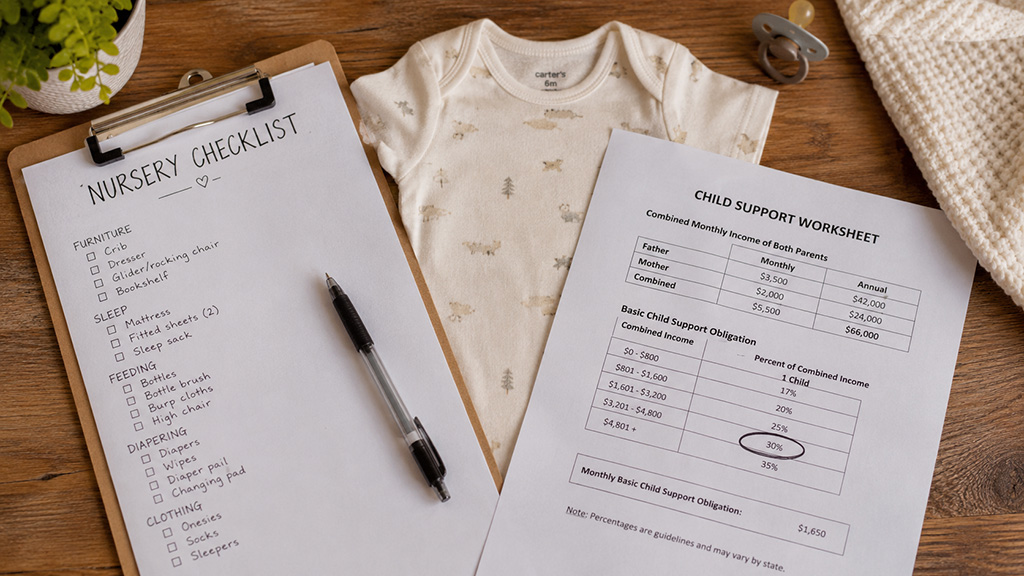
The adjustment is real money, not a token gesture. Under the standard guidelines, support for one child before the court is calculated at 20 percent of the obligor’s net resources with no other children to support. Under the multiple-family table, that same one child before the court drops to roughly 17.5 percent of net resources once the obligor also has one other child they are legally obligated to support, with the percentage adjusting further as the number of other children increases.
This is not automatic. A new child does not modify an existing order by itself. A father has to actually file a modification and present the new child’s existence and support obligation as part of the case. The breakdown of what counts as income under the Texas Family Code is useful background here too, since the multiple-family calculation still starts from the same net resources figure used in a standard case.
More Parenting Time Can Also Justify a Change
Texas does not use a strict formula that automatically lowers support dollar-for-dollar as possession time increases the way some states do, but Texas Family Code Section 154.123 specifically lists the amount of time of possession and access to a child as a factor a court can consider in deciding whether to vary from the standard guideline amount. A father who has gone from a standard possession schedule to something close to equal time, whether through an agreed change or a separate custody modification, has a real argument that the original support figure no longer reflects the actual cost-sharing happening between both households.
This argument tends to work best when it is paired with an actual, documented change in the possession schedule itself, not just an informal pattern of extra time that was never reflected in a court order. If you are pursuing both a possession change and a support change together, the possession side of that process is covered in this guide to how a father modifies a custody or possession order in Texas.
Filing both changes at once, rather than handling possession and support as two separate cases months apart, usually saves time and gives the court a complete picture of how the new arrangement actually affects both households financially. A judge weighing a support change in isolation, without knowing a possession change is also happening, may not have the full context needed to apply the possession-time factor accurately.
The Three-Year Rule: Modifying Without Proving a Major Life Change
Not every father has a dramatic story like a layoff or a new baby to point to, and Texas does not require one. If at least three years have passed since the current order was rendered or last modified, and the amount that would be calculated under the current guidelines differs from the existing order by 20 percent or $100 a month, that gap by itself is enough to support a modification under Section 156.401. This path exists specifically for situations where income has changed gradually, through raises, cost-of-living increases, or a slow decline, rather than through one identifiable event.
This is often the easiest and most overlooked route to a modification. A father whose income has simply grown or shrunk over several years without any single triggering event can still bring a case, and does not need to prove anything about intent, fault, or a specific incident.
What Doesn’t Count as a Material Change
- Voluntarily quitting or taking a lower-paying job to reduce support. Courts can impute income based on what a parent is capable of earning rather than accepting a self-inflicted pay cut.
- A short-term or temporary income dip. A few weeks without work or a temporary reduction in overtime generally does not meet the ongoing, substantial standard the statute requires.
- A new spouse’s income, standing alone. A new spouse’s earnings are not counted as the obligor’s own income for calculating support, so remarriage by itself is usually not a qualifying change.
- Informal extra time with the kids that was never made part of a court order. Extra time a co-parent has agreed to informally does not carry the same weight as a documented, court-ordered change in the possession schedule.
- A one-time bonus or windfall. A single unusually large paycheck, bonus, or gift is generally treated as an outlier rather than evidence of a genuine, ongoing shift in average income.
What Happens After You File
Filing a modification petition starts the clock, but the existing order remains in effect and enforceable until a new order is signed, so payments should continue as scheduled while the case is pending unless a court specifically orders otherwise. Both sides typically exchange financial information through discovery, including pay stubs, tax returns, and documentation of the change being claimed. Many child support modification cases in Bexar County resolve through an agreed order once both parents see the updated numbers, though a contested case proceeds to a hearing where a judge applies the guidelines to the current facts.

FAQs about Modifying Child Support as a Father in Texas
Can I stop paying the old amount as soon as I file for a modification?
No. The existing order stays in effect and enforceable, including any arrears that accrue, until a court signs a new order changing it, regardless of how strong the modification case looks.
Does losing overtime pay count as a material change?
It can, if the reduction is significant and ongoing rather than occasional, since overtime is typically included in the income calculation and a real, lasting drop in it can shift the guideline amount.
Can child support be modified downward if I become the parent with more possession time?
A significant, documented increase in possession time is a factor a court can weigh under Section 154.123, but it works alongside the standard guideline calculation rather than automatically replacing it, and the outcome still depends on the specific facts a court is presented with.
Is there a limit on how often child support can be modified?
There is no fixed limit on the number of modifications, but each one still has to independently meet either the material-and-substantial-change standard or the three-year and 20-percent-or-$100 threshold.
What if the other parent disagrees that my income actually changed?
Disputed income is resolved through the same discovery and hearing process as any other contested issue, using pay records, tax returns, and other financial documentation rather than either parent’s unverified account of what the other is actually earning.
Do I need a lawyer to file a child support modification in Texas?
Texas does not require an attorney, but calculating the correct guideline amount under the multiple-family adjustment or applying the three-year rule correctly is easy to get wrong without experience, especially when both a new child and a job change are involved at the same time.
Can a support modification apply retroactively to before I filed?
Generally no. A modification typically takes effect from the date of filing or service, not retroactively to when the change in circumstances actually happened, which is one of the strongest reasons not to wait once a qualifying change occurs.
What if my ex and I already agreed to a different amount informally?
An informal agreement between parents to pay more or less than the court-ordered amount is not enforceable and does not protect either side, since only a signed modification order actually changes the legal obligation.
Ready to Get Your Child Support Order Matched to Your Real Life?
An order based on a job you no longer have, or a family that has grown since it was signed, is not doing what it is supposed to do for anyone. The child support team at Brandi Wolfe Law helps San Antonio fathers bring modification cases that hold up, whether the trigger is a job loss, a new baby, or a real change in parenting time. Call (210) 571-0400 or schedule a free consultation to find out where your case actually stands under the guidelines.
Brandi Wolfe Law, PLLC, 7550 W Interstate 10 Suite 800, San Antonio, TX 78229. (210) 571-0400. Schedule a free consultation.