

How Do You Prove Minimum Reasonable Needs for Spousal Maintenance in Texas?
You prove minimum reasonable needs with a detailed, honest account of what it actually costs to keep a roof over your head, the lights on, and food on the table, backed by real records rather than a description of the life you used to live. Texas Family Code Section 8.051 makes this the threshold question in every maintenance case: a spouse only qualifies if they will lack sufficient property to meet their own minimum reasonable needs after the divorce. For the full eligibility rules beyond this one requirement, see how to qualify for spousal maintenance in Texas. The statute never defines the term with a dollar figure or a checklist, which means the number gets built case by case, from evidence you have to gather yourself.
Where “Minimum Reasonable Needs” Comes From
The phrase shows up twice in the maintenance statute. Section 8.051 uses it to decide whether a spouse is eligible for maintenance at all, and Section 8.052(1) lists “each spouse’s ability to provide for that spouse’s minimum reasonable needs independently” as one of the factors a court weighs once eligibility is established. Neither section defines the term further. Texas courts have filled in that gap over time through individual rulings rather than a fixed legislative formula, treating it as a fact question that has to be proven with evidence in each case rather than looked up in a table.
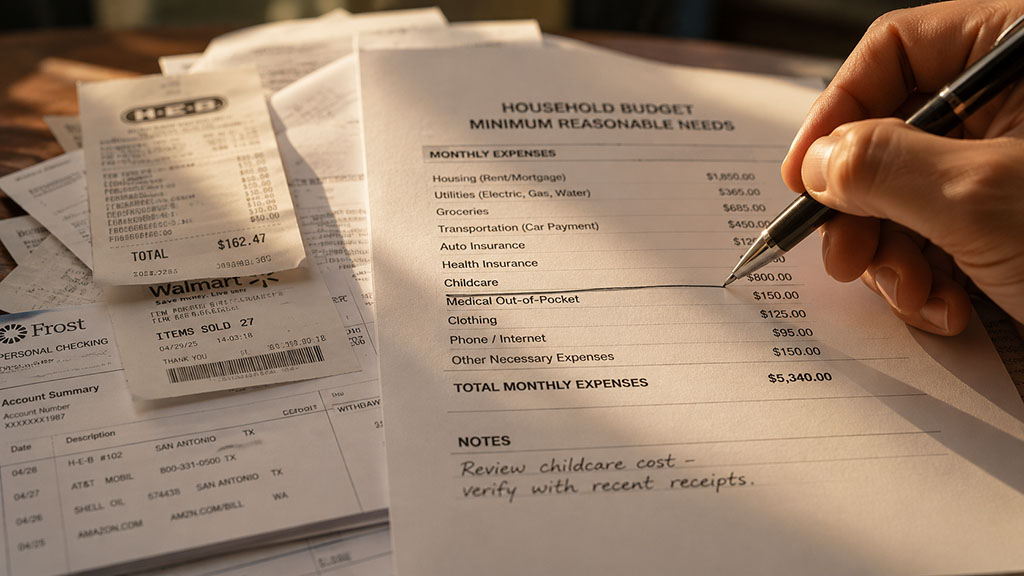
That case-by-case approach cuts against anyone hoping for a simple answer to “how much can I expect.” It also means the outcome depends heavily on how well a spouse’s attorney documents and presents the actual numbers, since there is no default figure a judge falls back on when the evidence is thin.
What “Minimum Reasonable Needs” Does Not Mean
Minimum reasonable needs is not the same question as “what did our household spend during the marriage.” A couple that dined out three times a week and took two vacations a year does not get to use that spending as the baseline for maintenance. The standard is narrower on purpose. It asks what a person actually requires to cover essential, ongoing expenses, not what would let them maintain the lifestyle the marriage once supported.
That distinction cuts both ways. A spouse asking for maintenance should not present a budget padded with discretionary spending, because a judge who spots inflated numbers tends to discount the whole request. At the same time, a spouse who understates their real costs out of embarrassment or uncertainty can end up with an order that does not actually cover rent, insurance, and groceries once the case is over.
What Courts Actually Look At When Weighing Reasonable Needs
There is no statutory line-item list, but Texas courts consistently look at the same categories of evidence when a spouse presents a minimum reasonable needs case:
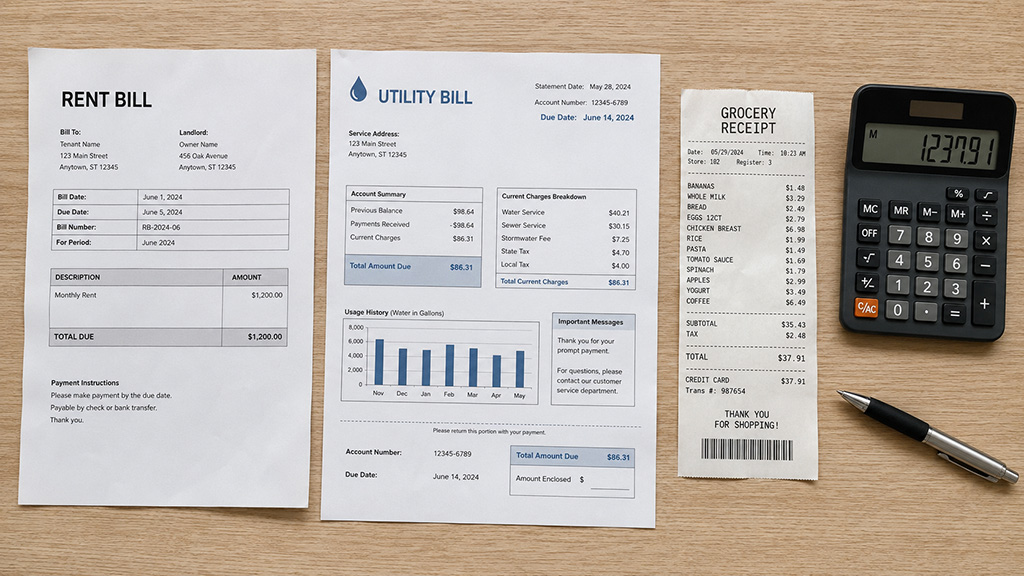
- Housing. Rent or a realistic mortgage payment, property taxes, and basic insurance for wherever the spouse will actually live after the divorce, not the marital home if it is being sold or awarded to the other spouse.
- Utilities. Electricity, water, gas, and a reasonable phone and internet bill, at ordinary usage levels rather than a household running multiple properties.
- Food. A grocery budget based on actual spending history, not restaurant and takeout spending folded in as if it were a necessity.
- Insurance. Health insurance premiums and out-of-pocket medical costs, along with any life insurance required to protect the maintenance itself.
- Transportation. A car payment or reliable transportation cost, fuel, and insurance, sized to what is needed to get to work and handle daily life.
- Minimum required debt payments. Payments on debts that already exist and cannot reasonably be avoided, as opposed to new discretionary credit spending.
None of these categories has a fixed number attached to it. A judge weighs the specific evidence a spouse brings for each one against what looks realistic for that person’s actual circumstances, including where they live and whether they have children in the home.
Why This Standard Hits Stay-at-Home Parents Differently
A spouse who left the workforce to raise children often has the hardest time putting a number on their own minimum reasonable needs, not because the need is smaller but because there has been no independent budget to point to. Every expense for years may have run through joint accounts and a single household budget that never separated “what it costs to support me” from “what it costs to support the family.” Rebuilding that separation after years out of the workforce takes more work than it does for a spouse who has always managed an individual paycheck and individual bills.

This is also where the earning-capacity side of the analysis matters most. A court weighing minimum reasonable needs for a spouse re-entering the workforce after raising children will typically also look at how long it will realistically take that spouse to become self-supporting, which is part of why the length of time out of paid work, not just current expenses, tends to come up heavily in these cases.
Discretionary Spending That Rarely Counts as a Reasonable Need
Certain categories show up in almost every disputed maintenance case, and most of them do not survive scrutiny as part of a minimum reasonable needs calculation:
- Dining out and entertainment. Restaurant spending and streaming or entertainment subscriptions are treated as lifestyle spending, not survival costs, no matter how routine they were during the marriage.
- Gym memberships and personal services. Recurring memberships, salon visits, and similar expenses are generally viewed as discretionary unless tied to a documented medical need.
- Private school tuition. This is usually addressed separately as part of child support or a specific agreement, not folded into the requesting spouse’s personal minimum needs.
- Vacation and travel budgets. Even modest, recurring travel is treated as beyond the minimum standard, regardless of how normal it felt during the marriage.
- Payments on newly acquired debt. A credit card balance run up after separation is viewed differently than a long-standing joint debt that predates the divorce.
None of this means discretionary spending is irrelevant to the case. It can still matter for property division or as context for the marital standard of living, but it does not belong in the minimum reasonable needs column, and including it tends to weaken the credibility of the whole request.
How to Document Your Minimum Reasonable Needs
Judges respond to records, not recollection. Before a hearing, pull together the paperwork that turns “I think I need about this much” into a number a court can actually rely on:
- Three to six months of bank and credit card statements, so the actual pattern of essential spending is visible rather than reconstructed from memory.
- Copies of recurring bills, including the lease or mortgage statement, utility bills, insurance premiums, and any minimum loan payments.
- A sworn financial statement or inventory that separates necessary expenses from discretionary ones, line by line, rather than one lump “monthly expenses” figure.
- Documentation of income, including pay stubs or, for a spouse who has not worked recently, evidence of the job search or training needed to become self-supporting.
Building this file early matters more than most people expect. A spouse who shows up to a hearing with a folder of statements and a clear, itemized budget looks credible in a way that a rough verbal estimate never does, and credibility is most of what decides a contested maintenance request.
Why Overstating or Understating Your Needs Can Backfire
Inflating a budget to justify a bigger number is one of the fastest ways to lose credibility with a judge. Opposing counsel will cross-examine specific line items against bank records, and a single obviously padded number, like a grocery bill that does not match actual spending, can cast doubt on every other figure in the request, even the accurate ones.
Understating needs causes a quieter but just as real problem. Some spouses, especially after years of not controlling household finances, guess low because they are unsure what things actually cost or feel uncomfortable asking for support at all. A number that is too low can result in an order that does not cover actual rent and utilities once the case is final, and going back to modify an order later requires showing a material and substantial change, not just “the number I gave the court turned out to be wrong.”
How Minimum Reasonable Needs Interacts With the Statutory Cap
A well-documented minimum reasonable needs case does not automatically translate into a matching maintenance order. The amount a court can order is still capped at the lesser of $5,000 a month or 20 percent of the paying spouse’s average monthly gross income under Texas Family Code Section 8.055, regardless of how high the documented need runs. A spouse with $6,500 a month in real, documented minimum needs cannot receive more than the statutory ceiling, even with airtight proof.
That means the needs analysis and the income calculation are two separate steps that both matter. For a full breakdown of how the cap itself works, see how Texas courts calculate spousal maintenance, including what counts as gross income and how long an order can last based on the length of the marriage.
What Happens If Your Ex Disputes Your Claimed Needs
A contested maintenance case usually turns into a dispute over the needs budget itself, line by line. The other side’s attorney will typically request bank and credit card records through discovery and compare them against the numbers presented, looking for gaps between what was claimed and what the records actually show. Categories that tend to draw the most scrutiny include entertainment or dining spending relabeled as “food,” a housing figure based on a home that is being sold rather than where the spouse will actually live, and transportation costs that assume a newer or more expensive vehicle than the one currently owned.

The strongest response to that kind of challenge is the same preparation that should happen before the dispute starts: real records that match the numbers being presented, gathered before opposing counsel asks for them rather than assembled under pressure after a subpoena.
FAQs about Minimum Reasonable Needs in Texas Spousal Maintenance Cases
Is there a set dollar amount that counts as minimum reasonable needs in Texas?
No. Texas Family Code Section 8.051 requires proof of minimum reasonable needs but does not set a dollar figure, so the number is built from the specific evidence presented in each case rather than a standard amount that applies to everyone.
Does minimum reasonable needs include debt from during the marriage?
It can include ongoing minimum payments on debt that already exists and cannot reasonably be eliminated, but new discretionary spending is generally not treated as part of a reasonable needs calculation.
Can a spouse who owns a home still qualify based on minimum reasonable needs?
Yes, if the property division still leaves that spouse without sufficient income or liquid resources to cover their basic monthly costs. Owning an asset like a home does not automatically disqualify someone if it does not generate income or cover ongoing expenses.
Do minor children’s expenses count toward a parent’s minimum reasonable needs?
Generally no, since child-related costs are addressed separately through child support. The minimum reasonable needs analysis focuses on the requesting spouse’s own basic expenses, not the children’s.
What if I do not have good financial records to prove my expenses?
Start rebuilding the picture now with whatever is available, including bank statements, old bills, and receipts, since a court still expects specific evidence rather than a general estimate, and gaps in documentation tend to work against the spouse who cannot fill them.
Can minimum reasonable needs change after the maintenance order is already in place?
Yes, but changing the order requires showing a material and substantial change in circumstances through a modification, not simply providing updated numbers to the same court informally.
Does the marital standard of living matter at all in a maintenance case?
It can provide context for how a couple lived, but it is not the legal standard the court applies when deciding the minimum reasonable needs question, which focuses on essential costs rather than the lifestyle the marriage supported.
Should I hire a forensic accountant to help document my needs?
For most cases, organized bank and credit card records are enough, but a forensic accountant can help in higher-conflict cases involving self-employment income, hidden assets, or a spouse disputing every line item in detail.
Ready to Build a Minimum Reasonable Needs Case That Actually Holds Up?
A guess about what you need to get by does not hold up under cross-examination, and neither does a budget that looks padded. The spousal support team at Brandi Wolfe Law helps San Antonio spouses put together the documentation a judge actually finds credible, whether you are asking for maintenance or defending against a claim that does not match the real numbers. Call (210) 571-0400 or schedule a free consultation to get your financial picture in order before it gets picked apart in a hearing.
Brandi Wolfe Law, PLLC, 7550 W Interstate 10 Suite 800, San Antonio, TX 78229. (210) 571-0400. Schedule a free consultation.