

How Long Does Spousal Maintenance Last in Texas?
How long spousal maintenance lasts in Texas depends on how long the marriage lasted, not on how much either spouse wants it to run. Texas caps maintenance at five, seven, or ten years depending on the length of the marriage, and courts are required to limit it to the shortest period that lets the receiving spouse become self-supporting. The monthly amount is capped too, at whichever is lower: $5,000 or 20 percent of the paying spouse’s average monthly gross income. Everything else, from job skills to who stayed home with the kids, affects where a judge lands inside those limits, and the difference between the statutory maximum and what actually gets ordered can be significant. Here is how the math actually works.

Qualifying Comes Before the Calculation
The formula below only matters once a spouse actually qualifies for maintenance in the first place, and Texas does not hand it out automatically just because one spouse earned less. A spouse generally has to show the marriage lasted at least 10 years and that they lack enough property or income to meet their own minimum reasonable needs, or qualify through a shorter path involving family violence, a disability, or caring for a child with a disability that prevents outside employment. This article assumes eligibility is already established and focuses on what happens next, since the calculation only becomes relevant once a court has already decided that maintenance applies to your case at all. For the eligibility rules themselves, see this breakdown of how to qualify for spousal maintenance in Texas.
The Legal Cap on Spousal Maintenance in Texas
Under Texas Family Code Section 8.055, a court cannot order a paying spouse to hand over more than the lesser of two numbers each month: $5,000, or 20 percent of that spouse’s average monthly gross income. Whichever number is smaller sets the ceiling. A high earner does not automatically owe a high-dollar amount just because 20 percent of their income is a large figure. The $5,000 statutory cap applies no matter how much someone makes, so a spouse earning $40,000 a month cannot be ordered to pay $8,000 (20 percent), only the flat $5,000 ceiling.
This is a maximum, not a target. A judge can order less than the capped amount based on the factors below, and in many cases does.
What Counts as “Gross Income” for the Calculation
The 20 percent figure is calculated against average monthly gross income, and Texas Family Code Section 8.055 defines that term broadly. It includes wage and salary income, commissions, overtime, tips, and bonuses; interest, dividends, and royalties; self-employment income; net rental income after operating expenses and mortgage payments; and other income actually being received, such as severance pay, retirement benefits, pensions, trust income, annuities, capital gains, and unemployment benefits.
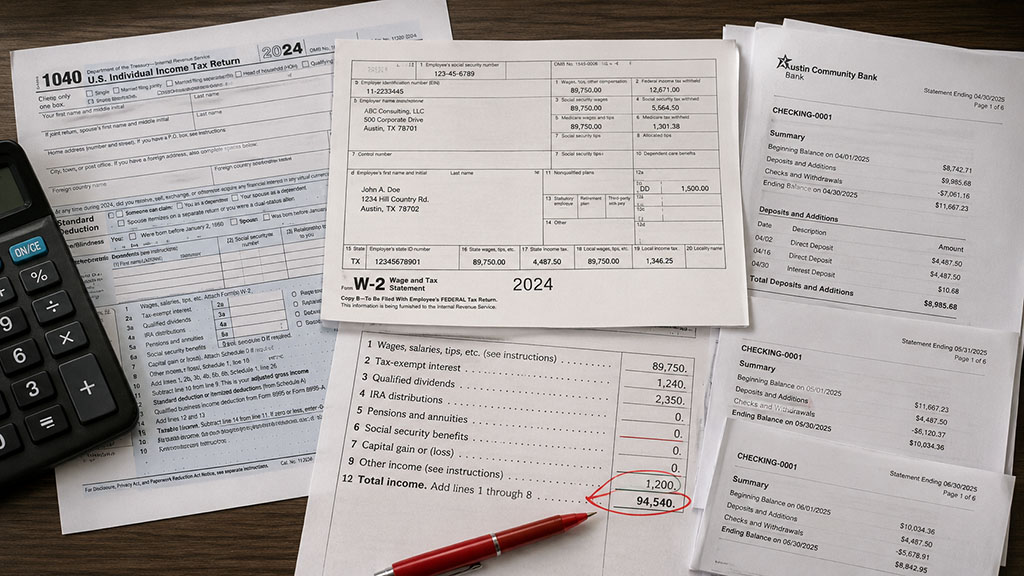
It does not include everything that shows up in a bank account. The statute excludes the return of principal or capital, accounts receivable, federal public assistance benefits, Temporary Assistance for Needy Families payments, foster care payments for a child, and Department of Veterans Affairs service-connected disability compensation. That last exclusion matters a lot in military divorce cases, where VA disability pay can make up a meaningful share of a spouse’s total income but is not counted toward the 20 percent calculation.
How Courts Determine “Average Monthly Gross Income” for the Calculation
The 20 percent figure only means something once a court settles on a real number for average monthly gross income, and that number is rarely as simple as looking at a single pay stub. For a spouse on a fixed salary, courts typically look at recent pay stubs and W-2s and calculate a simple monthly average. For a self-employed spouse, a business owner, or anyone paid on commission, the math gets harder, because income can swing significantly month to month and tax returns often show figures reduced by business deductions that do not reflect actual cash flow.
In those situations, the court may look at a longer trailing period, often the past one to three years of tax returns, bank records, and profit-and-loss statements, to smooth out the swings and reach a realistic average. If one spouse suspects the other is underreporting income or has reduced their hours specifically to lower a future maintenance obligation, that is generally addressed through the discovery process rather than accepted at face value, and a court can impute income based on earning capacity rather than reported income if it finds someone is intentionally underemployed.
How Long Does Spousal Maintenance Last?
Texas Family Code Section 8.054 ties the maximum duration of a maintenance order to the length of the marriage.
| Length of Marriage | Maximum Duration of Maintenance |
|---|---|
| Under 10 years (eligible only through a family-violence finding) | Up to 5 years |
| 10 to 20 years | Up to 5 years |
| 20 to 30 years | Up to 7 years |
| 30 years or more | Up to 10 years |
These are ceilings, not guarantees. The same statute requires a court to limit maintenance to the shortest reasonable period that lets the receiving spouse earn enough to cover their own minimum reasonable needs, unless a disability or a disabled child in their care makes that self-sufficiency unrealistic. A 15-year marriage does not mean an automatic 5 years of payments. It means 5 years is the outer limit a court is allowed to order.
What Factors Push the Number Up or Down
Once a spouse qualifies for maintenance, Texas Family Code Section 8.052 lists the factors a court weighs to set the actual amount and duration within the statutory caps:
- Ability to meet minimum reasonable needs independently, based on the financial resources each spouse actually walks away with after the divorce, not their pre-divorce standard of living.
- Education and employment skills, including how long it would realistically take the receiving spouse to get trained or educated enough to earn a sufficient income, and whether that training is actually available and affordable.
- Duration of the marriage, which also sets the outer duration limit described above and tends to carry significant weight in longer marriages.
- Age, employment history, earning ability, and physical or emotional condition of the spouse seeking maintenance, including any documented health condition that limits full-time work.
- The effect of child support obligations on either spouse’s ability to cover their own minimum needs while also paying or receiving support for the children in the household.
- Contribution as a homemaker, recognizing unpaid work that supported the household and the other spouse’s career, including time out of the workforce that reduced future earning capacity.
- Marital misconduct and family violence history, which can affect both eligibility and the amount a court is willing to order, particularly when documented through police reports or protective order filings.
No single factor controls the outcome. A judge weighs all of them together, which is why two marriages of similar length can end up with very different maintenance orders. A 22-year marriage where one spouse has a nursing license and steady income looks nothing like a 22-year marriage where one spouse has not worked outside the home in over a decade, even though both fall into the same statutory duration tier.
Court-Ordered Maintenance vs. Contractual Alimony in Texas
Everything above describes court-ordered spousal maintenance under Chapter 8 of the Family Code, which only applies when a spouse meets specific eligibility rules and only within the statutory cap and duration limits. Many Texas divorces instead include contractual alimony: a payment arrangement the spouses agree to themselves and write into the settlement, separate from what a judge could have ordered on their own.
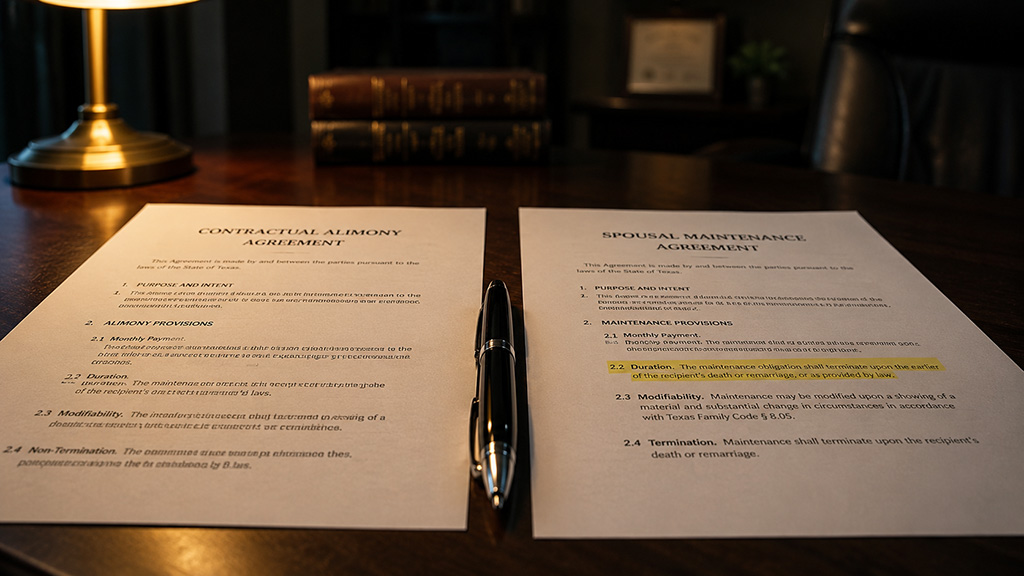
Contractual alimony is not bound by the $5,000 or 20 percent cap and is not limited to the 5, 7, or 10-year tiers, because it is a private agreement rather than a court-imposed order. That flexibility can work in either spouse’s favor depending on how it is negotiated. It also changes how the payments are enforced and how they may be treated for federal tax purposes, which depends on the specific agreement and current federal law rather than anything Texas Family Code Chapter 8 controls. Anyone negotiating contractual alimony instead of, or in addition to, statutory maintenance should have the specific language reviewed before signing, since the two types of support are not interchangeable and a decree that blends them without precision can create enforcement problems later.
Federal tax treatment of both types of support has also changed in recent years. Alimony and maintenance under agreements executed after December 31, 2018 are generally neither deductible by the paying spouse nor taxable income to the receiving spouse under current federal law, a reversal of the older rule. Current federal tax treatment can still depend on the specific year and structure of the agreement, so this is a point worth confirming with a tax professional rather than assuming based on an older divorce or something a friend’s decree said.
A Simple Example of How the Cap Works
The math is easier to see with actual numbers. If a paying spouse has an average monthly gross income of $10,000, 20 percent of that is $2,000, which is well under the $5,000 statutory cap, so $2,000 a month is the most a court could order regardless of need. If that same spouse instead earns $30,000 a month, 20 percent would be $6,000, but the $5,000 flat cap controls, so $5,000 remains the ceiling. The cap only stops mattering as the deciding factor once monthly gross income drops below $25,000, the point where 20 percent and the $5,000 cap are equal.
The math looks different for a self-employed spouse with irregular income. If a business owner’s income averaged over the trailing three years works out to $8,000 a month even though some months show far more and others show far less, the court applies the 20 percent calculation to that smoothed average, not to whatever the most recent bank statement happens to show. Twenty percent of $8,000 is $1,600, which becomes the ceiling regardless of a single strong or weak month right before the divorce.
FAQs about Spousal Maintenance Calculation in Texas
Does a judge always order the maximum amount allowed under the cap?
No. The cap sets the ceiling, not the default. Judges regularly order less than the maximum based on the Section 8.052 factors, particularly when the receiving spouse has some earning capacity or a shorter path back to self-sufficiency.
Can spousal maintenance be modified after the divorce is final?
Yes, if either spouse’s circumstances materially and substantially change, such as a significant income change or the receiving spouse becoming able to support themselves sooner than expected. A modification requires a separate motion, not an automatic adjustment.
Does overtime or bonus income count toward the 20 percent calculation?
Yes. Section 8.055 defines gross income to include overtime pay and bonuses along with regular wages, so a spouse’s average monthly income for this calculation should reflect what they actually receive, not just a base salary.
Is military retirement pay counted in the maintenance calculation?
Retirement benefits and pensions are listed as included income under the statute, so military retirement pay generally counts, while VA disability compensation is specifically excluded from the calculation.
What happens if the paying spouse’s income changes significantly after the order?
A significant, ongoing change in income can support a motion to modify the maintenance amount, but the change has to be substantial and generally needs to be more than a temporary dip to justify reopening the order.
Can spousal maintenance and child support both be ordered in the same case?
Yes. The two are calculated separately, but Section 8.052 specifically directs courts to consider how paying both affects each spouse’s ability to meet their own minimum reasonable needs.
Does the cap apply to contractual alimony too?
No. The $5,000 and 20 percent limits apply only to maintenance a court orders under Chapter 8. Contractual alimony negotiated between spouses and written into the settlement is not bound by the statutory cap or duration tiers.
What happens if a paying spouse simply refuses to pay court-ordered maintenance?
Court-ordered maintenance can be enforced through a motion for contempt, wage withholding, or other enforcement remedies available for violating a court order, which is generally a stronger set of tools than what applies to a purely contractual alimony agreement.
Ready to Find Out What Spousal Maintenance Actually Looks Like in Your Case?
The cap tells you the ceiling. It does not tell you what a judge will actually order in your specific marriage, and guessing wrong before you negotiate a settlement can cost you real money in either direction, whether you are the one paying or the one counting on the support. If you already know you qualify and want a realistic number instead of a worst-case guess, talk to a San Antonio divorce attorney at Brandi Wolfe Law. Call (210) 571-0400 or schedule a free consultation to get a straight answer before you agree to anything or sign a settlement you have not had reviewed.
Brandi Wolfe Law, PLLC. (210) 571-0400. Schedule a free consultation.