

What Does an Uncontested Divorce Actually Cost in Bexar County?
Filing is the cheap part. The county’s fee is a few hundred dollars, and it is the only number in this process you can look up before you start.
What you pay after that comes down to how much you and your spouse actually settled before filing. You can handle the case without an attorney if you want to.
But uncontested does not mean foolproof.
You still have to meet Texas residency requirements, wait at least 60 days, properly divide every asset and debt, prepare a final decree that says exactly what you agreed to, and appear before a judge to finish the case. One missing provision or poorly written order can turn a simple divorce into a frustrating mess that takes months to fix.
Here is what it really costs, how long it takes, and what to have ready before you file.
What Makes a Divorce “Uncontested” in Texas
A divorce is uncontested when you and your spouse agree on everything the judge will need to decide. That includes who gets what property, who is responsible for which debts, what happens with the children, how possession and visitation will work, whether child support will be paid, and whether either spouse is asking for maintenance.
You do not have to be friendly. You do not have to trust each other. You do not even have to be speaking much. You just have to agree on the terms.
The moment one issue is still up for debate, the divorce is no longer truly uncontested. It could be the house, the truck, a credit card balance, or how many nights the children spend with each parent. Even one unresolved disagreement can push the case onto a slower, more expensive track.

Plenty of Texas divorces start out labeled uncontested and drift into contested territory once the paperwork forces people to commit specifics to paper. If you are not sure which category your case actually falls into, this breakdown of truly uncontested versus actually contested divorce in Bexar County walks through the warning signs before you file.
Residency Requirements Before You Can File
Before a Texas court can take your divorce case, at least one spouse must meet both residency requirements. Under Texas Family Code Section 6.301, that person must have lived in Texas for the six months before filing and in the county where the case is filed for at least 90 days.
The same spouse has to satisfy both rules. You cannot combine your six months in Texas with your spouse’s 90 days in Bexar County and call it good. One of you must independently meet both requirements before the case is filed.
Where you file matters. To file for divorce in Bexar County, either you or your spouse must have lived in Texas for at least six months and in Bexar County for at least 90 days.
So, if you moved to Bexar County four months ago from another Texas county, you likely meet both requirements. But if you have been in Bexar County for less than 90 days, you may need to wait or file in the Texas county where you previously lived.
Military families stationed near San Antonio can have additional questions about residency. Time spent in Texas under military orders may count, but the answer depends on your specific circumstances. It is much better to confirm that you are filing in the right county before you submit the paperwork than to discover a problem when you are standing in front of the judge.
The Three Costs You Have to Budget For
An uncontested divorce is usually much less expensive than a contested one, and for most people it is the shortest route to an affordable divorce in San Antonio. But cheaper does not mean free.
Most people need to budget for three things: the court’s filing fees, attorney fees if they hire a lawyer, and the smaller costs that tend to pop up along the way. Those extra expenses are easy to overlook until the case is already moving.
Court Filing Fees in Bexar County
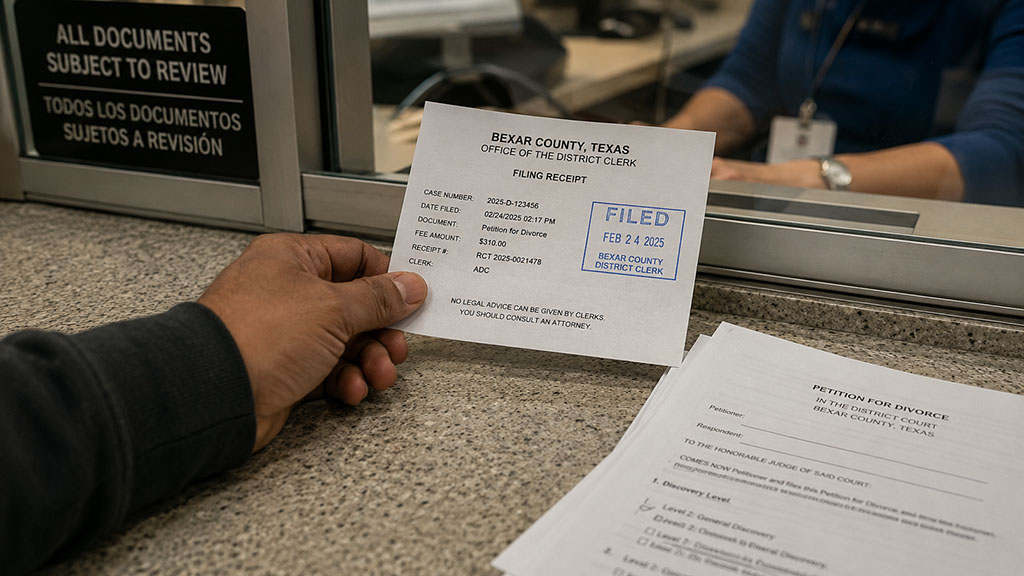
The Bexar County District Clerk charges $350 to file an Original Petition for Divorce, or $401 if the couple has children together, according to the District Clerk’s published fee schedule. The fee is flat and does not change based on whether you and your spouse agree.
| Filing Type | Fee |
|---|---|
| Divorce or annulment, no children | $350.00 |
| Divorce or annulment, with children | $401.00 |
If your spouse will not sign a waiver of service, add the cost of getting them served. Bexar County charges $100 to issue and serve a citation through the Sheriff’s office, and the same $100 for service by certified mail with restricted delivery. If you use a private process server or a constable instead, the District Clerk charges $8 to issue the citation and the server bills their own fee on top of that. Certified copies of the final decree cost $5 per document plus $1 per page for the first 10 pages and $0.10 per page after that, and you will likely need more than one for banks, title companies, or a name change.
Attorney Fees for an Uncontested Divorce
Many Texas family lawyers charge a flat fee for an uncontested divorce instead of billing by the hour. That’s because the work is usually more predictable when both spouses have already agreed on the terms. Brandi Wolfe Law offers a flat fee uncontested divorce for cases that genuinely qualify.
For a simple uncontested divorce in the San Antonio area, attorney fees may range from a few hundred dollars to the low thousands. The price usually depends on whether the case involves children, a house, retirement accounts, or other property that has to be divided correctly in the final decree.
The cost can increase quickly when “we agree on everything” really means you had a conversation but never worked out the details in writing.
A flat fee will often cover preparing the petition, final decree, and required parenting or property documents, along with a limited number of revisions before the final hearing. It usually does not include contested hearings, extra court appearances, major changes after the case is filed, or a separate order needed to divide a retirement account.
Hidden Costs That Surprise People
- Retirement account division. Splitting a 401(k) or pension usually requires a separate qualified domestic relations order, which carries its own drafting fee on top of the divorce itself.
- Real estate transfer. Moving a house out of one spouse’s name typically requires a deed prepared and filed with the county, which is not included in a basic decree.
- Extra certified copies. Lenders, the Social Security Administration, and the DMV often each want their own certified copy of the decree.
- Mediation. If you thought you agreed on everything and discover a gap once the paperwork gets specific, a mediator’s fee can resolve it faster than letting the case turn contested.
How Long Does an Uncontested Divorce Take in Texas?
Texas Family Code Section 6.702 bars a court from granting any divorce, uncontested or not, before the 60th day after the petition is filed. The only exception applies when the court finds the respondent has a final conviction or deferred adjudication for a family-violence offense connected to the marriage. Outside that narrow exception, the 60-day clock runs no matter how fast both spouses agree.

Sixty days is the legal floor, not a realistic estimate. In practice, most uncontested divorces in Bexar County take closer to two to four months from filing to final decree once you account for drafting and signing the settlement paperwork, waiting for a waiver of service or completing formal service, and getting a slot on a court’s docket for the final hearing. Some Bexar County courts book these short hearings weeks out, especially during busy filing periods, so the calendar gap between “we are ready” and “it is final” is usually the waiting period plus a scheduling delay, not the waiting period alone.
What You Need Before You File
A smooth uncontested divorce depends on having the substance settled before the paperwork starts, not during it. Before you file, get these in writing:
- A complete property and debt agreement. Every account, vehicle, piece of real estate, and outstanding debt, not just the big-ticket items.
- A parenting plan and possession schedule if you have children together, spelled out by specific days and holidays rather than a general understanding.
- Correct legal descriptions for real property, pulled from the deed rather than written from memory.
- A full inventory of retirement and investment accounts, including account numbers and current balances.
- A signed waiver of service from your spouse, or a plan to have them formally served if they will not sign one.
- A final decree draft that matches everything you actually agreed to, word for word, not a template with the blanks filled in loosely.
One more thing to know before you file. Bexar County puts a standing order in place the moment your case is opened, and it limits what both spouses can do with money, property, and the children while the divorce is pending. It applies whether you agree on everything or not.
What Bexar County Divorce Forms Do and Do Not Cover
This is where most self-filed divorces stall. People look for a Bexar County divorce packet, find the District Clerk’s forms page, and assume the petition and decree are in there.
They are not.
The District Clerk’s forms page gives you the administrative paperwork that has to travel with your case. It does not give you a fill-in-the-blank Original Petition for Divorce or a Final Decree of Divorce. Those are drafted from scratch for your specific agreement, and they are the two documents that actually decide who gets what.
What the county does provide for divorce and parent-child cases:
- The Civil District Judge’s Standing Order. This has to be attached to every new divorce petition and every new suit affecting the parent-child relationship. Not optional, not situational.
- Inventory and Appraisement, Exhibit A. The county’s format for listing property and debt.
- Income and Expense Sheet, Exhibit B. Used when support or maintenance is part of the case.
- Rules for Mediation, Exhibit C. Relevant if a gap in your agreement sends you to a mediator.
- Civil Case Information Sheet. Filed with the petition, with separate instructions available.
- Request for Process. How you ask the clerk to issue a citation when your spouse will not sign a waiver.
The clerk also publishes Pro Se Hearing Guidelines and a Pro Se Acknowledgement Form for people representing themselves. Read both before your final hearing if you are handling the case alone. They tell you what the court expects when you stand up without a lawyer, and judges notice when someone has clearly not looked at them.
Worth being blunt about the gap. The forms the county hands you are the easy part. The petition and the decree, the two documents nobody gives you a template for, are where a self-filed divorce either works or quietly creates a problem you find out about years later.
For where to take the paperwork once it is ready, the Bexar County filing process covers the clerk’s office, what to bring, and what happens at each step after you file.
What a Self-Prepared Divorce Decree Can Cost You Later
A divorce decree is not a summary of what you agreed to. It is the court order that controls what each person owns and owes once the case is closed.
Some very simple cases can be handled without a lawyer, especially when there are no children, no house, no retirement accounts, and very little property or debt to divide.
The risk is everything that looks simple now but creates a problem later.

If the wording is vague, incomplete, or leaves out an asset, the court may not be able to fix it later.
For example, forgetting to identify a retirement account can mean the account never gets legally divided. Failing to clearly address spousal maintenance can create an argument after the divorce is final. Military retirement has its own rules, and a standard online form may not divide it correctly at all. How retirement assets get divided in a San Antonio divorce is worth understanding before you sign anything.
These mistakes usually do not become obvious when you sign the papers. They show up months or years later, when someone tries to refinance the house, retire, sell property, or finally collect the asset they thought they were awarded.
A review of the property division terms before you file, even for an otherwise self-prepared case, is usually far cheaper than fixing a decree after the fact. If you would rather have someone handle the filing itself, the uncontested divorce process at Brandi Wolfe Law is built around cases where the spouses have already agreed and just need it done correctly.
Common Mistakes That Turn an Uncontested Divorce Into a Contested One
A divorce does not have to start with a big fight to become contested. Sometimes all it takes is one detail nobody fully worked out before the paperwork was filed.
Most of the time, the spouses thought they agreed. The problem is that they only agreed in general terms. Once the forms start asking specific questions, the gaps show up.
Relying on verbal agreements. “We already talked about it” is not enough. Until the agreement is clearly written into the final decree, it is not something the court can enforce. And once the paperwork starts, people often remember those conversations very differently.
Dividing assets but forgetting the debt. Couples may decide who keeps the house, cars, and bank accounts but never spell out who is responsible for the credit cards, personal loans, or remaining car payments. That unresolved debt can become the first real dispute in the case.
Leaving retirement accounts for later. Retirement accounts are often among the largest assets in a marriage. Putting them off or leaving them out of the agreement can create a much bigger problem when it is time to draft the decree.
Making a handshake deal about the children. Saying you will “split time fairly” is not the same as having a clear possession schedule. Holidays, school nights, pickup times, travel, and decision-making all need to be addressed in a way the court can enforce.
Once a real disagreement appears, the case moves onto the contested track. That usually means more paperwork, more time in court, and more money than it would have taken to work through the details before filing.
FAQs about Uncontested Divorce in Texas
Can both spouses use the same lawyer for an uncontested divorce in Texas?
No. Texas rules of professional conduct don’t allow one lawyer to represent both spouses in a divorce, since their interests are legally adverse even when they agree on every term. One spouse can hire an attorney to prepare the decree while the other reviews it independently or proceeds unrepresented.
Can you get an uncontested divorce finalized in less than 60 days in Texas?
Only if the court finds the respondent has a final conviction or deferred adjudication for a family-violence offense tied to the marriage, under the narrow exception in Section 6.702. Outside that exception, the waiting period applies regardless of how quickly both spouses agree.
What happens if my spouse will not sign the waiver of service?
The petitioner can have the respondent formally served through a county constable or a private process server, which adds a service fee and a little time. It does not make the case contested on its own as long as the response still agrees with the terms once served. Refusing to sign the decree is a different problem, and there are options when an ex will not sign the divorce papers.
Can I change my last name as part of an uncontested divorce?
Yes. A request to restore a prior legal name can be included in the final decree without paying a separate filing fee, but it has to be requested in the petition or decree language rather than added later through its own filing. The Bexar County District Clerk does charge $10 for the change of name certificate itself, which you will want for the Social Security Administration and the DMV.
Do uncontested divorces still require a court appearance?
Yes. Texas requires at least one spouse to appear at a short final hearing, where the judge confirms under oath that the terms are fair and were agreed to voluntarily, even when nothing about the case is disputed.
What if we agree on everything except what happens to the family pet?
Texas law treats pets as property rather than as children subject to custody. A dispute over the family dog technically makes the case contested until it is resolved, even if every other term is already settled. Here is how pet custody actually works in a Texas divorce.
Can you change an uncontested divorce decree after it is final?
Property division in a final decree is generally not modifiable once it is signed, so mistakes in that section usually require a separate legal action to fix rather than a simple correction. Terms involving children, such as possession schedules and child support, can be modified later if circumstances change and the change meets the legal standard for a modification.
Ready to Get Your Uncontested Divorce Done Right?
An uncontested divorce can save you time, money, and stress, but only if the agreement is complete and the paperwork says exactly what you think it says.
Brandi Wolfe Law helps San Antonio spouses handle agreed divorces without overlooking the house, retirement accounts, debt, parenting terms, or other details that can create expensive problems later. Some clients want the entire process handled. Others just want an attorney to review an agreement they already worked out. Either way, we can help you finish it correctly the first time.
Call (210) 571-0400 or schedule a free consultation with Brandi Wolfe Law, PLLC.