

A Texas teenager has to go to court-ordered visitation unless the order itself says otherwise. A teenager can share an opinion in a custody case, but that opinion doesn’t override the court order.
There is no age under 18 at which a child can legally decide to skip the schedule, even when your teen would rather be at work, at practice, or with friends. The parent who has the teenager is generally responsible for making the child available for the other parent’s possession period.
What can change is the order itself. A maturity clause is a section some Texas family lawyers write into custody orders so a teenager gets some say over certain weekends. You won’t find the term in the Texas Family Code. It’s language written into the order, and how much flexibility it gives depends on the exact wording.
Can a Texas Teenager Refuse Court-Ordered Visitation?
Not on their own. No Texas statute gives a child the right to opt out of a possession order at 12, 14, 16, or any other age. Texas Family Code Section 101.003 defines a child as a person under 18 who hasn’t married or had the disabilities of minority removed, and the possession order tells the parents what to do, not the child.
In a standard possession order, the parent who has the child is ordered to surrender the child to the other parent at the start of each period of possession under Section 153.316. TexasLawHelp’s guide to court-ordered visitation says the custodial parent generally must make the child available for the visit. It also notes that an order can include language letting the child choose not to visit, and then the child may make that choice.
Safety is a separate question. If a teen is refusing because of a fear of abuse or neglect, that same guide points the parent toward protective steps such as a CPS report or a request to modify the order.
What Happens if Your Teen Doesn’t Go
The other parent can file a motion for enforcement. Under Section 157.001, a court can enforce any provision of a temporary or final order, including by contempt, and TexasLawHelp lists fines, fees, and even jail time among the possible penalties.
The motion names a parent, not the teenager. Whether a judge actually finds that parent in contempt depends on the facts and on what the order says. A parent may feel they can’t force a 16-year-old to go, but the order doesn’t include that exception.
If the other parent repeatedly fails to make the teenager available, document each missed possession period, what was said, and when.
Where Your Teen’s Opinion Does Count
A judge can hear from your teen directly. Under Section 153.009, in a nonjury trial or hearing, the judge must interview a child 12 or older in chambers when a party, the amicus attorney, or the child’s attorney ad litem asks, but that required interview covers conservatorship and who gets the exclusive right to designate the child’s primary residence.
Possession is handled differently. Section 153.009(b) says the judge may interview a child of any age about possession and access, on request or on the court’s own motion. The judge doesn’t have to.
Either way, the interview doesn’t take away the judge’s discretion to decide what’s in the child’s best interest. In a jury trial, the judge can’t interview the child about an issue the jury is entitled to decide. The judge may consider your teenager’s preference, but the teenager does not get to decide the schedule.
Why a Teenager’s Schedule Can Conflict With Standard Visitation
When the parents live 100 miles apart or less, Section 153.312 gives the possessory conservator weekends beginning at 6 p.m. on the first, third, and fifth Friday of each month and ending at 6 p.m. the following Sunday. It adds Thursday evenings from 6 to 8 p.m. during the regular school term, unless the court finds that isn’t in the child’s best interest. Your order may use different start and end times, because Section 153.317 lets a conservator elect alternatives.

Texas law presumes that schedule is a reasonable minimum and in the child’s best interest under Section 153.252. The same weekend pattern applies at 6 and at 16.
A standard possession schedule can be hard to follow when a teenager works or has a heavy load of extracurricular activities. A Saturday shift or a weekend tournament doesn’t move because it’s the other parent’s weekend, and the teen can end up choosing between the schedule and the commitment.
Texas law allows courts to depart from the standard possession schedule in some circumstances. Section 153.253 tells the court to order possession as similar as possible to the standard order when the work schedule or other special circumstances of a parent or the child make the standard order unworkable or inappropriate. When a court departs from the standard order, Section 153.256 lets it consider the child’s age, developmental status, circumstances, and needs.
What a Maturity Clause Is
A maturity clause is a section of your custody order that gives your teenager some say in visitation. There’s no single standard version.
A maturity clause is not defined in the Texas Family Code. Its effect comes from the language written into the custody order. It’s the kind of opt-out language TexasLawHelp describes, written for specific periods and specific reasons.
One Option: Require One Weekend Each Month
One version of a maturity clause can keep some visitation required. If the non-primary parent has the first, third, and fifth weekends, the clause might keep the first weekend required while making the third and fifth weekends optional when the teenager has a conflicting activity.
That keeps one weekend a month with the other parent while leaving the other weekends open for a job, a game, or a school event.
A Broader Clause: Optional Weekends, Required Holidays
A broader maturity clause can make the first, third, and fifth weekends optional while keeping holidays required. That gives the teenager the most control over regular weekends while keeping the holiday schedule in place.
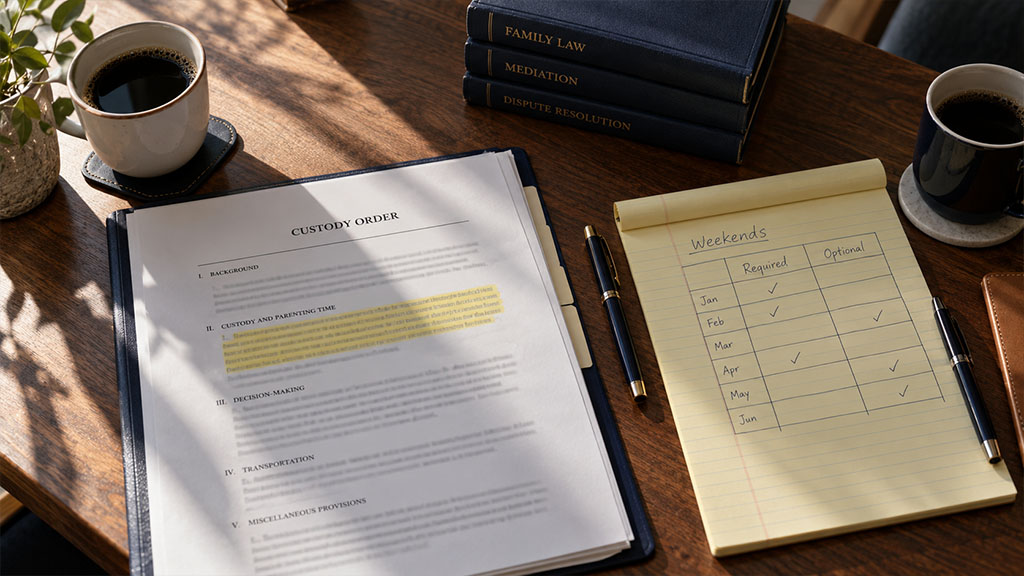
Here’s how the two versions compare with the standard weekend schedule:
| Period | Standard possession order | Clause with a required weekend | Broad clause |
|---|---|---|---|
| First weekend | Required | Required | Optional |
| Third and fifth weekends | Required | Optional if the teen has something scheduled | Optional |
| Holidays | Per the order’s holiday schedule | Set by the rest of the order | Required |
How a Maturity Clause Gets Into Your Order
If both parents agree, they can ask the court to include the clause in the order. The Family Code gives parents at least two ways to do that.
An Agreed Parenting Plan
Section 153.007 lets parents sign a written agreed parenting plan covering conservatorship and possession, including variations from the standard possession order. If the court finds the plan is in the child’s best interest, it renders an order that follows it. Once it’s in the order, those terms can be enforced like any other part of the judgment, including by contempt.
A Mediated Settlement Agreement
Courts can send custody cases to mediation under Section 153.0071. A mediated settlement agreement is binding if it states in bold, capital letters, or underlining that it is not subject to revocation, and it’s signed by each party and by each party’s attorney who is present.
When those requirements are met, a party is entitled to judgment on the agreement. A court can decline to enter it only in narrow situations involving family violence that impaired a party’s decision-making, or terms letting a person with a history of abuse, or certain registered sex offenders, live with the child or have unsupervised access, and only if it also finds the agreement isn’t in the child’s best interest.
You, your attorney, and possibly the mediator can write a clause that fits your teenager’s actual schedule.
When the Other Parent Won’t Agree
If the parents cannot agree, the court can decide whether the possession schedule should be changed. Sections 153.253 and 153.256 give the court authority to depart from the standard order for a teenager’s circumstances, but nothing in the Family Code requires a judge to include a maturity clause. The court will need specific facts about why the current schedule no longer works, such as a job, sports season, school activities, or other recurring commitments.
Be Specific About How the Clause Works
Vague wording like “optional if the child has something” can lead to arguments about what counts. Under Section 157.421, a court can clarify an order that is not specific enough to be enforced by contempt. That means another trip to court over wording that could have been settled when the order was written.
A clear maturity clause answers these questions:
- Who decides to skip? The teen, the teen with one parent’s agreement, or both parents.
- What counts as a conflict? A work shift, a game, a practice, a school event, or any plans at all.
- How much notice? A set deadline before the weekend starts, and how that notice is given.
- Which periods stay required? Weekends, Thursday evenings, holidays, and summer each need an answer.
- Is missed time made up? Whether the other parent gets make-up time for skipped weekends.
The order should also address transportation. Whether the other parent must take the teenager to an activity during their possession time depends on what the order requires.
Adding a Maturity Clause to an Order You Already Have
An informal deal with your co-parent doesn’t change your order. TexasLawHelp’s guide to changing a custody order is direct about it: the existing order stays in effect until a judge signs a new one, and a parent who stops following it could face penalties.

If you both agree, the clause can go into an agreed modification order for the judge to sign. If the other parent won’t agree, Section 156.101 lets a court modify possession when the change is in the child’s best interest and the circumstances of the child, a conservator, or another party affected by the order have materially and substantially changed since the order was rendered or since the mediated agreement it’s based on was signed. Whether a new job or a demanding sports schedule meets that standard depends on the facts.
Our San Antonio custody modification attorneys handle these cases in Bexar County courts, and our guide on how to modify a custody order in Texas walks through the filing process.
FAQs about Teenagers and Texas Visitation Orders
These come up once parents start rethinking a teen’s schedule.
Does the Thursday evening visit still apply to a teenager?
Yes, unless your order says otherwise. The standard order’s Thursday period doesn’t change with the child’s age, and it continues through the regular school term unless the court found it isn’t in the child’s best interest. If Thursdays are the real conflict, a maturity clause or a modification can address them specifically.
What if we never had a custody order?
Then there’s no visitation schedule to follow or enforce. TexasLawHelp explains that without a court order, both parents have equal rights to the child, and there’s no way to force visitation. Parents can get a custody and possession order in place through a SAPCR filed without a divorce.
When does the visitation schedule stop applying to my teen?
A possession schedule governs a child, and Texas defines a child as a person under 18 who hasn’t married or had the disabilities of minority removed. Once your teen turns 18, the schedule no longer controls where they spend weekends. Child support has its own separate rules about when it ends.
Changing a Schedule That No Longer Works
A schedule that worked when your child was younger may not fit a teenager’s job or activities. Changing it takes a new court order, not an informal agreement. Brandi Wolfe Law can review your current order and help you determine whether a modification makes sense for your teenager’s schedule.
Call Brandi Wolfe Law, PLLC at (210) 571-0400 or get a free strategy session to talk through your options.