
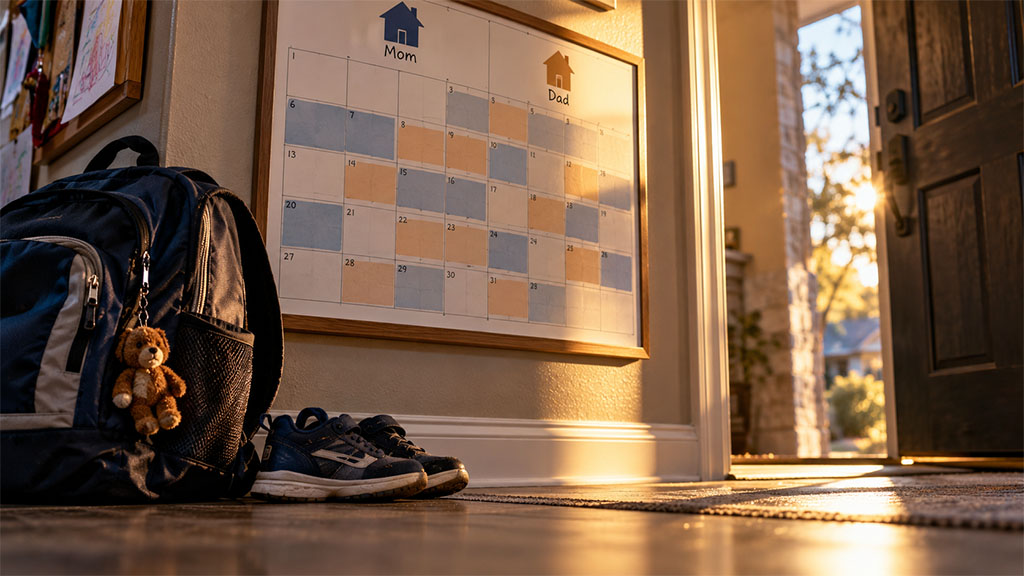
Legally, nothing. Texas law doesn’t have a “primary parent.” What a Texas custody order can give one parent is the exclusive right to designate the child’s primary residence, and in May 2026 the Texas Supreme Court said calling that parent the “primary parent” has no basis in the statute.
So losing that designation doesn’t mean losing your child. But it isn’t an empty label either. In Gopalan v. Marsh, the Court held that a child’s primary residence can’t be a home where the child lives less time than somewhere else. When a jury gives one parent that right, the judge can’t hand the other parent more possession time.
Custody in Texas Is Three Separate Decisions
In Texas, custody generally involves three separate issues. They are related, but a custody order addresses each one separately.
- Conservatorship. Who makes the big decisions about the child, like medical care and schooling, which we call heads and meds.
- The primary residence designation. Which parent has the exclusive right to decide where the child lives.
- Possession and access. This is the schedule that determines when each parent has the child.
The Family Code also treats these as separate issues. When a Texas court orders both parents to be joint managing conservators, Texas Family Code Section 153.134(b) requires it to designate the parent with the exclusive right to determine the child’s primary residence, specify each parent’s rights and duties for the child’s physical care, support, and education, and divide the remaining parental rights independently, jointly, or exclusively.
A parent who does not have the right to designate the child’s primary residence can still have significant decision-making rights. That parent still gets rights and duties spelled out in the order, and depending on how the order divides them, can hold decision-making rights alone or shared with the other parent. Our San Antonio child custody attorneys handle all three issues, not just the residence question.
What Gopalan v. Marsh Decided
The Court framed the central issue as whether a trial court’s possession order went against a jury’s verdict on the primary residence right.
The Case
In a Texas divorce, a jury found that the father should have the exclusive right to designate the children’s primary residence within Travis County. The trial court’s decree then gave the mother more possession time, about 57%, along with the majority of the exclusive parental rights. A divided court of appeals affirmed, reasoning that the decree followed the letter of the verdict and nothing required the parent with the residence right to get more time.
The Supreme Court of Texas reversed on May 22, 2026. You can read the Texas Supreme Court’s opinion in Gopalan v. Marsh (No. 25-0161), written by Justice Devine, on the court’s website.
The Holding
The Court read “primary residence” the way an ordinary person would: the place where someone lives most of the time.
“The ordinary meaning of ‘primary residence’ does not encompass a home where the child lives less time than elsewhere.” Gopalan v. Marsh, Supreme Court of Texas (2026)
Under Texas Family Code Section 105.002(c), a court can’t contravene a jury verdict on which joint managing conservator has the exclusive right to designate the child’s primary residence. The same section bars asking the jury about a specific term or condition of possession. So the Court held that the verdict doesn’t dictate a specific term of the schedule. It imposes a general constraint on the schedule the judge sets. A decree that gives the other parent more time violates that constraint.
The Court sent the possession order back to the trial court to be redone. It also reversed the child support award and the split of parental rights and duties so the trial court could reconsider them with the new schedule.
Why the Court Rejected the “Primary Parent” Label
One party repeatedly called the parent with the residence right the “primary parent.” The Court rejected that label, writing: “We emphatically reject this conflation, which has no textual basis.”
The Court didn’t downplay the right itself. It said the significance of the primary residence right “cannot be doubted,” but that assigning it “reflects a best-interest consideration, not a hierarchical ordering of the parents in rank or importance.” It added that courts and litigants should stop using shorthand like “primary parent” that carries “contentious value judgments untethered from any legal grounding.”
A lot of people think that word “primary” is a huge deal. Legally, it names a right about the child’s home. It doesn’t rank you as a parent.
Does “Primary” Mean More Time? What the Designation Still Controls
But the designation still has an important effect on possession time. Even though Texas law does not recognize the label “primary parent,” the right to designate primary residence is still important.

Where the Child Actually Lives
Under Gopalan, a child’s primary residence, in the ordinary sense of the phrase, isn’t a home where the child lives less time than elsewhere. In the jury case the Court decided, that meant the judge couldn’t give the other parent more possession time.
Equal time is still allowed. The Court pointed to Section 153.135, which says joint managing conservatorship doesn’t require equal or nearly equal possession, and read it to mean equal time is permissible. But there can be only one primary residence. Even with equal time, the Court said a schedule can still contravene the verdict if it’s structured so the designated home isn’t really primary.
School Is a Related but Separate Question
It’s easy to assume “primary” is only about which school the child attends. The Court rejected that narrow reading and noted that children may generally attend a public school where either parent resides.
The Family Code treats school as its own right. In the list of a sole managing conservator’s rights in Section 153.132, the right to designate the child’s primary residence and the right to designate and enroll the child in school are separate items.
The Geographic Restriction
Section 153.134(b)(1) requires a joint conservatorship order to do one of two things with the residence right: set a geographic area where the child’s primary residence has to stay, or say the parent can choose the residence without regard to location. A custody order may limit the child’s primary residence to a specific geographic area. If you hold the right, the boundary in your order limits where you can use it.
Losing the Designation Is Not Losing Your Child
If the other parent ends up with the residence right, you can still be a joint managing conservator. You can still hold decision-making rights, independently or jointly, depending on how the order allocates them. And your possession schedule can be substantial.
When a jury gives one parent the right to designate primary residence, the judge cannot give the other parent more possession time. Equal time can still be possible. It isn’t guaranteed, because Section 153.135 says joint conservatorship doesn’t require it.
The more important question is what rights and possession schedule the order gives each parent, and what the evidence supports. Here’s how custody plays out for mothers worried about custody during a Texas divorce and for fathers asserting their custody rights in San Antonio.
Does Gopalan Apply if a Judge Decides Instead of a Jury?
The holding is about jury verdicts. The case came up under Section 105.002(c), which bars a court from contravening a jury’s answer on the primary residence right. The opinion doesn’t address bench trials or agreed orders.
The Court’s reading of “primary residence” is a reading of Family Code language, and that same phrase appears in orders a judge signs without a jury. Whether and how courts apply that reading outside a jury verdict is a question the opinion didn’t decide.
Texas parties can generally demand a jury in a custody case under Section 105.002(a), with exceptions for adoption and parentage suits. The jury can decide who gets the residence right and whether there’s a geographic restriction. It can’t set the specific possession schedule. That’s still the judge’s job, now within the limit Gopalan describes. Whether to request a jury depends on the specific issues in the case.
What to Look at Before Focusing on the “Primary” Label
Before making the primary-residence designation the focus of the dispute, look at:
- Read the order you have now. Find who holds the exclusive right to designate primary residence, the geographic area, and the possession schedule.
- Decide what you actually need. The residence right, decision-making rights, and possession time are separate. Know which ones matter most for your child.
- Make sure the possession schedule is consistent with the primary-residence designation. After Gopalan, a jury’s designation and a schedule giving the other parent more time can’t both stand.
- If your case is already final, look at modification rules. Changing an existing order has its own standards. Start with how to modify a custody order in Texas.
FAQs about the Primary Residence Right in Texas
Does every joint custody order have to name one parent with the primary residence right?
Not always. When parents file a written agreed parenting plan, Section 153.133(c) lets the court adopt it if it says the child’s primary residence will be within a specified geographic area and meets the section’s other requirements. When a court orders joint conservatorship without that kind of agreement, Section 153.134(b)(1) requires it to designate one parent.
Is having the primary residence right the same as sole custody?
No. A sole managing conservator has the right to designate the child’s primary residence plus a list of other exclusive rights under Section 153.132, unless the court order limits them. A joint managing conservator with the residence right shares conservatorship with the other parent, and the other rights get divided in the order.
Can my 12-year-old decide who gets the primary residence right?
Not on their own. If the child is 12 or older, Section 153.134(a)(6) makes the child’s preference about who should have the residence right one factor in deciding whether joint conservatorship is in the child’s best interest. The court’s primary consideration is still the child’s best interest.
Can the primary residence designation be changed later?
Yes, through a modification. Under Section 156.101, the change has to be in the child’s best interest, and one of three grounds has to apply: a material and substantial change in circumstances, a child 12 or older telling the judge in chambers who they want to have the residence right, or the designated parent voluntarily giving up primary care and possession of the child to someone else for at least six months. That last ground has an exception for military deployment and similar duty. If you file within a year of the order, Section 156.102 also requires a supporting affidavit before the court will set a hearing.
What the Primary Residence Right Actually Controls
The label itself won’t decide your case. What matters is the rights, the residence designation, and the possession schedule in your order. Brandi Wolfe Law can review your current or proposed custody order and explain how the primary-residence designation, geographic restriction, and possession schedule affect your case.
Call Brandi Wolfe Law, PLLC at (210) 571-0400 or schedule a free consultation before you agree to a custody term you haven’t fully read.