

It depends on what you want the judge to do. An enforcement asks the court to make your ex follow the order you already have, and to impose consequences for the times they didn’t. A modification asks the court to change the order itself. They’re separate requests with separate proof, and filing the wrong one won’t get you what you need. Some parents need both at the same time. The real question is which problem you’re trying to fix first.
What an Enforcement Does
An enforcement is about the past. Your ex was supposed to do something under the order and didn’t. You want the court to deal with that.
Texas is picky about how this gets filed. Under Family Code section 157.002, a motion for enforcement has to identify the exact provision your ex allegedly violated, describe how your ex failed to comply, and say what relief you want. For missed or blocked visits, it has to list the date and location of each one, plus the time where that’s relevant. Brandi says it plainly: “Enforcements are super detailed.”
To get contempt, the order has to be specific enough to enforce that way. If it isn’t, the court can issue a clarification order that spells things out so contempt is possible going forward.
Service rules matter too. When the motion is about possession of or access to a child, your ex generally has to be personally served with the motion and the hearing notice at least 10 days before the hearing, under section 157.062. A service problem can delay the hearing.
What Can Happen to the Parent Who Violated the Order
A judge can hold a parent in contempt. Outside justice and municipal courts, the punishment for each contempt can be a fine of up to $500, up to six months in county jail, or both. Whether any of that happens depends on the evidence and the judge.
What a Modification Does
A modification is about the future. You’re asking the court to rewrite the schedule, change who decides where the child lives, or adjust other terms because the current order no longer fits.
That takes a different kind of proof. Under Family Code section 156.101, the change has to be in the child’s best interest, and you also have to show one of the grounds the statute lists. The first is a material and substantial change in the circumstances of the child, a conservator, or another affected party since the order was rendered, or since the mediated or collaborative settlement it was based on was signed, whichever came first. Asking to change who decides where the child lives within a year of the order (or of the mediated settlement it’s based on, if that came first) is harder still: section 156.102 requires a sworn affidavit with specific supporting facts before the court will even set a hearing.
Repeated violations can be part of that picture. The judge is still deciding what’s best for the child going forward, which is a broader question than whether your ex broke the rules. For a full walk-through of the standard, see how to modify a custody order in Texas.
Enforcement and Modification Side by Side
As Brandi put it when comparing the two, “These are not the same.”
| Enforcement | Modification | |
|---|---|---|
| What you’re asking for | Make your ex follow the existing order and address past violations | Change the order going forward |
| What you have to show | The specific provision, and each violation with dates and details | Best interest plus a ground the statute lists, like a material and substantial change |
| Possible outcomes | Contempt, makeup possession time, or other remedies the court allows | A new schedule, new decision-making rights, or other changed terms |
| Looks at | What already happened | What’s best for the child from here on |
Can You File Both at Once?
Yes. Under section 157.003, a person asking for enforcement can join other claims and remedies in the same proceeding, and filing an enforcement doesn’t lock you out of other options.

Whether you should combine them is a strategy call. Sometimes an enforcement alone gets the other parent back in line. Sometimes the violations happen because the order doesn’t work anymore, and fixing the order is the point. Your attorney should look at both before anything gets filed, including which one to file first.
What to Write Down Before You Call an Attorney
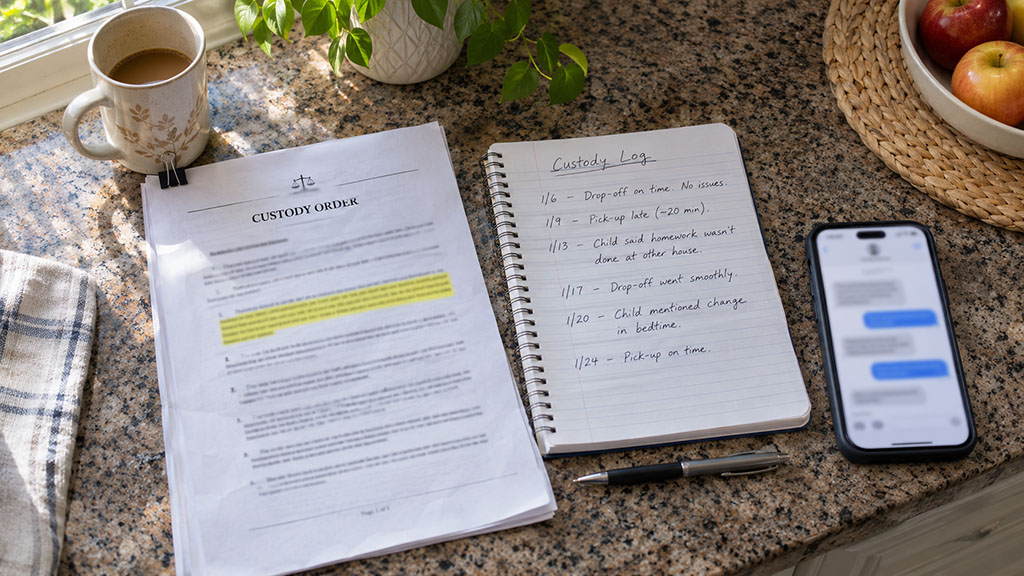
You can save yourself time and money by showing up organized. An enforcement needs details you won’t remember six months from now, so start a log today.
- Each missed or blocked visit. Write down when and where each exchange was supposed to happen.
- What was said. Save texts and emails about the exchange, especially any excuse your ex gave.
- The order itself. Find the exact paragraph you think was violated and keep a copy handy.
- Any agreement you made. If you two agreed to a different arrangement for a particular weekend, write that down too.
That last one matters. Under section 157.007, a parent accused of violating possession can raise a defense to contempt by showing that the parent filing the enforcement voluntarily gave up possession for that same period. An informal swap you agreed to can come back at you.
Mistakes That Backfire
The worst one is answering a violation with your own. Keeping the kids from your ex because they kept them from you can hand them an enforcement case against you. Keep following your order even when the other side isn’t.
Don’t file an enforcement built on vague language and hope the judge reads it your way. Have an attorney read the order first. And don’t let violations pile up for a year. Details fade, and every missed weekend is time with your child that’s hard to make up.
FAQs about Custody Enforcement and Modification in Texas
Here are short answers to three related questions.
What if my custody order is too vague to enforce?
The court can clarify it. Under section 157.421, the judge can issue a clarification order with specific terms so it can be enforced by contempt later. Clarifying the order doesn’t change the finality of the original one.
Will my ex go to jail for violating the order?
Jail is possible, but nothing about it is automatic. Each contempt finding can carry jail time up to six months, a fine up to $500, or both. What the judge actually does depends on the facts proven at the hearing.
Does a modification fix past violations?
Not by itself. A modification changes the order going forward. To address violations that already happened, you can file an enforcement, and it can be filed in the same proceeding.
Not Sure Which One to File?
If your ex keeps ignoring the order, the answer might be enforcement, modification, or both, and the order you file them in matters. Brandi Wolfe Law helps San Antonio parents sort out which case fits the problem, then builds it with the details these filings require. Call (210) 571-0400 or set up a free consultation and read more about custody modification in San Antonio.