

How Unmarried Parents Establish Custody Rights
I got a call recently “We were never married, so how do I actually get custody?” The answer is a SAPCR, short for Suit Affecting the Parent-Child Relationship. It’s the case Texas uses to set custody, visitation, and child support when there’s no divorce involved. If you’re an unmarried parent, a separated parent who isn’t divorcing, or a non-parent who’s been raising a child, a SAPCR is the case you file. It’s a standalone proceeding in family court, governed by the Texas Family Code, and it operates on its own track separate from any other family law matter. The orders that come out of a SAPCR carry the same weight as orders from a divorce.
What a SAPCR Actually Is in Texas
A SAPCR is a Texas family court case that sets the legal terms of a child’s life when there’s no divorce in the picture. The acronym stands for Suit Affecting the Parent-Child Relationship, and it’s authorized under Chapter 102 of the Texas Family Code. You’ll sometimes hear it called an “original suit” because in most cases, it’s the very first court order ever entered for that child.
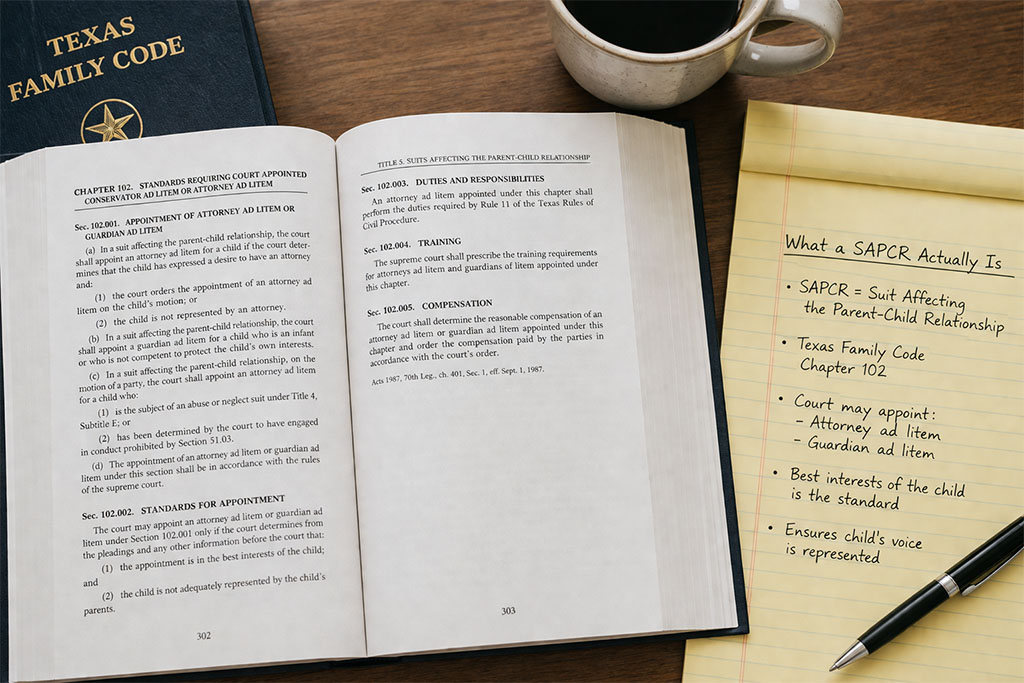
The point of a SAPCR is to put real, enforceable orders in place. Verbal agreements between parents have no legal weight in Texas. Without a court order, either parent can change the arrangement on a whim, and there’s nothing the other parent can do about it short of filing a case. A SAPCR fixes that by giving both sides clear, written rules the court can enforce.
A SAPCR addresses four core issues:
- Conservatorship. Who has legal decision-making authority over the child.
- Possession and access. When each parent has the child and how holidays, summers, and weekends get divided.
- Child support. Monthly payments calculated under Texas guidelines.
- Medical and dental support. Who carries health insurance and how uncovered costs get split.
What a SAPCR does not address: divorce, division of marital property, or spousal support. Those issues belong inside a divorce case. If you’re married and want to end the marriage, a SAPCR isn’t the right vehicle and you’ll want to look at our Texas divorce practice instead. If you’re not married, or you’re married but staying that way, a SAPCR is exactly the right vehicle.
For the full statute, the Texas Family Code is available on the Texas Legislature’s official site.
Who Can File a SAPCR
Before a court ever looks at custody, support, or visitation, it looks at one threshold question: do you have the legal right to be in court at all? That’s called standing, and it’s the first thing the other side will challenge if they think you don’t have it. No standing means no case. The judge dismisses the petition before the merits are ever heard, regardless of how strong your facts are. Standing rules live in Texas Family Code 102.003 and the sections that follow.

Parents
Either parent of the child has standing to file. It doesn’t matter if you were married, never married, or separated. It doesn’t matter who has been doing more of the parenting up to this point. If you’re a legal parent, the door is open. For unmarried fathers, paternity needs to be established at some point in the case, either before filing or as part of the SAPCR itself. Our paternity practice page explains how that process works.
Grandparents and Other Relatives
Grandparent standing is narrow and fact-specific. A grandparent generally needs to show either substantial past care of the child or evidence that the child’s current environment presents a serious risk of physical or emotional harm. Other relatives like aunts, uncles, or adult siblings face similar hurdles. Texas law presumes a fit parent’s decisions about who spends time with the child should be respected, and the standing rules reflect that presumption. For a deeper look, see our overview of grandparents’ rights in Texas.
Non-Parents With Actual Care
A non-parent who isn’t a relative can still have standing if they’ve had actual care, control, and possession of the child for at least six months, ending no more than 90 days before filing. This catches a lot of people off guard. The classic example is a long-term partner of a parent who has helped raise the child but has no legal relationship. If that person has been the day-to-day caregiver for six months or more, they may have standing. If they haven’t, they don’t.
When Standing Gets Contested
Standing fights are common, especially in non-parent cases and cases where one party claims the other hasn’t actually been involved in the child’s life. The challenge usually comes as a motion to dismiss for lack of standing, filed early in the case. If the court agrees, the case ends there. That’s why standing has to be the first thing analyzed, not an afterthought. Filing without it wastes time, money, and any leverage you might have had. The full standing statute is Texas Family Code Section 102.003.
SAPCR vs Divorce: When Each One Applies
The line between a SAPCR and a divorce trips people up constantly, including parents who’ve been told by friends or family to “just file for divorce” when they were never married. You can’t divorce someone you weren’t married to. And if you are married, custody usually rides inside the divorce instead of being filed as a separate SAPCR.
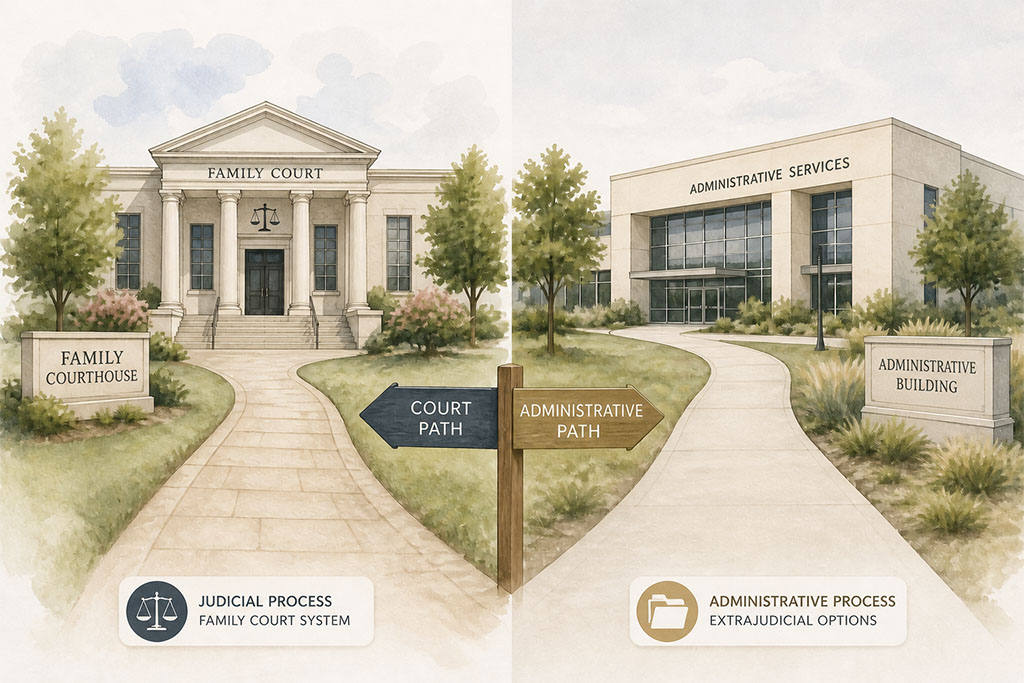
Here’s the simple version. If you’re unmarried and need custody orders, you file a SAPCR. If you’re married and ending the marriage, custody is decided as part of the divorce. If you’re separated but not divorcing, whether by choice, religious preference, immigration status, or any other reason, a SAPCR is how you get enforceable custody and support orders without filing for divorce.
| Use a SAPCR If… | Use a Divorce If… |
|---|---|
| You and the other parent were never married | You and the other parent are married and ending the marriage |
| You’re separated but not pursuing divorce | You need to divide marital property or debts |
| Paternity is established but no custody order exists | You need spousal support orders |
| You’re a non-parent seeking custody rights | You want one case to handle custody, property, and support together |
| You need to add custody orders to an existing paternity case | You want a final divorce decree |
A common scenario in Bexar County: parents who lived together for years, have kids together, and split up without ever marrying. They don’t need a divorce because there’s no marriage to dissolve. They need a SAPCR. Filing the wrong type of case wastes filing fees and delays getting orders in place.
What a SAPCR Decides
A SAPCR resolves four core issues, and each one is governed by its own chapter of the Texas Family Code. Conservatorship sits in Chapter 153, child support in Chapter 154. The court’s North Star throughout all of it is the best interest of the child, the legal standard that overrides almost every other consideration in a Texas family case.

Conservatorship (Legal Decision-Making)
Conservatorship is the legal term for parental rights and decision-making authority. It covers things like where the child goes to school, what medical care they receive, what religion they’re raised in, and where they live. Texas law presumes both parents should be Joint Managing Conservators, meaning rights and duties are shared between them. JMC is the default in most cases, but it doesn’t mean 50/50 time. It means shared decision-making.
Sole Managing Conservator status puts those decision-making rights in one parent’s hands. A court only orders SMC when the evidence shows it’s in the child’s best interest, typically in cases involving family violence, child abuse, neglect, substance abuse, or a parent’s prolonged absence from the child’s life. The other parent usually becomes a Possessory Conservator with visitation rights but limited decision-making power.
Possession and Access (the Visitation Schedule)
Possession and access is the visitation schedule. Texas law presumes a Standard Possession Order is in the child’s best interest for kids age three and older. The SPO gives the non-primary parent first, third, and fifth weekends, Thursday evenings during the school year, alternating holidays, and 30 days in the summer. Parents can opt for an Expanded Standard Possession Order, which extends those weekends and Thursdays into overnights. Custom schedules are allowed by agreement or court order, especially for special circumstances like work schedules, long-distance parenting, or kids with specialized needs.
Child Support
Texas calculates child support as a percentage of the obligor’s net resources. One child is 20%, two is 25%, three is 30%, and it scales from there. Net resources mean gross income minus federal income tax, Social Security tax, state income tax (where applicable), union dues, and the cost of the child’s health insurance premium. Guideline support applies up to a statutory cap that the Texas Attorney General adjusts every six years. Courts can deviate above or below guidelines when justified, like proven special needs, a parent’s intentional underemployment, or extraordinary expenses. The Texas Office of the Attorney General Child Support Division publishes the current cap and guideline tables.
Medical and Dental Support
Every Texas child support order has to include medical and dental support. The court designates one parent to carry health and dental insurance for the child, then assigns responsibility for uncovered costs, usually a 50/50 split. If neither parent has access to private insurance, the court can order coverage through Medicaid or CHIP. Skipping this section isn’t an option, it’s required by statute.
How to File a SAPCR in Bexar County
Filing a SAPCR in Bexar County follows a defined sequence. Skipping a step or doing one out of order can stall the case for weeks or get the petition kicked back. The basic flow looks like this.

- Confirm Standing and Venue. Before drafting anything, verify two things: that you have standing to file, and that Bexar County is the right venue. Texas law requires a SAPCR to be filed in the county where the child has lived for the past six months. If your child has lived in Bexar County for at least that long, you’re in the right place. If they’ve recently moved here, you may need to file in the previous county or wait until the six-month window is met.
- Draft and File the Original Petition. The original petition is the document that opens the case. It identifies the parties, the child, what orders you want the court to enter, and the legal grounds for those orders. Filing happens electronically through eFileTexas with the Bexar County District Clerk. Filing fees in Bexar County run a few hundred dollars, and a fee waiver is available for people who can’t afford to pay.
- Serve the Other Party. The other parent (or other respondent) has to be formally notified of the case. This usually happens through personal service by a constable or private process server. If the other side is cooperative, they can sign a Waiver of Service instead, which saves time and money. Without proper service, the court can’t move forward.
- Request Temporary Orders. Temporary orders govern custody, support, possession, and conduct while the case is pending, which can be many months. A temporary orders hearing is often the most important moment in a SAPCR because the orders entered there frequently become the template for the final orders. Going in without a strategy is one of the fastest ways to lose ground. Our breakdown of temporary orders in Texas family cases covers what to expect.
- Mediation. Most Bexar County family courts require mediation before a final hearing. Mediation is a confidential negotiation session led by a neutral third party, usually another family lawyer or retired judge. A meaningful percentage of SAPCRs settle in mediation, which avoids trial cost, delay, and the unpredictability of a judge’s ruling.
- Final Orders or Trial. If mediation produces a deal, both sides sign an Agreed Final Order and submit it to the court. If it doesn’t, the case goes to a contested final hearing or trial. The judge hears testimony, reviews evidence, and enters final orders. From there, those orders govern until somebody files to modify or enforce them.
A note specific to Bexar County: family cases here are heard in the Bexar County family district courts, and each court has its own local procedures, scheduling preferences, and standing orders. What flies in one court may not in another. Knowing the local landscape matters.
How Long a SAPCR Takes and What It Costs
Two of the first questions clients ask are how long this is going to take and how much it’s going to cost. Honest answers depend on whether the case is contested. The gap between an uncontested SAPCR and a contested one is significant, both in months and in dollars.

Uncontested Timeline
When both parties agree on every issue (custody, possession, support, medical support), an uncontested SAPCR can finalize in 60 to 90 days from filing. The process is largely paperwork: file the petition, get the other side served or have them sign a waiver, draft an Agreed Final Order, and submit it for the judge’s signature. Many uncontested cases never require a court appearance beyond a brief prove-up hearing.
Contested Timeline
A contested SAPCR is a different animal. Six months is the short end. A year or longer is common. Custody evaluations, expert witnesses, and high-conflict opposing parties stretch the timeline. Bexar County family court dockets are busy, and trial settings often get bumped. Temporary orders disputes early in the case also push things back.
What Drives Cost
Contested custody is the single biggest cost driver. The more the parties fight, the more hours the case takes. Other factors:
- Custody evaluations or social studies. Court-ordered evaluations run thousands of dollars and take months.
- Amicus or ad litem attorneys. When the court appoints a lawyer for the child, the parents split the cost.
- Expert witnesses. Psychologists, vocational experts, and forensic accountants all bill hourly.
- High-conflict opposing parties. Constant motions push costs up regardless of how reasonable your side is.
A straightforward agreed SAPCR might run a few thousand dollars. A heavily contested one can hit five figures. The difference isn’t the hourly rate, it’s the volume of work the case demands. If you’re dealing with a high-conflict or narcissistic opposing party, expect the higher end.
Modifying or Enforcing a SAPCR Order
A SAPCR order isn’t permanent. Kids grow, jobs change, parents move, and what made sense at the time of the original order often stops making sense a few years later. Texas law provides two distinct tools for dealing with that reality: modification and enforcement. They sound similar but solve different problems.

A motion to modify is the right tool when circumstances have changed and the order itself needs to be updated. Modifying conservatorship, possession, or child support requires showing a material and substantial change in the circumstances of the child, a parent, or another party affected by the order. Common examples include a parent relocating, a significant income change, a child’s developmental needs shifting, or a parent’s history of instability becoming relevant. See our page on custody and support modifications in Texas for a deeper look.
Texas courts will not modify a SAPCR order without a material and substantial change in circumstances since the date of the prior order. The standard exists to keep cases from being relitigated every time someone is unhappy with the result.
A motion to enforce is the right tool when the existing order is fine but the other party isn’t following it. Common violations include withholding the child during the other parent’s possession time, missing or shorting child support payments, refusing to share medical information, or breaking the geographic restriction in the order. Remedies include make-up possession time, judgment for unpaid support plus interest, attorney’s fees, and contempt of court, which can include jail time in serious cases.
The procedural rules for both are in Chapters 156 (modification) and 157 (enforcement) of the Texas Family Code.
Common Mistakes That Hurt SAPCR Cases
Some SAPCR cases are lost on the law and the facts. Plenty more are lost on self-inflicted wounds. The mistakes below come up over and over, and almost all of them are avoidable.

- Posting on social media. Anything you post (or get tagged in) can end up as a court exhibit. Judges read screenshots all the time.
- Ignoring temporary orders. Violating them early signals you won’t follow final orders either, and that perception is hard to undo.
- Hostile communication with the other parent. Texts and emails get printed and entered as evidence. Write everything like a judge will read it.
- Withholding the child as leverage. Self-help looks like contempt to a Texas family judge, regardless of what the other parent is doing.
- Filing without standing. Non-parents who skip the six-month rule get dismissed, and the filing fees are gone.
- Skipping the temporary orders hearing. Temporary orders often become the template for final orders. Walking in unprepared costs ground that’s hard to recover.
- Talking to the child about the case. Judges and custody evaluators view it as a sign of poor judgment.
- Hiding income or assets. Forensic accountants and discovery tools find what people try to hide, and getting caught torches credibility on every other issue.
If any of these are already in play in your case, the goal shifts from avoiding them to limiting the damage.

FAQs about SAPCR Cases in Texas
Do I need a lawyer to file a SAPCR?
You don’t have to, but representing yourself in a contested SAPCR is risky. The other side will likely have counsel, and procedural mistakes around standing, service, or temporary orders can cost you custody time or support dollars. Uncontested cases with full agreement are the only scenarios where going solo is reasonable.
Can a SAPCR be filed before paternity is established?
Yes. Paternity can be addressed inside the SAPCR itself or in a paired paternity action. If the mother is married to someone else when the child is born, the husband is the presumed father under Texas law, and that presumption has to be rebutted before the biological father is recognized.
What if the child lives in another state?
Texas can only decide custody if it qualifies as the child’s “home state” under the Uniform Child Custody Jurisdiction and Enforcement Act, generally meaning the child has lived in Texas for the past six consecutive months. If the child recently moved or splits time between states, jurisdiction has to be sorted out before the merits.
Can the other parent file in a different county?
The proper venue is the county where the child has lived for the last six months. If the other parent files somewhere else, the case usually gets transferred on a motion to transfer venue. Filing first doesn’t lock in the wrong county.
Does a SAPCR show up on background checks?
SAPCR cases are public court records but don’t appear on standard criminal background checks. They can surface in civil court record searches, which some employers and landlords run. Records are searchable through the Bexar County District Clerk’s office.
What if we already have an informal agreement?
Informal agreements aren’t enforceable in Texas. Without a court order, either parent can change the arrangement at any time, and law enforcement won’t get involved. A SAPCR is what turns the agreement into something a court will back up.
Can I file a SAPCR while we’re still living together?
Yes. Texas law doesn’t require parents to be separated before filing. People file while cohabiting to lock in support obligations or address decision-making conflicts that have escalated.
How is a SAPCR different from a paternity case?
A paternity case establishes who the legal father is. A SAPCR sets custody, possession, and support orders. The two often run together when an unmarried father wants both legal recognition and a court-ordered schedule.
Get a Texas SAPCR Attorney in Your Corner
A SAPCR sets the legal framework for your relationship with your child, and the orders that come out of it shape years of your life. Going in without a strategy, or going up against a represented opponent without your own counsel, leaves too much on the table.

The San Antonio family lawyers at Brandi Wolfe Law represents parents and non-parents in SAPCR cases across San Antonio and Bexar County. We handle uncontested filings, contested custody fights, high-conflict cases, paternity-paired SAPCRs, and modifications and enforcements of existing orders. If you’re filing one, defending one, or trying to clean up one that’s already gone sideways, we want to hear about it.
Call (210) 571-0400 or visit our office at 7550 W Interstate 10, Suite 800, San Antonio, TX 78230 to schedule a consultation. The sooner we have a clear picture of your situation, the sooner we can start protecting your time with your child.