

Same-sex breakup in Texas: What happens if marriage is no longer legally recognized?
Last week, someone asked me what would happen if Texas disallowed gay marriage again – specifically, how that would affect a lesbian couple with a child if they broke up. It wasn’t a hypothetical meant for debate. It was a real concern grounded in growing uncertainty about the future of marriage rights.
Legally, the question raises a number of serious issues: federal supremacy, parental recognition, custody, and the ripple effect of marriage laws on family stability. While Obergefell v. Hodges still stands, it’s not unreasonable to imagine a scenario where Texas attempts to push back – creating confusion and conflict for families and courts.
This article breaks down the legal consequences of such a move, especially as it relates to same-sex parenting, and highlights the protections that families in Texas should consider now.
The Legal Foundation: Federal vs. State Authority
From a legal standpoint, the foundation of this issue begins with Obergefell v. Hodges, the 2015 U.S. Supreme Court decision that recognized same-sex marriage as a constitutional right. This ruling held that all states must both license and recognize marriages between two people of the same sex.
If Texas were to pass a law disallowing gay marriage today, that law would directly conflict with Obergefell. Under the Supremacy Clause of the U.S. Constitution, federal law takes precedence over state law. In practice, this means that even if Texas enacted a ban, it would likely be deemed unconstitutional by federal courts.
That said, the path from a new state law to a federal injunction isn’t always immediate. A state could attempt to enforce a ban, triggering lawsuits and appeals that might take months – or longer – to resolve. During that time, same-sex couples could face serious legal uncertainty.
There is precedent for this kind of push-pull between federal and state power. After the Supreme Court’s Brown v. Board of Education decision, some states resisted desegregation orders for years. The risk isn’t just what laws say – it’s what states attempt to enforce while those laws are being challenged.
In this case, if Texas were to act against Obergefell, the courts would intervene. But during that legal process, families could find themselves in limbo – especially when trying to access benefits, assert parental rights, or engage with family courts that are unsure how to proceed.
What Would It Mean if Texas Banned Gay Marriage Again?
If Texas attempted to ban same-sex marriage again – whether through legislation, executive action, or constitutional amendment – it would create immediate legal and administrative uncertainty, even if such a ban were ultimately struck down.
The first and most pressing issue would be the status of existing marriages. Would Texas attempt to void them retroactively? Would state agencies refuse to honor marriage licenses that had been valid for years? While federal precedent would override such actions, the enforcement gap between passing a law and judicial invalidation can cause real harm.
Families could face disruptions in everything from insurance coverage and tax filings to hospital access and school records. For same-sex couples raising children, the effects could extend to birth certificate amendments, custody filings, or step-parent adoptions that had been based on the legality of the marriage.
The Texas Republican Party platform in 2023 explicitly supported overturning Obergefell. While platforms are not law, they signal legislative intent and political strategy. If a formal attempt were made to undermine or stop recognition of same-sex marriages, state courts and agencies might begin interpreting existing laws in more restrictive ways, even before a final court ruling.
In short, the moment such a law is passed – even if eventually blocked – creates a period where couples could lose access to critical rights and services. The potential for legal confusion, inconsistent enforcement, and family instability is high.
Custody and Parental Rights in Same-Sex Breakups
In Texas, parental rights are determined by legal status – not emotional bonds or length of caregiving. That becomes especially problematic when same-sex couples separate and only one parent is legally recognized.
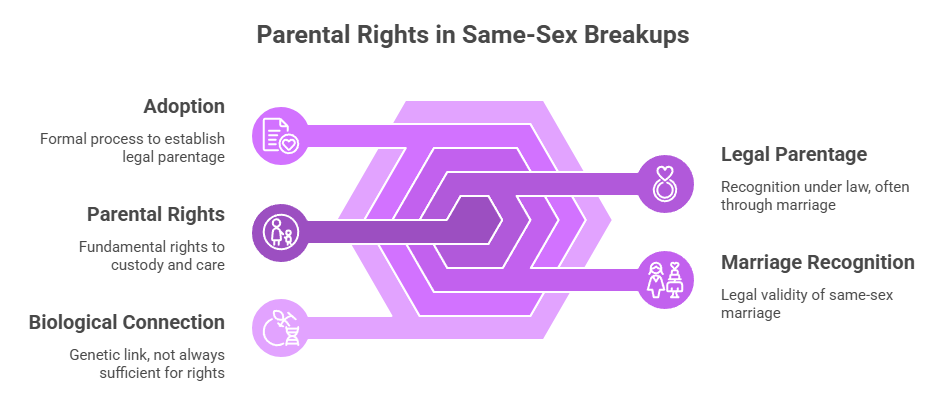
If a lesbian couple has a child – whether through donor insemination, surrogacy, or previous adoption – and they later break up, the court will ask: who are the legal parents? If the couple was married at the time of the child’s birth, Texas typically presumes that both spouses are legal parents. But that presumption is tied to the recognition of the marriage itself.
If Texas were to stop recognizing same-sex marriage, that legal presumption could disappear. A parent who was never listed on the birth certificate and who did not complete a formal adoption could lose all parental rights. This includes custody, visitation, and even the ability to make medical or educational decisions for a child they helped raise from birth.
This isn’t just theoretical. Courts in Texas have already shown reluctance in granting custody or visitation to non-biological, non-adoptive parents in same-sex relationships – even when those parents have been fully involved in the child’s life.
If the marriage is no longer recognized, courts could interpret that to mean the parent never had standing in the first place. The biological parent could end up with sole rights, while the other might be treated as a legal stranger.
To protect parental rights in these cases, legal action must often be taken before the relationship ends. Once there’s a dispute, the legal system becomes much less flexible – and much more focused on paperwork over parenting history.
Legal Tools LGBTQ+ Parents Should Secure Now
In Texas, same-sex couples raising children cannot rely solely on marital status to secure parental rights – especially in a shifting legal environment. The safest approach is to proactively formalize each parent’s legal relationship to the child, regardless of marriage.
Second-Parent Adoption in Texas
This is the strongest form of legal protection. A second-parent adoption allows a non-biological parent to be legally recognized without terminating the rights of the biological parent. Once granted, the adoptive parent has the same standing as a biological parent in custody, visitation, and decision-making matters. This legal recognition remains valid even if marriage laws change.
Co-Parenting Agreements
Although not binding in the same way as a court order, written parenting agreements can help demonstrate the couple’s intentions. These agreements can be introduced in court during custody disputes to support claims of shared parenting or informal arrangements.
Power of Attorney for Minors
This document authorizes a non-parent to make urgent or temporary decisions for the child, such as approving medical treatment or picking the child up from school. It’s not a substitute for legal parenthood but serves as an important stopgap measure.
Wills and Guardianship Nominations
If one parent dies, a will that nominates the other parent as guardian strengthens that parent’s case to retain custody. Without formal legal ties, surviving non-biological parents may be challenged by extended family members or even state authorities.
Medical Authorization Forms
Hospitals and clinics often require legal documentation to allow a non-parent to make healthcare decisions. These forms help avoid access issues during emergencies.
Taking these steps now can prevent far more difficult outcomes later. Waiting until a dispute arises – or until marriage protections are challenged – can leave non-recognized parents with limited or no legal recourse.
Could This Happen? The Politics Behind Reversing Gay Marriage
Ten years after Obergefell v. Hodges guaranteed same-sex marriage nationwide, the legal status of that right was formally challenged again in 2025. A key case – Ermold v. Davis – involved a former Kentucky county clerk, Kim Davis, who refused to issue marriage licenses to same-sex couples in 2015. She was found personally liable in federal court, and she asked the Supreme Court not only to review her liability but also to revisit and overturn Obergefell.
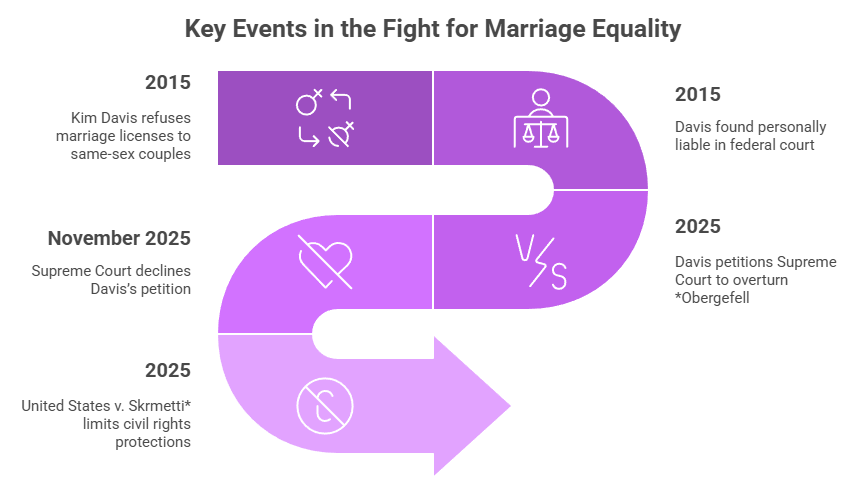
In November 2025, the Supreme Court declined to take up Davis’s petition. Because fewer than four justices voted to hear the case, the Court let stand the lower court’s ruling and refused to revisit the constitutional right to same-sex marriage. As a result, Obergefell remains the law of the land – for now.
This decision signals that a majority of the current Court is not ready to overturn marriage equality at this time, though conservative interest in revisiting other precedents remains a subject of debate among legal scholars.
It’s also worth noting that while Obergefell survives this challenge, the Court’s broader rulings on related civil rights issues – such as United States v. Skrmetti (a 2025 case upholding a Tennessee ban on certain medical treatments under the Equal Protection Clause) – demonstrate that the Supreme Court’s current majority is willing to limit other protections under federal constitutional frameworks.
On the political front, efforts to undermine marriage equality continue in several states, and Republican-led legislative platforms have reiterated support for revisiting federal rulings like Obergefell. While those efforts have so far not succeeded at the Supreme Court level, they heighten unpredictability for LGBTQ+ rights and reinforce why legal safeguards beyond marriage – such as parental rights documentation – matter deeply.
Second-Parent Adoption: The Strongest Legal Safeguard
Of all the legal strategies available to LGBTQ+ parents in Texas, second-parent adoption remains the most comprehensive and durable. It provides full legal recognition of the parent-child relationship and ensures that parental rights don’t rely on marriage status, biological ties, or shifting political winds.
What It Is
Second-parent adoption allows a non-biological parent to adopt a child without terminating the rights of the biological or first legal parent. In same-sex families, this often applies when one parent gives birth or adopts, and the other wishes to be recognized as an equal legal parent.
Why It Matters
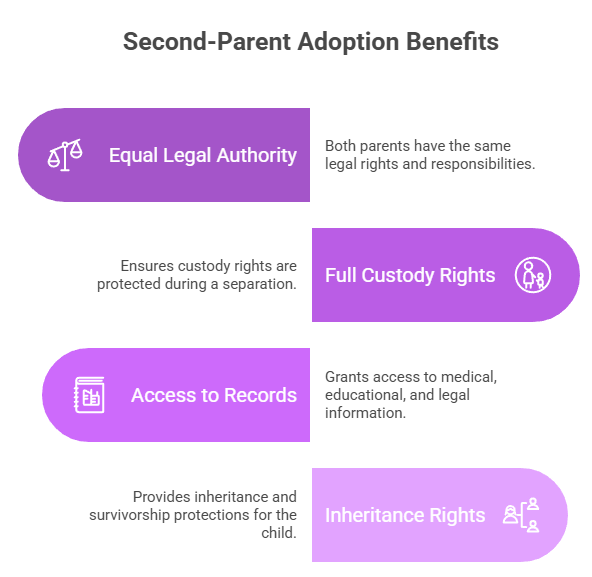
Marriage may confer presumed parentage, but that presumption is vulnerable to legal challenges if the state ceases to recognize the marriage. A second-parent adoption, by contrast, is a court order that stands independently. Once granted, it secures:
- Equal legal authority for both parents
- Full custody rights during a breakup
- Access to the child’s medical, educational, and legal records
- Inheritance rights and survivorship protections
Without this step, a non-biological parent could be denied custody or visitation – even after years of co-parenting – especially if the legal status of their marriage is questioned or ignored.
How It Works in Texas
Texas permits second-parent adoption, but the process varies by county. Typically, it involves:
- Filing a petition for adoption
- Submitting to a background check
- Completing a home study (required in some jurisdictions)
- Attending a final court hearing where a judge signs the adoption decree
This process should ideally be completed while the relationship is stable and uncontested. If a dispute arises before adoption is finalized, courts are far less likely to grant standing to the non-legal parent.
Other Considerations
Even with adoption in place, parents should consider additional documents like wills, guardianship designations, and medical authorizations. These help address scenarios that fall outside of day-to-day custody, especially in emergencies or after a death.
Second-parent adoption closes the legal gaps that marriage may not fully protect – particularly in a state that may seek to challenge federal precedent. For same-sex couples raising children, it is the most effective legal tool to preserve both parents’ rights, regardless of what happens in the courts or legislature.
FAQs about Same-Sex Parenting and Marriage Law in Texas
Can Texas refuse to list a non-biological same-sex parent on a birth certificate?
Texas has previously attempted to deny non-biological same-sex parents a place on their child’s birth certificate, especially in cases where the couple was not married or had not completed an adoption. Although federal courts have ruled that states must treat married same-sex couples equally in this regard, enforcement has been inconsistent. Without marriage recognition or legal adoption, listing both parents remains legally vulnerable.
What happens if a same-sex couple marries in another state but lives in Texas?
Under current federal law, Texas must recognize valid marriages performed in other states. However, if Texas stopped recognizing same-sex marriage, couples who married elsewhere could face resistance in matters like spousal benefits, medical decision-making, or family court jurisdiction – until a court reaffirmed their rights under federal precedent.
Can schools or daycares refuse to acknowledge both parents in a same-sex household?
While public institutions cannot legally discriminate based on sexual orientation, private childcare providers or religiously affiliated schools may try to limit acknowledgment of a non-biological or non-adoptive parent. This often depends on the legal documentation the parents can provide. A second-parent adoption order typically prevents these issues.
What if one parent moves to another state after a breakup – how are parental rights handled?
If only one parent has legal custody due to biological or adoptive status, that parent may be able to relocate with the child without consent. If both parents are legal, custody must be resolved through a court order. Courts in other states will generally honor Texas adoption decrees or custody orders, but enforcement becomes harder if the non-legal parent lacks documentation.
How does Texas treat donor sperm or egg agreements in same-sex parenting cases?
Texas does not have comprehensive statutes governing third-party reproduction in same-sex relationships. Without clear donor contracts and legal adoption, courts may defer to biological connections. This can create complications, especially if a known donor attempts to assert parental rights or if one parent is not biologically related to the child.
Are legal protections different for male vs. female same-sex couples in parenting cases?
The underlying legal principles are the same, but female couples may face fewer barriers when one parent gives birth. Male couples, who typically rely on surrogacy, often encounter more complex legal processes, including the need for gestational agreements, pre-birth orders, and post-birth adoptions.
Protect Your Parental Rights Before Laws Change
If you’re in a same-sex or blended marriage and raising children in Texas, the safest time to act is before legal challenges arise. Marriage recognition can shift, but a properly executed adoption or custody order holds firm.
At Brandi Wolfe Law, we guide families through second-parent adoption, co-parenting agreements, and custody protections tailored for Texas law. Don’t wait until your rights are questioned – put legal safeguards in place now.
Call (210) 571-0400 to schedule a consultation and protect your role in your child’s life.