

Divorce Delays During Deployment: What You Need to Know
You filed for divorce (or you’re trying to) but now he’s deployed, and everything is on hold. He’s not signing, not responding, and every time you ask what’s next, you hear the same thing: “There’s nothing you can do right now.”
Meanwhile, you’re stuck – emotionally exhausted, legally frozen, and wondering if he can really drag this out forever.
Here’s the truth: deployment can cause a delay, but it’s not a permanent pause. Courts do give active-duty service members time to respond when duty makes legal participation difficult. But judges are also watching for fairness, and they can move cases forward when delays go too far.

If you’re tired of waiting while he controls the timeline from overseas, this article will help you understand what’s legal, what’s not, and how you can start regaining control.
What the Servicemembers Civil Relief Act Really Means in Divorce
You may have heard that your husband’s military status gives him the power to stop the divorce until he’s ready. That’s not true – but it’s a misunderstanding that causes a lot of women to feel helpless.
The Servicemembers Civil Relief Act (SCRA) does allow active-duty military members to request a temporary pause in civil cases, including divorce. But it’s not automatic, and it’s not permanent.
To legally delay the divorce:
- He must ask the court in writing
- He must explain how his military service prevents him from participating
- He needs a statement from his commanding officer confirming that
When all of that is submitted correctly, a judge may grant a 90-day stay – a temporary pause. After that, he must request additional time, and the court decides whether the delay is reasonable or being used to avoid responsibility.
What the SCRA Does – and Doesn’t – Do
- ✔ Gives active-duty service members a short window to respond if duty truly interferes
- ✔ Protects against default judgments while deployed
- ✘ Does not allow someone to delay divorce indefinitely
- ✘ Does not apply to every situation just because someone is in the military
If your spouse is using the SCRA as a wall you can’t get around, the court may be able to break it down – especially if he’s refusing to communicate or dragging out the process on purpose.
How Long Can Divorce Be Delayed for Deployment?
If you’re waiting for your divorce to move forward while he’s overseas, it may feel like the court is on his schedule, not yours. The truth is, military deployment can only delay things for so long – and it’s the judge, not your husband, who makes that decision.
Under the SCRA, a court may grant a 90-day pause in divorce proceedings if the service member shows that military duty prevents them from participating. But after those 90 days, delays don’t happen automatically. He has to request more time – and prove that he still can’t reasonably take part.
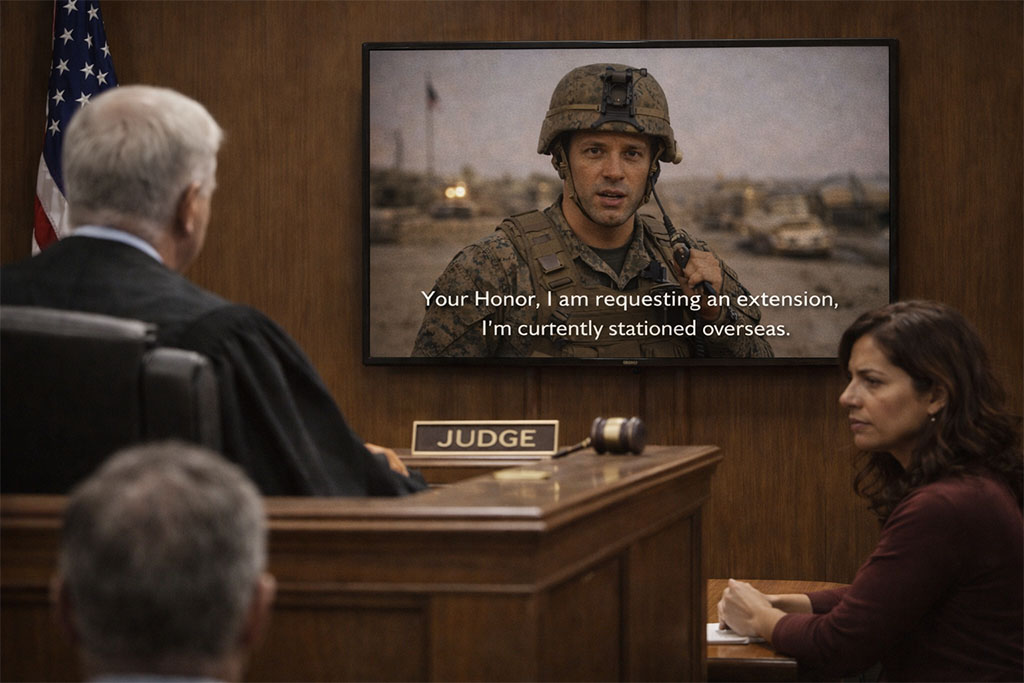
Judges don’t just look at the fact that someone is deployed. They look at the details:
- Is he stationed in a combat zone or on a base with full internet access?
- Has he responded to any part of the case – or ignored everything?
- Can he appear by phone or video, or through an attorney?
Courts understand military duty, but they also understand when it’s being used as a shield. If the deployment is being used to stall the case unnecessarily, the judge may deny additional delays and allow the case to proceed.
Delay Duration Examples: When Courts Say Yes or No
| Situation | What the Court May Do |
|---|---|
| Deployed to remote combat zone with no reliable communication | Grant a delay |
| Stationed on base with legal access and ignores court deadlines | Deny further delay |
| Repeatedly asks for more time with no valid reason | Allow the divorce to continue |
You don’t have to sit in silence while the clock runs out on your peace of mind. If the delay is going on too long, there may be a way to push forward.
What Happens If He Keeps Requesting Extensions?
If your husband keeps asking the court for more time – month after month – you may be wondering: Is this ever going to end?
It’s one thing to delay the process for a valid military reason. It’s another to use deployment as a way to dodge accountability, avoid communication, or punish you emotionally by dragging out the divorce.
Judges know the difference.
Every time he requests an extension under the SCRA, he must provide:
- A written explanation of why his duty prevents participation
- A formal statement from his commanding officer confirming that
And the court doesn’t just rubber-stamp those requests. Judges look at patterns – and if your spouse keeps avoiding hearings, refusing to respond, or making vague claims, the court can start asking tougher questions.
Red Flags Judges Watch For:
- Multiple delay requests with no new justification
- Refusal to appear by video or phone when it’s clearly possible
- No effort to respond through an attorney
- Gaps in communication that suggest intentional avoidance
If the court sees signs that he’s using his deployment to stall the case rather than participate in good faith, it may deny further delays. In some cases, the judge may move forward without him or allow key parts of the divorce – like custody or support – to proceed independently.
You’re not powerless in this. Courts have tools to stop unnecessary stalling. The key is knowing when and how to challenge it.
What Can the Civilian Spouse Do to Move Things Forward?
When he’s deployed and the divorce feels frozen, it’s easy to think you have no say – that you’re expected to wait, no matter how much it costs you emotionally or financially. But you do have legal options, and the court can act when the delay becomes unfair.
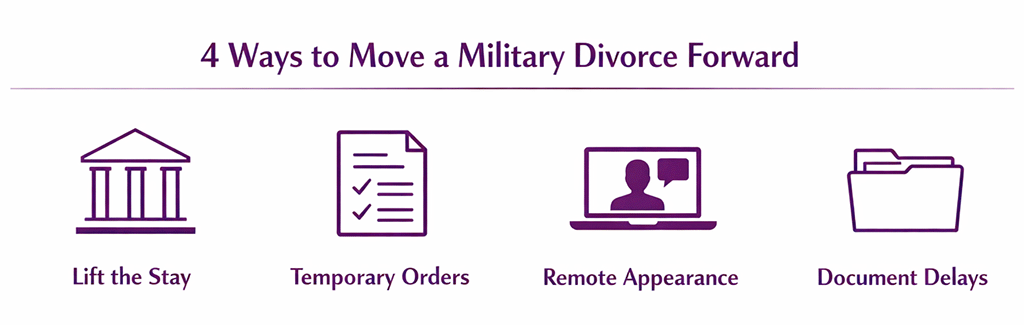
If the SCRA has been used to stall the process, here’s what you can do to start taking control back:
Steps You Can Take:
- File a motion to lift the stay
You can ask the court to remove the delay, especially if you can show that it’s causing harm – or that he’s capable of participating but chooses not to. - Request temporary hearings
Even if the divorce is paused, many courts will move forward with temporary orders for things like child support, custody, or use of the home. You don’t have to wait for a full divorce to get protection. - Ask the court to require remote participation
If he has access to internet or phone service, the judge may order him to appear by video or allow his attorney to speak on his behalf. - Document the delays and their impact
Keep track of every extension, every missed deadline, and how the stall is affecting your life. This can help your attorney argue that the delay has gone too far.
Judges want fairness – not silence. If the balance has tipped too far and you’re left in limbo, the law gives you a voice. And if you’re working with an attorney who understands military divorce, they can help you push forward even when your spouse is deployed.
How Courts Balance Military Duty and Divorce Fairness
Courts respect military service – but they don’t hand out unlimited patience. Judges understand that deployment is demanding, but they also see the damage that long delays can cause – especially to the spouse left waiting.
When one partner wants to move forward and the other keeps stalling, courts have to find the middle ground. Their goal is simple: protect the rights of both spouses while maintaining a fair legal process.
If your husband is deployed, the court may still allow parts of the divorce to move forward, especially if:
- He has access to an attorney who can represent him
- He’s shown little interest in cooperating
- You’ve waited a significant amount of time with no progress
What Judges May Do to Keep the Case Moving:
- Allow remote hearings by phone or video
- Proceed with temporary orders (custody, support, visitation)
- Set deadlines for participation, even during deployment
- Split the case: pausing some issues but deciding others
Judges don’t expect perfection – they expect effort. If he’s made no attempt to respond, while you’re stuck paying bills or raising kids alone, the court can intervene.
This process can feel heavy, especially when you’re facing it alone. But when the law is applied fairly – and with the right help – you can begin to move forward again, even if he’s still overseas.
FAQs About Divorce and Deployment
Can I serve divorce papers to someone on active duty?
Yes, but it’s not always simple. If he’s stationed stateside, personal service is usually required. If he’s overseas, service can get complicated. Some jurisdictions allow alternative methods, but you’ll likely need a court’s permission and help from an experienced attorney.
Can the court finalize the divorce without him?
Not while he’s protected under the SCRA and has proven that military duty prevents participation. But if he refuses to engage, and the court finds he’s using deployment to avoid responsibility, the judge may allow parts of the case to proceed or even deny further delays.
What if I need child support or custody orders now?
You can absolutely ask for temporary orders, even if the divorce is delayed. Courts can and do hold hearings on urgent matters like custody, parenting time, or financial support – especially when children are involved.
Will the court wait for him to come home?
Not always. If he’s deployed long-term but has ways to participate remotely, the court may move forward with parts of the case. Judges try to balance fairness to both sides.
Can his military attorney represent him in divorce?
No. JAG officers can offer general legal advice, but they don’t represent service members in civilian court. He’ll need to hire a private attorney to formally respond to the divorce.
What if I can’t afford to wait any longer?
That’s something the court takes seriously. If the delay is hurting you – financially, emotionally, or otherwise – you can ask the court to lift the stay or move forward with certain parts of the case. Don’t assume you’re stuck. You may have more power than you think.
You Don’t Have to Wait Forever
If you’re exhausted from delays and feeling like he controls the timeline just because he’s deployed, it’s time to take your power back. The law protects military service – but it also protects you. You have a right to clarity, movement, and peace of mind.
At Brandi Wolfe Law, we help women navigate complicated military divorces with strength, strategy, and support. If your case is stalled and you’re ready for answers, we’re here to help.
Call (210) 571-0400 to speak directly with an attorney who understands how to move these cases forward – without leaving you behind.