

Proving Emotional Abuse in a Texas Divorce: A Documentation Guide
You already know what happened. You lived it. The question now is how to make sure a Texas court knows it too, and that starts with documentation. Emotional abuse doesn’t leave bruises, which is exactly why abusers get away with it for so long. But it does leave a trail, and once you know how to capture it, you become the person in this divorce with the receipts. That shift in power is real. This is how you build it.
Does Emotional Abuse Matter in a Texas Divorce?
Texas is one of the states that still allows fault-based divorce, and that matters more than most people realize going into this process. Under Texas Family Code Section 6.002, cruel treatment is a recognized ground for divorce. The standard is whether one spouse’s conduct made living together insupportable, and emotional abuse can absolutely clear that bar.
“The court may grant a divorce in favor of one spouse if the other spouse is guilty of cruel treatment toward the complaining spouse of a nature that renders further living together insupportable.” — Texas Family Code § 6.002
What that means practically is that sustained psychological harm, coercive control, intimidation, and manipulation are not just things you endured. They are things a Texas court can hold your spouse accountable for, if you can show them. The fault ground matters because it follows your spouse into decisions about property division and custody. It is not just about being believed. It is about what the court does with that finding.
The honest caveat: courts do not act on accusations. They act on evidence. That is not a flaw in the system working against you. It is the system giving you a tool, and documentation is how you use it.
What Texas Courts Recognize as Emotional Abuse
Not every painful marriage qualifies as legally actionable emotional abuse, and I think it’s worth being straight with you about that before you walk into a courtroom. Courts look for a pattern of behavior. Not a bad month. Not a period of cruelty followed by years of normalcy. A sustained, recurring pattern of conduct designed to control, diminish, or harm.

That distinction is not meant to minimize what you experienced. It is meant to help you build the strongest possible case by focusing on the evidence that actually moves courts.
Behaviors that Texas courts take seriously include:
- Coercive control: Using threats, manipulation, or intimidation to govern a spouse’s decisions, movements, or relationships over time.
- Isolation: Systematically cutting a spouse off from family, friends, or any support system outside the marriage.
- Financial abuse: Controlling all access to money, sabotaging employment, or weaponizing finances as punishment.
- Verbal degradation: Repeated humiliation, name-calling, or public embarrassment calculated to erode self-worth.
- Gaslighting: Deliberately distorting a spouse’s perception of reality to make them doubt their own judgment and memory.
- Threats: Against the spouse, the children, pets, or financial security.
The Difference Between a Difficult Marriage and Legal Abuse
A spouse who is cold, withholding, chronically critical, or emotionally absent is not automatically abusive under Texas law. That is a hard line to sit with, but knowing it protects you. If your evidence shows a spouse who was unkind but not controlling, opposing counsel will use that gap to dismantle your credibility. The goal is not to prove that your marriage was miserable. The goal is to prove a pattern of conduct that meets the legal threshold. Know the difference, and document accordingly.
Start a Private Abuse Journal
This is the advice I give every client who comes to me with an emotional abuse case: start a journal, and start it today. Not because it’s the only tool you have, but because a contemporaneous record, one written at or near the time each incident occurs, is one of the hardest things for opposing counsel to attack. You cannot fabricate timestamps. You cannot manufacture the kind of detail that comes from writing something down the night it happened. That consistency is exactly what gives a journal its credibility in court.

Most people either never start one or start one too late. Do not make that mistake.
Each entry should include:
- Date and time. Be exact. “Last week” is useless in a courtroom. “April 3, 2025, approximately 10:20 p.m.” is evidence.
- What happened. Write factually. What was said, what was done. Leave your emotional response out of the entry itself and stick to observable facts.
- Who was present. Children, visitors, anyone who may have witnessed or overheard anything.
- Physical context. Where were you in the home? Was anything thrown, broken, or damaged?
- Aftermath. Did you leave, call someone, take photos, or seek any kind of medical or emotional support afterward?
Where you store this matters as much as what you write. Keep it somewhere your spouse cannot access. Not a shared Google Drive. Not a family laptop. Not a notes app synced to a shared Apple ID. Use a personal email account they have no knowledge of, a private app on a phone they do not touch, or a physical journal stored outside the home entirely. If they find it, your safety and your case are both at risk.
Digital Evidence That Holds Up
Here is something I want you to understand about digital evidence: it is often the most powerful thing you can bring into a divorce case involving emotional abuse, because it is your spouse’s own words. Not your account of what they said. Not your therapist’s notes about what you reported. Their actual words, timestamped, preserved, and admissible. Courts respond to that in a way they simply do not respond to testimony alone.
The mistake most people make is assuming they need to gather new evidence. You probably already have it. Go back through your texts, your emails, your voicemails. The pattern is likely already there.
Preserve everything:
- Text messages: Screenshot every relevant thread and back them up to a private cloud account or email them to yourself. Do not delete anything, even messages that seem minor or that you sent in a moment you regret.
- Emails: Forward threatening, demeaning, or controlling emails to a private account and save them in a clearly labeled folder.
- Voicemails: If your phone does not automatically back them up, record them externally before they expire or get deleted.
- Social media: Screenshot posts, direct messages, and comments. Platforms update, accounts get deactivated, and content disappears. Capture it now.
What About Recording Conversations in Texas?
Texas is a one-party consent state under Texas Penal Code Section 16.02. That means you can legally record any conversation you are personally part of without notifying the other person. If your spouse is threatening you in your own kitchen, you can record it on your phone. That recording can be used in court.
Where it gets complicated is your children. Recording a conversation where only your child and your spouse are present, or encouraging your child to record the other parent, crosses a legal and ethical line that can seriously damage your custody case. The evidence is not worth that cost. Talk to your attorney before you record anything involving your kids.
Witnesses, Professionals, and Third-Party Corroboration
One of the most common things I hear from clients is “but no one was there.” That is rarely as true as it feels. Emotional abuse does not always happen in a sealed room. It happens at family dinners, in parking lots after school events, over the phone while a friend is visiting. People witness more than you realize, and their accounts matter.
Courts understand that abuse happens behind closed doors. A witness who can speak to what they personally observed, your emotional state over time, visible changes in your behavior, or a specific incident they witnessed firsthand adds a layer of credibility that no journal entry can provide on its own.
| Lay Witnesses | Professional Records | |
|---|---|---|
| Who | Friends, family, coworkers, neighbors | Therapists, doctors, counselors |
| What they establish | Observed behavior, emotional state, visible changes over time | Diagnosis, treatment history, documented disclosures |
| Limitations | May be seen as biased, especially family members | Require a subpoena or signed release to obtain |
| Best use | Corroborating specific incidents | Establishing pattern and psychological impact |
A treating therapist who has documented your disclosures over months or years is particularly valuable. Those records exist completely independent of your divorce proceedings. They were created before any litigation motive existed, which makes them significantly harder for opposing counsel to dismiss as self-serving.
If you are not already working with a therapist, that is worth reconsidering. Not just for your own wellbeing, which matters enormously, but because every session where you disclose what has happened to you becomes part of a professional record that can support your case. You are building evidence and taking care of yourself at the same time. That is not a small thing.
What Not to Do When Documenting Abuse
Building a strong record can be undone fast if you make the wrong moves along the way. These mistakes are avoidable, and they matter.
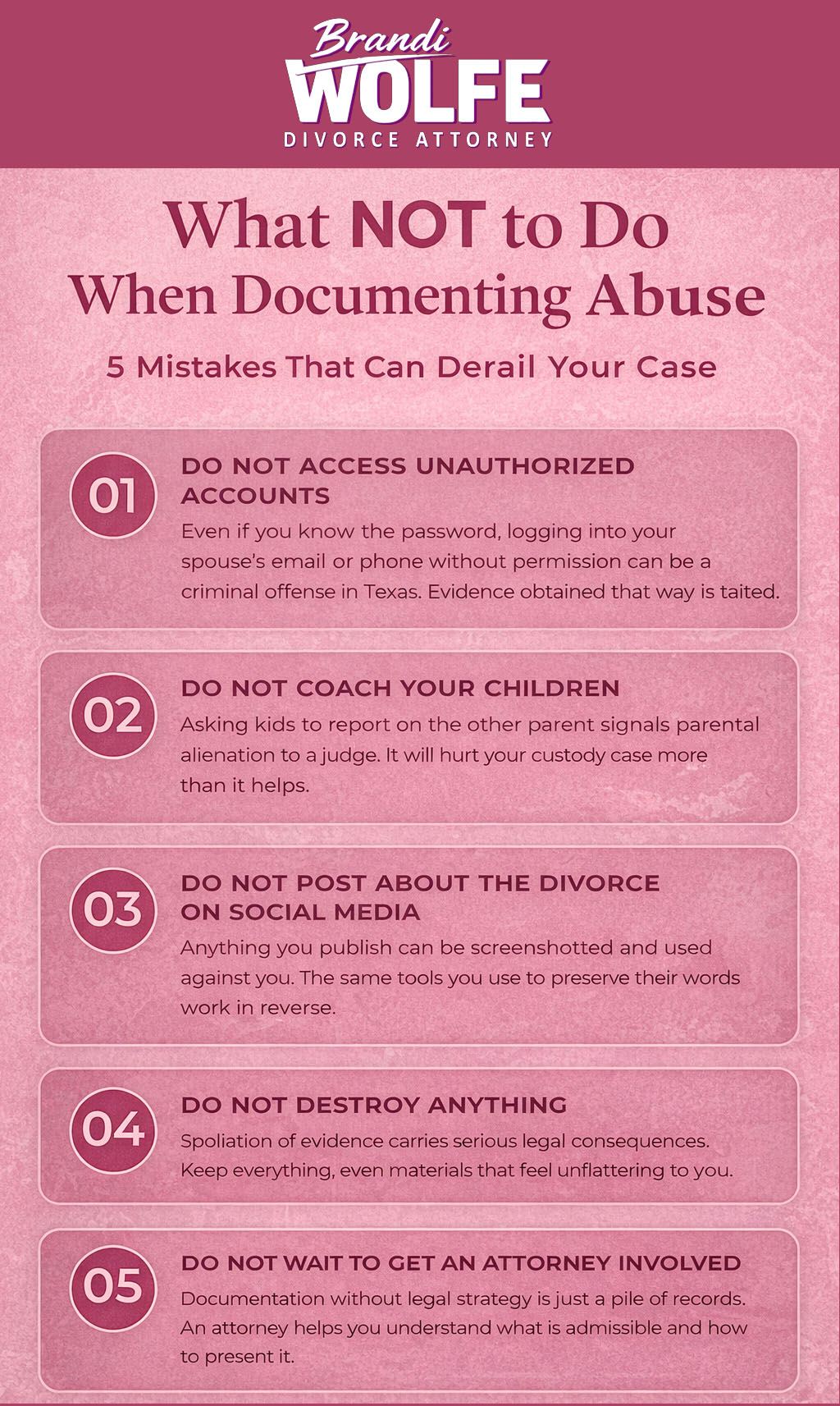
- Do not access accounts you are not authorized to use. Even if you know the password, logging into your spouse’s email or phone without permission can be a criminal offense in Texas. Evidence obtained that way is tainted and your credibility goes with it.
- Do not coach your children. Asking kids to report on the other parent or repeat things in court signals parental alienation to a judge. It will hurt your custody case more than it helps.
- Do not post about the divorce on social media. Anything you publish can be screenshotted and used against you. The same tools you are using to preserve your spouse’s words work in reverse.
- Do not destroy anything. Spoliation of evidence carries serious legal consequences and tells the court exactly what kind of party you are. Keep everything.
- Do not wait too long to get an attorney involved. Documentation without legal strategy is just a pile of records. An attorney helps you understand what is admissible and how to present it effectively.
How Documentation Affects Custody, Property, and Support in Texas
Documentation is not just about proving what happened to you. It is about what happens next. The record you build now follows your spouse into every major decision a Texas court makes in your divorce, and those decisions have real, lasting consequences for your life and your children’s lives.
Custody and Conservatorship
Texas courts determine custody using the best interest of the child standard. Evidence of a parent’s coercive control, pattern of intimidation, or sustained psychological abuse speaks directly to that standard. A well-documented history of emotional abuse can support an argument for sole managing conservatorship, meaning you make the major decisions for your children without needing the other parent’s agreement. Under Texas Family Code Section 153.004, courts are specifically directed to consider a history of family violence when making conservatorship orders and can restrict an abusive parent’s access to the children.
Property Division
Texas is a community property state, but fault changes the math. A court can award one spouse a disproportionate share of the marital estate based on fault grounds, including cruel treatment. The documentation you build to support your abuse claims is the same documentation that can shift the financial outcome of your divorce in your favor.
Protective Orders
A documented pattern of threats, intimidation, or coercive control can support an application for a temporary or permanent protective order. That order can affect where your spouse is allowed to be, who controls the family home during the divorce, and what the possession schedule looks like for your children while proceedings are ongoing.
The evidence you collect is not just your story. In a Texas courtroom, it becomes your leverage.
FAQs about Documenting Emotional Abuse in a Texas Divorce
Can I file for divorce on the grounds of emotional abuse even if it was never physical?
Yes. Texas Family Code Section 6.002 recognizes cruel treatment as a fault ground for divorce, and that includes sustained psychological abuse. Physical violence is not a requirement. What the court needs is evidence of a pattern of conduct that made the marriage insupportable.
How far back can my documentation go?
As far back as you have it. There is no cutoff on when abuse occurred, but more recent evidence carries more weight. A pattern documented over the last year is generally more persuasive than incidents from five years ago with nothing recent to support them.
What if my spouse is already trying to reframe the abuse as mutual?
This is a common tactic, and it is exactly why contemporaneous documentation matters. A journal started before any divorce filing, therapy records predating litigation, and witness accounts that exist independent of the divorce proceedings are all significantly harder to reframe as fabricated or retaliatory.
Do I need a police report to prove emotional abuse in Texas?
No. Police reports help, but they are not required. Courts regularly consider emotional abuse cases built entirely on journals, digital evidence, therapy records, and witness testimony. A police report is one tool, not the only one.
Will a judge automatically believe my spouse’s denial?
No judge is required to accept a denial at face value, and most family court judges in Bexar County have seen every version of this dynamic. What a denial does is raise the stakes on your documentation. The stronger and more consistent your record, the less weight a flat denial carries.
My spouse controls all our finances. Can I still afford to pursue this?
Financial control is itself a form of documented abuse. Bring what you have to an initial consultation. Many family law attorneys, including this firm, can discuss fee structures and options during that first conversation. Do not let financial control be the thing that keeps you from getting legal help.
What if my children witnessed the abuse? Can they testify?
Texas courts are cautious about putting children in that position. A judge may interview a child privately in chambers, particularly in custody disputes, but it is rarely the first option and never something to push for without careful legal guidance. Therapy records documenting what a child disclosed to a professional are often a better path.
Is emotional abuse relevant if we are filing an uncontested divorce?
If both parties are agreeing to terms, fault grounds may not be litigated. But documentation still matters. It gives you negotiating leverage during settlement discussions and protects you if your spouse later contests the agreement or seeks modifications.
You Have More Power in This Than You Think
If you have read this far, you are already doing something right. You are not waiting to be believed. You are building the case yourself, piece by piece, and that is exactly the right instinct.
Emotional abuse cases are winnable in Texas courts. They require preparation, consistency, and an attorney who understands what judges in Bexar County actually respond to. That is where this firm comes in.
Brandi Wolfe Law works with clients across San Antonio who are leaving high-conflict marriages and need an attorney who will fight as hard as they have been fighting, just with the law behind them. If you are documenting abuse, considering divorce, or trying to figure out your next move, the best thing you can do right now is get a legal strategy built around your specific situation.
If you are divorcing a narcissist or leaving a high-conflict relationship, start here.
Call Brandi Wolfe Law at (210) 571-0400 or reach out online to schedule a consultation. You have already done the hard part of deciding you deserve better. Let us help you prove it.