

Phone Tracking, Spyware, and Stalking: What Texas Divorce Law Actually Allows
Clients ask me this all the time, and the honest answer is: it depends on how he’s doing it. Some forms of tracking are legal. Others cross into criminal territory. The line comes down to consent, device ownership, and method. What feels like an invasion of privacy may or may not be illegal, and what your spouse thinks is “just keeping tabs” may be a felony under the Texas Penal Code or federal law. Here’s what you need to know before you assume you’re protected, or before you assume you’re not.
Is Phone Tracking Legal in Texas?
The legality of phone tracking during a divorce isn’t black and white, and I want to be straight with you about that. Two things drive most of the analysis: who owns the device and whether you ever consented to being tracked. Both matter, and neither one alone gives you the full answer.
When Tracking May Be Permitted
If your phone is on a shared family plan and the account is in his name, he may have access to your location data through the carrier. A lot of carriers give the account holder visibility into every device on the plan. That’s not illegal. That’s account access he’s probably always had.
Same goes for shared apps. If you and your husband set up Google Family Sharing or Apple’s Find My together at some point, that location access is generally considered consensual. You agreed to it, even if that was years ago and everything looks different now.
Device ownership and consent are what courts look at first. If the phone is on his plan or jointly owned, and location sharing was something you both set up, the argument that he’s crossed a legal line gets a lot harder to make.
That doesn’t mean it feels okay. It just means it may not be illegal.
When It Becomes Illegal
The second he installs something on your phone without your knowledge, we’re in completely different territory.
Installing an app, a tracking tool, or any software on your device without your consent isn’t a gray area. It’s a crime. Texas Penal Code Chapter 16 prohibits the unlawful interception of electronic communications, including calls, texts, and data sent from your phone. Being married doesn’t change that. Going through a divorce doesn’t change that. Consent is required, and marriage is not consent.
The Computer Fraud and Abuse Act adds a federal layer on top of that for anyone accessing a device or account without authorization. These aren’t technicalities. They’re criminal statutes, and the consequences include potential jail time.
If he installed something on your phone without telling you, that’s not just a divorce issue anymore.
What Counts as Illegal Surveillance in Texas?
“Tracking” covers a lot more ground than most people realize. It’s not just knowing where you are. It’s reading your texts, monitoring your calls, accessing your email, and watching everything you do on your phone in real time. Here’s where the lines are.
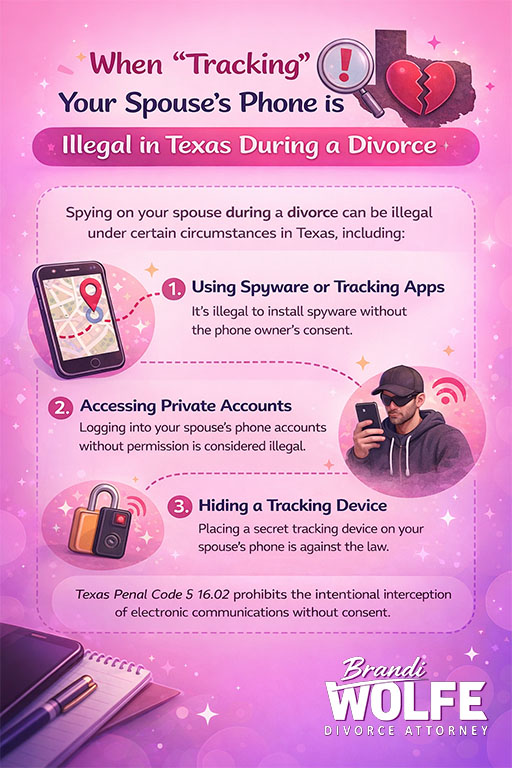
Spyware and Stalkerware
Stalkerware is software installed on your device to secretly monitor your calls, texts, location, browsing, and activity without you knowing it’s there. It’s designed to be invisible. No icon, no notification, nothing.
Most of the time it gets installed physically, during the few minutes someone has access to your unlocked phone. Sometimes it arrives through a link you click without realizing what it is. Either way, once it’s on your device, whoever installed it can see almost everything.
Under Texas law, installing this kind of software without your consent is unlawful interception and carries serious criminal penalties. The fact that he’s your husband, or soon-to-be ex-husband, is not a defense.
If your phone has been acting strange, battery draining faster than usual, data usage spiking, running warm when you’re not using it, don’t dismiss it. Those are real warning signs worth looking into.
GPS Trackers on Shared Vehicles
This one is genuinely a gray area, and I want to be honest with you about that.
Texas courts have given spouses more latitude when it comes to tracking a vehicle that’s marital property. If the car is jointly owned, placing a GPS tracker on it may not carry the same legal exposure as putting spyware on your phone. The ownership argument is different when both of your names are on the title.
That said, context matters. If GPS tracking is part of a broader pattern of surveillance, harassment, or control, a judge is going to notice that. It doesn’t exist in a vacuum.
Reading Texts and Emails Without Permission
There’s a real difference between knowing your password and being authorized to use it.
If your husband is accessing your email, your texts, or your social media accounts without your permission, even using a password he’s known for years, that can violate the Stored Communications Act at the federal level. Unauthorized access doesn’t require breaking down a door. Logging into your accounts without your consent is enough.
This comes up constantly in divorce cases. Screenshots of texts pulled from a spouse’s phone or account without permission, emails accessed and forwarded, private messages used as evidence. If that evidence was obtained illegally, it creates serious problems for the spouse who gathered it.
Can Illegally Obtained Evidence Be Used Against You in a Texas Divorce?
This is the question most people don’t think to ask until they find out their spouse has been watching them for months. If he’s already been tracking you, you need to know what that means for your case, and for his.
Admissibility in Texas Family Court
Texas courts can exclude illegally obtained evidence, but it’s not automatic, and I don’t want to oversell that protection.
The exclusionary rule works differently in civil proceedings than it does in criminal cases. In a criminal trial, illegally obtained evidence is generally thrown out. In family court, a judge has more discretion. Some judges will exclude it outright. Others may consider the circumstances before deciding. What you can count on is that illegally obtained evidence opens the door to motions to suppress, sanctions, and serious credibility damage for the spouse who gathered it.
Here’s the practical reality: even if evidence is ruled inadmissible, the judge still knows it exists. It doesn’t vanish from the room. What it does do is signal to the court exactly what kind of person your spouse is and how far he’s willing to go. That matters.
When Illegal Surveillance Can Hurt Your Spouse’s Case
If your husband illegally tracked you, that’s not just a procedural headache for him. It’s a liability that follows him through every part of your case.
Criminal charges are a real possibility. Depending on how the surveillance was conducted, he could be looking at charges under Texas Penal Code Chapter 16, the Computer Fraud and Abuse Act, or both. That’s separate from your divorce entirely, but it runs alongside it.
A protective order may also be available to you if the surveillance is part of a pattern of harassment or control. In Bexar County family courts, judges take this seriously. Surveillance doesn’t happen in a vacuum, and courts understand that.
Beyond the legal exposure, think about what illegal surveillance does to his credibility on every other issue in front of the judge. Custody. Property division. Support. A spouse who spied on you illegally has a much harder time positioning himself as the reasonable party. Judges are people. They remember what they hear.
What to Do If You Think Your Spouse Is Tracking You
This is where most people need the most practical help. You suspect something is wrong, your gut is telling you something is off, and you don’t know what to do first. Here’s what I tell my clients.
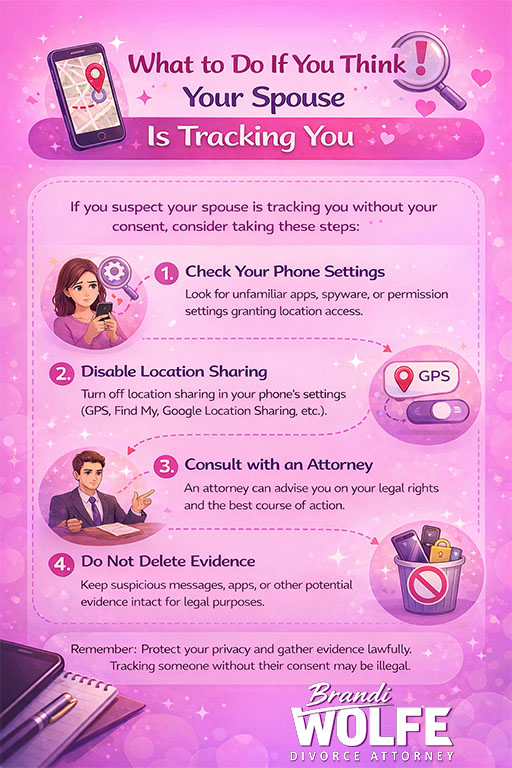
Check Your Devices and Accounts
Start with what you can see. On your phone, look for apps you don’t recognize, unusual battery drain, data usage spikes, or a device that runs warm when you’re not actively using it. These aren’t guarantees of spyware, but they’re worth paying attention to.
Then check your account access logs. Both Google and Apple let you see which devices have accessed your account and when. Go through that list carefully. If you see a device you don’t recognize, or access from a time when you weren’t using your phone, that’s a red flag worth documenting.
Check your email accounts too. Gmail and Outlook both show recent login activity. If someone has been accessing your email from a separate device, it will show up there.
Do Not Delete Evidence
This is the part that feels counterintuitive, but it matters.
Before you delete anything, remove any apps, or wipe your phone, document everything you find. Take screenshots. Write down what you saw and when. Preserve evidence first, then deal with the threat.
If you scrub your phone before your attorney knows what was on it, you may lose the ability to use that surveillance against your spouse in court. The evidence of what he did is valuable. Don’t accidentally destroy it trying to protect yourself.
Talk to Your Attorney Before Taking Action
I know the instinct is to act immediately. Change every password, call your carrier, get a new phone today. Some of those steps are the right ones. But the order and timing of what you do matters legally, and acting without a strategy can create problems you didn’t anticipate.
Your attorney needs to know what you’ve found before you make any moves. Together you can decide what to preserve, what to report, and how to use what you’ve discovered in a way that actually helps your case.
Protecting Your Privacy During a Divorce in Texas
Once you know surveillance is possible, or if you just want to make sure you’re covered, taking proactive steps to protect your privacy isn’t paranoia. It’s smart. Here’s where to start.
Get a New Device and Fresh Accounts
If you have any reason to suspect your current phone has been compromised, a new device is the cleanest solution. Trying to scrub an existing phone is messier and less reliable than starting fresh. New accounts on a new device give you a clean slate your spouse has no history with.
Enable Two-Factor Authentication Everywhere
Lock down every account with two-factor authentication right now. Email, social media, banking, cloud storage, all of it. Even if your spouse knows your password, he can’t get in without access to your phone or a separate verification code. It’s one of the most effective steps you can take immediately.
Get Off the Shared Phone Plan
Call your carrier and separate your line. As long as you’re on a plan he controls, he has access to account-level data about your device. Getting your own plan removes that visibility entirely. Your carrier can walk you through it, and it’s usually straightforward.
Audit Who Has Access to What
Go through every shared account, streaming services, cloud storage, family location sharing apps, and remove his access. Change passwords on anything that was ever shared or that he might know. Do this after you’ve talked to your attorney so the timing works in your favor.
Tell Your Attorney Before You Make Any Moves
If you suspect any surveillance at all, your attorney needs to know before you take action. The sequence of what you do and when you do it can affect how evidence is handled and what options are available to you. Don’t act in isolation.
FAQs about Phone Tracking and Divorce in Texas
Can my husband track my location through a shared Google or Apple account?
Yes, if location sharing was enabled on a joint account, he may still have access to your location even after you separate. Check your Google and Apple account settings and remove his access. Do this after speaking with your attorney so the timing doesn’t create issues with your case.
What should I do if I find spyware on my phone?
Document everything before you remove it. Take screenshots, note what you found and when, and contact your attorney immediately. Removing spyware without documenting it first can eliminate evidence you may need in court.
Can I use evidence of my husband’s surveillance against him in the divorce?
Yes, and it can be significant. Illegal surveillance affects his credibility with the judge on every issue in front of the court, including custody and property division. It also opens the door to criminal exposure on his end and potentially a protective order on yours.
Does it matter if we’re still living together when the tracking happens?
It doesn’t change the legal standard. Consent and authorization are still required regardless of whether you’re under the same roof. Proximity is not permission.
Can my husband read my texts legally in Texas?
Not without your consent. Accessing your text messages without authorization can violate both the Stored Communications Act and Texas Penal Code Chapter 16, even if he knew your password at some point.
If I find out my husband tracked me illegally, can I get a protective order?
Possibly, especially if the surveillance is part of a broader pattern of control or harassment. A family law attorney can evaluate whether the circumstances meet the threshold for a protective order in Bexar County.
Will a judge care that my husband spied on me during the divorce?
Yes. Judges in Texas family courts are not neutral on this. Illegal surveillance signals a pattern of behavior, and that pattern follows your spouse into every part of the case.
Can a private investigator hired by my husband legally track my phone?
A private investigator cannot legally install spyware on your device. They can conduct lawful surveillance in public spaces, but accessing your private device or accounts without consent crosses the same legal lines as anyone else doing it.
Ready to Find Out What Your Spouse Actually Knows? Call Brandi Wolfe Law.
If you’re asking whether your husband can track your phone, there’s a good chance you already suspect he is. Trust that instinct. The steps you take right now, before you’ve made any moves, can make a real difference in how your case unfolds.
At Brandi Wolfe Law, we handle high-conflict divorces in San Antonio and across Bexar County every day. We know how these situations escalate, and we know how to use them strategically when they do. If your spouse has been surveilling you, that’s not just a privacy violation. It’s leverage.
Call us at (210) 571-0400 or visit brandiwolfelaw.com to schedule a consultation. The sooner you have an attorney in your corner, the sooner you can stop reacting and start building your case.