

Military Child Support in Texas: How BAH and Other Allowances Are Counted
Yes, Basic Allowance for Housing counts as income for child support in Texas. This catches a lot of people off guard, military parents and civilian co-parents alike. Texas courts don’t just look at base pay when calculating support. They look at the full picture of what a service member earns, including allowances that never show up on a tax return. Under Texas Family Code Section 154.062, BAH is part of the calculation. Full stop.
What Counts as Income Under Texas Family Code?
Texas child support is calculated based on net resources, not just a paycheck. But before you get to net resources, you have to establish what Texas actually counts as income.
Texas Family Code Section 154.062 defines resources broadly, covering “all income from whatever source.” That language is intentional. The Legislature did not want parents hiding money in allowances, side income, or non-traditional compensation. If money is coming in and it increases a parent’s ability to support their child, Texas courts want to know about it.
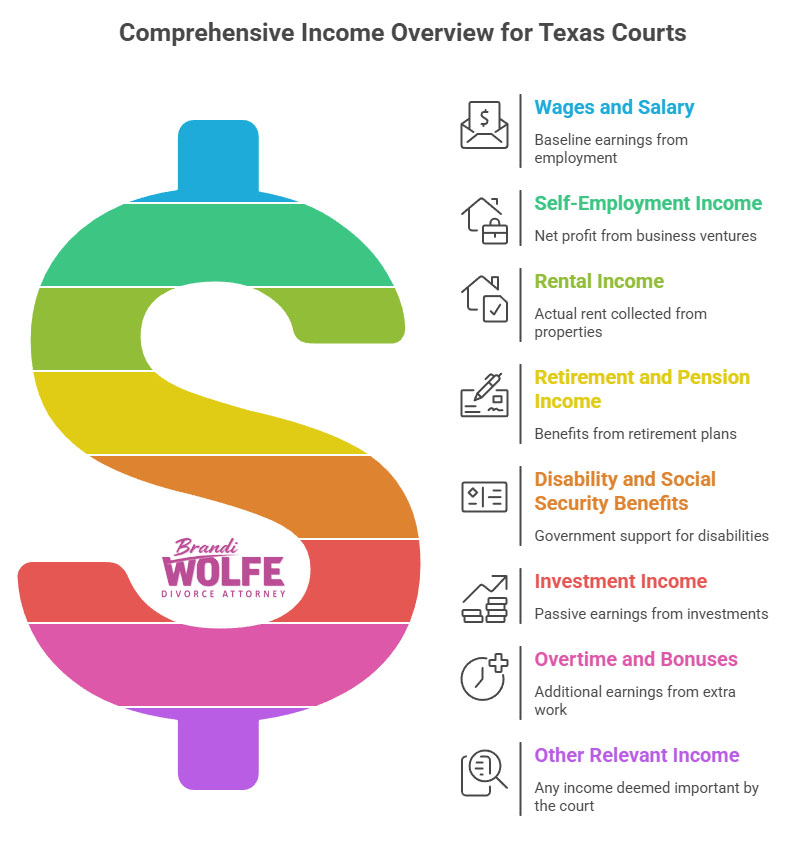
Here is what falls under that definition:
- Wages, salary, commissions, and tips: The baseline for most parents.
- Self-employment and business income: Net profit after legitimate business expenses.
- Rental income: What you actually collect, not what the property is worth.
- Retirement and pension income: Includes military retirement pay.
- Disability and Social Security benefits: Both count, with limited exceptions for SSI.
- Interest, dividends, and investment income: Passive income is not invisible to a Texas court.
- Overtime and bonuses: Consistent overtime is included. Courts look at patterns, not just the current pay period.
- Any other income the court finds relevant: This catch-all is exactly what it sounds like.
Where Military Allowances Fit In
That last bullet is where military allowances land when there is no specific statutory guidance. Courts have broad discretion, and Texas case law has consistently supported including BAH and other allowances in net resources.
One thing worth knowing: Texas child support guidelines apply to net resources up to $9,200 per month. Above that threshold, the court has discretion to order additional support based on the child’s proven needs. For high-ranking service members with significant total compensation, that ceiling matters.
How Texas Courts Treat Military Pay
Military compensation is not a single paycheck. It is a package of pay and allowances that can look very different from a civilian W-2. Texas courts are trained to look past the base pay line. When a support calculation is being set, the court will want the full Leave and Earnings Statement, which breaks down every component of a service member’s monthly compensation.
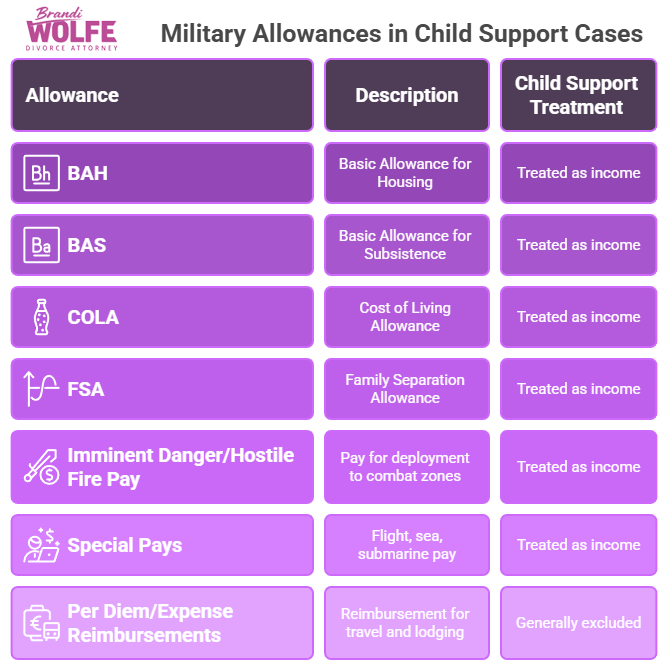
The table below shows how the most common components are treated:
| Pay Component | Counts as Income for Child Support? |
|---|---|
| Basic Pay | Yes |
| BAH (Basic Allowance for Housing) | Yes |
| BAS (Basic Allowance for Subsistence) | Yes |
| Special Pay (flight, sea, etc.) | Yes |
| Hazard / Imminent Danger Pay | Yes |
| Family Separation Allowance | Yes |
| Cost of Living Allowance (COLA) | Yes |
| Per Diem | Generally no |
| Reimbursements for expenses | Generally no |
Per diem and reimbursements are excluded because they offset actual costs rather than add to a parent’s financial resources. Everything else on that list is fair game.
Does BAH Count as Income Even Though It’s Tax-Free?
This is the question clients ask me most often on this topic. The answer is yes, and the reasoning is straightforward.
Texas Family Code does not defer to the IRS. The fact that BAH is non-taxable income under federal law has no bearing on how a Texas family court treats it. The court’s job is to assess a parent’s ability to financially support their child. BAH directly increases that ability. It covers housing costs the service member would otherwise have to pay out of pocket, which frees up other income. Courts recognize that.
The legal standard is whether the money constitutes a net resource available to the parent. BAH qualifies. It is paid monthly, it is predictable, and it is tied to the service member’s rank and duty station. Texas courts have consistently included it, and arguing otherwise is not a winning position.
If anything, BAH can be one of the larger line items on a Leave and Earnings Statement. Depending on rank and location, it can run anywhere from roughly $1,000 to over $3,000 per month. Leaving it out of the calculation would significantly understate what a service member actually has available.
What About Other Military Allowances?
BAH and BAS get the most attention in child support cases, but they are not the only allowances on a Leave and Earnings Statement. Depending on a service member’s assignment, rank, and family situation, several other allowances may appear, and courts in San Antonio and across Bexar County see these regularly given the concentration of military installations in the area.
Cost of Living Allowance (COLA)
Paid to service members stationed in high-cost areas, including certain overseas assignments. Texas courts treat COLA as income for child support purposes. It increases purchasing power the same way BAH does, and courts make no distinction between the two for calculation purposes.
Family Separation Allowance (FSA)
Paid when a service member is away from their dependents due to military orders for more than 30 days. This one surprises people. The allowance exists because of the family situation, but it still counts as a net resource available to the paying parent.
Imminent Danger Pay and Hostile Fire Pay
Both count as income. Being deployed to a combat zone does not pause or reduce a child support obligation, and the extra pay that comes with that assignment is included in the net resources calculation.
Special Pays
Flight pay, sea pay, submarine pay, and similar specialty pays are part of total compensation and are included in net resources. These can add several hundred dollars per month to the calculation.
Per Diem and Expense Reimbursements
Generally excluded. Per diem reimburses a service member for actual travel and lodging costs. Expense reimbursements follow the same logic. Because these offset documented costs rather than add to available income, courts typically leave them out.
How BAH Affects the Child Support Calculation
Once you know what counts as income, the math becomes straightforward. Texas child support is calculated as a percentage of net resources, and BAH can move that number significantly.
Building the Gross Resources Picture
Start with what a service member actually brings in each month. Base pay, BAH, and BAS are the three most common components. BAH with dependents is consistently higher than the without-dependents rate, sometimes by $200 to $400 per month depending on duty station and rank. For a mid-grade enlisted member or junior officer stationed at a high-cost installation, total countable compensation can look very different from base pay alone.
Here is a straightforward example using round numbers:
| Income Component | Monthly Amount |
|---|---|
| Basic Pay | $3,200 |
| BAH (with dependents) | $1,800 |
| BAS | $400 |
| Total Gross Resources | $5,400 |
From Gross Resources to Net Resources
Texas allows certain deductions before arriving at net resources, including Social Security taxes, federal income tax (based on the tax withholding for a single filer with one exemption), and union dues if applicable. After standard deductions, net resources on $5,400 gross might land around $4,600 to $4,900 depending on the service member’s tax situation.
What the Guideline Percentage Produces
Apply the guideline percentage for one child, which is 20% of net resources, and the monthly support obligation comes out to roughly $920 to $980 per month.
Now run the same calculation without BAH. Base pay and BAS alone bring gross resources to $3,600. After deductions, net resources drop to roughly $3,100 to $3,300. At 20%, that produces a support figure of $620 to $660 per month.
The difference between including and excluding BAH in that scenario is $300 or more per month. Over a year, that is $3,600. Over the life of a child support order, it adds up to a significant amount of money for the child receiving support.
Courts use the guideline percentage as the starting point. A judge can deviate from guidelines, but doing so requires findings on the record explaining why. In practice, guideline support is the baseline most orders follow.
When the Other Parent Is the Service Member
If you are the service member, understand this clearly: a Texas court sees your total compensation, not just your base pay. Walking into a support hearing with only your base pay figure is not a strategy. It is a mistake courts and opposing counsel see coming.
What Opposing Counsel Already Knows
Attorneys who handle military divorce and child support cases in San Antonio know how to read a Leave and Earnings Statement. They know where BAH sits, what rate the service member is receiving, and whether the dependency status on file matches the family situation at hand. Presenting an incomplete picture of your income does not make the rest of it disappear.
How Enforcement Works for Military Pay
Child support can be enforced through an income withholding order sent directly to DFAS (Defense Finance and Accounting Service). This is not a collections action reserved for parents who fall behind. It can be established as part of the original support order, meaning payments come out of your military pay automatically before you ever see them. For service members, this is actually the most common enforcement method.
What this means practically is that your support obligation follows your compensation. If BAH increases because you move to a higher-cost duty station or your dependent status changes, that increase is visible. A modification petition based on changed income is a straightforward argument when the Leave and Earnings Statement tells the whole story.
If you are a service member facing a child support proceeding in Texas, the most useful thing you can do is get clear on your full compensation picture before you walk into that courtroom or mediation.
Modifying Child Support When BAH Changes
BAH is not a fixed number. It changes when a service member transfers to a new duty station, gets promoted, or gains or loses dependent status. Any of those changes can shift net resources enough to make the current child support order inaccurate in either direction.
The Material and Substantial Change Standard
In Texas, modifying a child support order requires showing a material and substantial change in circumstances since the last order was signed. A duty station change that increases BAH by several hundred dollars a month is exactly the kind of change that meets that standard. So is a reduction. If a service member loses BAH with dependents status or transfers to a lower-cost installation, that is also a legitimate basis for modification.
The Three-Year Review Option
Texas also has a time-based review option. If it has been at least three years since the last order was established or modified, and the new guideline amount differs from the current order by either 20% or $100 per month (whichever is less), that difference alone is enough to support a modification petition. You do not have to prove a specific life change occurred. The passage of time and the shift in numbers is sufficient.
For military families, this comes up more often than it does for civilian families. Service members move. Ranks change. Dependent status changes after a divorce is finalized. Each of those events is a potential trigger for revisiting the support order.
If BAH has changed significantly since your last order was set, the current amount may not reflect what Texas guidelines would produce today. That is worth looking at.
FAQs About BAH and Child Support in Texas
What happens to child support if the service member is deployed?
Child support obligations do not pause during deployment. The order stays in effect, and payments are still due. If anything, deployment often increases total compensation through imminent danger pay, hostile fire pay, or family separation allowance, all of which count as income. An income withholding order through DFAS can keep payments running automatically throughout a deployment.
Does BAH count as income if the service member lives on base instead of collecting the allowance?
A service member who lives in on-base housing typically does not receive BAH in cash. In that situation, the housing benefit has value, but courts handle it differently than a cash allowance. Some courts will impute a housing benefit to net resources, but this is more fact-specific than a straightforward BAH calculation. If this applies to your case, it is worth addressing directly with your attorney rather than assuming it goes one way or the other.
Can a court order child support above the guideline amount for high-earning service members?
Yes. Texas child support guidelines apply to net resources up to $9,200 per month. Above that threshold, the court has discretion to order additional support based on the child’s proven needs and the parent’s ability to pay. For senior officers or highly compensated service members, total compensation can exceed that ceiling, and the calculation becomes more involved.
What if the service member separates or retires from the military?
Leaving the military is a material change in circumstances that can support a modification petition. BAH and other allowances disappear at separation. Base pay is replaced by whatever civilian income the former service member earns, or by military retirement pay if they served long enough to retire. The existing order does not automatically adjust. A modification has to be filed.
Does the child support order have to be in Texas to account for BAH?
Not necessarily, but a Texas court can only modify or enforce an order it has jurisdiction over. If the original order was issued in another state, it may need to be registered in Texas before a Texas court can act on it. This comes up regularly in military cases where the family has moved between duty stations and states. Registration is a straightforward process but it has to happen before Texas can do anything with the order.
What if the service member claims BAH should not count because it goes directly to housing costs?
This argument does not hold up in Texas courts. The fact that BAH is intended for housing does not change its classification as a net resource. Texas courts look at what is available to the parent, not what that parent chooses to spend it on. A civilian parent who spends a large portion of their income on rent does not get that amount excluded from the child support calculation either.
Is BAH treated the same way in all Texas counties?
The statute is statewide, so the legal framework is consistent across Bexar County, Travis County, Harris County, and everywhere else in Texas. In practice, judicial interpretation can vary slightly, particularly on edge cases like on-base housing or overseas COLA. Working with an attorney who handles military family law cases in your specific county matters, especially in San Antonio where military cases come through the courts regularly.
Get Clear on What the Military Pay Picture Actually Looks Like
Whether you are trying to make sure a support order reflects a service member’s full compensation, or you are a service member trying to understand your exposure before a hearing, the numbers matter. BAH is income under Texas law. So are most of the other allowances on that Leave and Earnings Statement. Getting that wrong, in either direction, has real financial consequences for your family.
Brandi Wolfe Law handles military divorce and child support cases in San Antonio and across Bexar County. If you have questions about how military pay is calculated for child support purposes, or if you need to file a modification because compensation has changed, call (210) 571-0400 or visit brandiwolfelaw.com to schedule a consultation.