
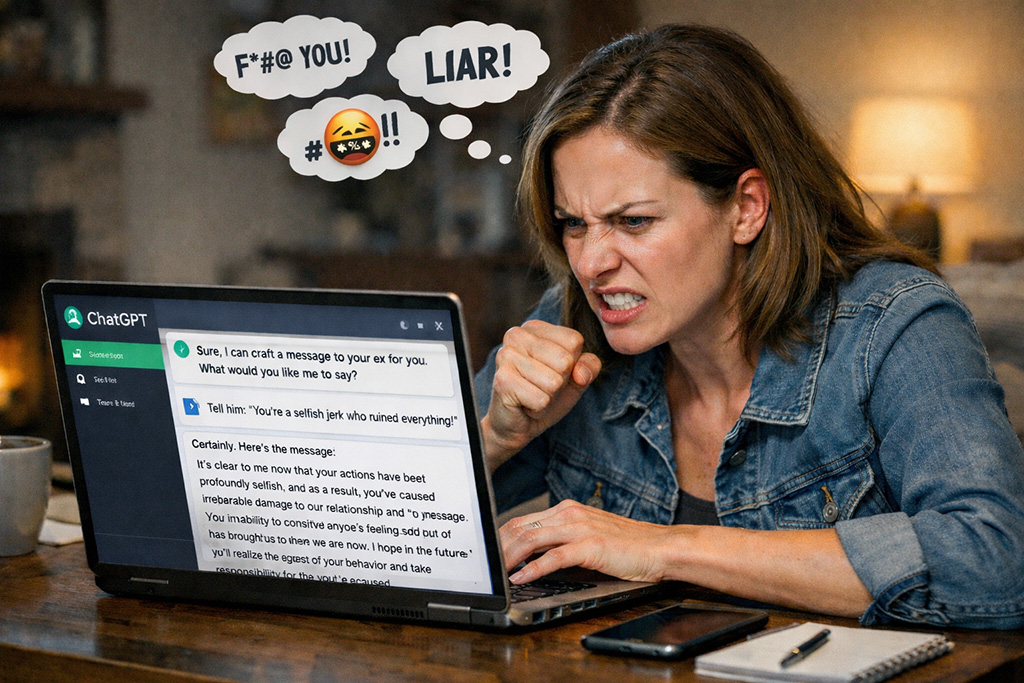
Divorcing? Here’s Why ChatGPT May Not Be the Best Messenger
As a divorce attorney, I’ve seen a lot of messy communication between exes – but recently, there’s a new kind of message making its way into court filings, custody exchanges, and legal disputes: long-winded, overly formal messages clearly written by ChatGPT.
I can spot them instantly. What should have been a simple question – like “Can we switch weekends?” – turns into a multi-paragraph monologue about “mutual understanding,” “effective co-parenting,” and “constructive dialogue moving forward.” These messages aren’t just unnecessary – they’re often counterproductive.
Clients use AI thinking it will make their tone sound calm and professional. But what actually happens is that the message becomes bloated, repetitive, and completely out of touch with the emotional reality of a tense divorce. Worse, when these messages are brought into court, they can hurt credibility or trigger conflict that could have been avoided with a direct, human response.
ChatGPT wasn’t designed for your divorce. It doesn’t understand your history, your co-parenting dynamic, or the legal context behind your words. And in a process where every word can matter, relying on AI can quietly – and quickly – make things worse.
Why People Turn to AI Tools Like ChatGPT During Divorce
Divorce is one of the most emotionally draining life events a person can go through. When anger, sadness, or anxiety take over, communicating clearly with an ex can feel nearly impossible. That’s where tools like ChatGPT seem to offer relief. With just a few prompts, users hope to generate a message that’s calm, neutral, and conflict-free.

The appeal is strong:
- It’s fast and easy to use.
- It promises to remove emotional charge from your words.
- It can help you avoid saying something you’ll regret.
- It feels like a buffer between you and someone who might trigger you.
In many cases, people aren’t looking to manipulate – they just don’t trust themselves to stay composed. Whether it’s settling a schedule, updating about a child, or negotiating next steps, users ask ChatGPT to “make this sound professional” or “write this without sounding bitter.” The goal is to smooth out the conflict.
But what often comes back is far from simple.
Even short prompts like “Please let me know if you’ll be picking up the kids on time” get returned as verbose messages that may read:
“In the interest of maintaining open communication and ensuring we continue to meet our agreed-upon schedule, I would appreciate your confirmation regarding the pickup time for the children.”
To the user, it might seem composed. To the recipient – especially one in a tense divorce – it can come off as patronizing, overly formal, or emotionally removed.
This mismatch is where problems begin.
When communication tools prioritize tone over clarity, and polish over emotional intelligence, messages can feel less like helpful coordination and more like scripted performances. What’s meant to reduce friction may, in reality, create more of it.
Miscommunications, Repetition, and Tone Problems AI Can’t Predict
In the middle of a divorce, the last thing anyone needs is to be misunderstood. But that’s exactly what can happen when you rely on ChatGPT to generate messages that sound “calm” or “professional.” While the AI can mimic tone and structure, it doesn’t grasp emotional nuance or shared history – and that’s where things often go sideways.
A major issue is verbosity. ChatGPT frequently transforms direct thoughts into drawn-out explanations, even when the situation calls for simplicity. What starts as “Let me know if you’ll be there at 4” becomes:
“I just wanted to reach out and kindly confirm whether you’re still planning to arrive at 4 p.m., as previously discussed. Your timely response would be greatly appreciated.”
To someone outside the relationship, it might sound polite. But to an ex – especially in a strained divorce – it can feel passive-aggressive, overly formal, or just plain exhausting.
ChatGPT also tends to:
- Repeat key ideas, often in slightly different ways, making messages longer than necessary.
- Include vague qualifiers (“at your earliest convenience,” “if it works for you”) that create ambiguity.
- Default to generic pleasantries that don’t fit the emotional tone of the situation.
This can unintentionally escalate tension. A message that’s meant to be neutral might come off as controlling or insincere. Even worse, repeating the same idea multiple times can feel like pressure or condescension.
These problems get compounded when the recipient is already on edge. Every extra word becomes room for misinterpretation. And because ChatGPT doesn’t know your ex – or what battles you’ve had in the past – it can’t predict how its words will land.
In emotionally fragile situations, clarity and brevity are more powerful than any polished script.
Legal Risks & Privacy: Why Your AI Conversations Aren’t Confidential
When using ChatGPT to communicate with an ex, most people assume those conversations are private. But that assumption can be costly – especially during a divorce.
What you type into an AI platform isn’t protected in the same way a conversation with your lawyer or therapist would be. Unless you’re using strict privacy settings and opt-outs, your inputs may be stored by the system, reviewed for training purposes, or potentially exposed in legal discovery.
Divorce attorneys are increasingly warning clients that AI tools can introduce serious legal vulnerabilities, including:
- Loss of confidentiality: ChatGPT and similar platforms are not bound by legal privilege. Anything you say could be stored – and in some cases, reviewed by third-party systems.
- Court admissibility: Messages created with or by AI could be subpoenaed and presented in court. Even if you only used the AI to draft a message, that content might be reviewed and interpreted as your intention.
- Accidental disclosures: In seeking the “right words,” users may provide more detail than necessary – information that could complicate a case if surfaced later.
One divorce attorney noted that AI interactions, once seen as casual drafts, are increasingly being printed and submitted as part of legal disputes – especially when there’s disagreement over tone, intent, or language used.
This means a message generated to “smooth things over” could later be dissected by a judge or opposing counsel. And because AI often includes vague language or layered phrasing, it’s easy for someone to claim the wording was misleading – or manipulative.
To stay protected, experts recommend treating every AI-generated message as if it could be made public. If you wouldn’t want your draft shown in court or shared in a custody hearing, don’t put it into an AI system.
Emotional Detachment or Avoidance? The Psychological Impact
Divorce isn’t just a legal process – it’s an emotional one. And how you communicate during this time can shape your healing, especially if children or long-term conflict are involved. While ChatGPT may seem like a helpful way to keep things “professional,” therapists caution that it can also act as a shield – blocking people from confronting hard feelings or saying what they truly mean.

For some, using AI becomes a way to emotionally disconnect. Instead of expressing boundaries, disappointment, or needs in their own words, people outsource the task to a tool with no personal history or emotional depth.
This can lead to:
- Avoidance of emotional responsibility (“I didn’t write it, the AI did”)
- Detachment from personal values or intentions
- Messages that lack authenticity, even if they sound polished
Imagine telling ChatGPT, “Write this in a way that doesn’t sound angry,” and getting back a long, formal message that dances around the issue. It may sound calm, but it’s missing something important: your actual voice.
Over time, this distancing can interfere with closure. When people rely on AI to communicate in place of working through difficult emotions, they miss the chance to clarify their own needs and values. The result? Delayed grief, unresolved tension, and even confusion about what they truly want moving forward.
Therapists emphasize that discomfort is part of the healing process. Avoiding it with overly managed communication may feel safer in the moment – but can slow personal growth and make healthy boundaries harder to establish.
Expert Advice: Better Ways to Handle Communication During Divorce
When you’re in the middle of a divorce, it’s tempting to search for the perfect words – something that feels emotionally safe but still gets the job done. But according to legal professionals and mental health experts, the best messages aren’t generated by AI – they’re clear, brief, and unmistakably human.
Experts consistently recommend the following:
1. Use direct language.
Avoid long explanations or overly polished phrases. The goal isn’t to impress – it’s to inform.
2. Speak for yourself.
Even if your emotions are complicated, messages written in your own voice are more honest, more grounded, and less likely to create confusion.
3. Review before sending – but skip the robot.
Instead of asking AI to revise your tone, ask a neutral third party. Therapists, divorce coaches, or mediators can offer guidance without stripping away your intent.
4. Avoid over-communication.
Repeating your point several ways may feel thorough, but it’s usually read as pressure or control. Say what you need to say, then stop.
Let’s look at a quick comparison:
| Scenario | AI-Generated Message | Better Human Message |
|---|---|---|
| Confirming a pickup | “I’d like to reconfirm our previously discussed plans regarding the pickup time for the children tomorrow.” | “Just confirming pickup at 4pm.” |
| Requesting financial info | “In the interest of clarity, could you kindly provide the agreed-upon expense breakdown from last month?” | “Can you send last month’s expenses?” |
| Scheduling a meeting | “If it’s not too much trouble, I’d like to discuss potentially adjusting our upcoming meeting time to 2pm.” | “Can we move the meeting to 2pm?” |
In difficult conversations, simplicity builds trust. You don’t need perfect words – you need honest ones. Over time, consistent, direct messaging becomes a stronger foundation for co-parenting, negotiation, or closure than anything a chatbot can create.
Safer Tools for Divorce Communication: Co-Parenting Apps and Court-Friendly Platforms
When communication with your ex is necessary – especially around children – it’s not just about tone. It’s about accountability, clarity, and legal protection. That’s why many legal professionals recommend structured platforms built for co-parenting, not general-purpose AI tools.
Co-parenting apps offer several key advantages:
- Message logging: Every interaction is time-stamped and stored.
- Legal admissibility: Many platforms are recognized by courts and judges.
- Boundaries built-in: These tools often prevent editing or deleting messages.
- Audit-friendly: Professionals can review conversations for patterns or issues without relying on screenshots or claims.
Popular platforms include:
- OurFamilyWizard – Frequently recommended in custody cases; includes tone filters, calendar sharing, and message audit trails.
- Talking Parents – Known for simplicity and court-approved logging features.
- AppClose – Offers free messaging and calendar tools with court-usable records.
Unlike ChatGPT or email, these tools are purpose-built for high-conflict communication. Their design minimizes ambiguity and discourages emotional manipulation. Judges, mediators, and attorneys can request access or receive documentation as needed, creating a clear record that protects both parties.
These platforms also reduce the temptation to “edit for tone” using tools like ChatGPT. With legal visibility comes an incentive to be direct, clear, and respectful – no AI-generated fluff required.
If you’re navigating a divorce where communication is fragile, these tools provide the structure and legal footing that AI can’t offer.
When (If Ever) It’s OK to Use ChatGPT with an Ex
ChatGPT isn’t inherently dangerous – but using it during a divorce requires caution and restraint. While it shouldn’t replace direct communication in sensitive conversations, there are limited ways it can be helpful – as long as you remain fully in control of the message.
Safe, limited uses include:
- Drafting rough ideas: You might use AI to explore how something could be phrased – but never copy it word-for-word.
- Grammar checks: Cleaning up typos or correcting sentence flow can be helpful if you’re unsure of your writing.
- Practicing tone: ChatGPT can suggest softer ways to phrase something – but those suggestions should be reviewed carefully and revised to reflect your intent.
Think of it this way:
AI Draft → Personal Edit → Final Human Message
If you’re relying on ChatGPT to avoid confrontation, that’s a red flag. Messages about parenting, legal terms, or emotional boundaries should be written in your own words. AI lacks the understanding of context, trust, and nuance that these conversations demand.
Never use ChatGPT for:
- Communicating feelings like anger, sadness, or blame
- Making legal or financial proposals
- Anything you wouldn’t want shown in court
A quick rule of thumb: if a message has emotional, legal, or long-term consequences, it should not pass through AI filters. Write it, reflect on it, get help from a professional if needed – but make sure it’s yours.
AI & Emotional Dependencies: When Technology Becomes a Crutch
For some people, ChatGPT becomes more than just a writing tool during divorce – it becomes a sounding board, a comfort mechanism, even a replacement for real emotional processing. What starts as a quick way to draft messages can evolve into emotional reliance.

This dependency can take subtle forms:
- Asking ChatGPT to validate your feelings about your ex
- Seeking advice on whether your reaction is “reasonable”
- Using the chatbot to simulate conversations you’re afraid to have
At first, this might feel therapeutic. It’s fast, always available, and never judges. But that’s also the danger. AI responses can feel emotionally satisfying in the moment – without pushing you toward real insight, healing, or human connection.
Mental health professionals caution that this kind of digital attachment can stall growth. Unlike therapy, where the goal is self-awareness and long-term coping, AI tools often reinforce emotional loops:
- Rumination without resolution
- Reassurance without accountability
- Planning messages without follow-through
It’s not wrong to test ideas or rehearse language – but if you find yourself turning to ChatGPT more than to trusted friends, professionals, or your own inner voice, it may be time to reassess.
AI can offer structure. It can offer language. But it can’t offer closure, healing, or transformation. Those still come from within – and from real relationships.
Need Guidance During Divorce? Let Brandi Wolfe Law Help You Communicate with Clarity
If you’re navigating divorce and unsure how to handle communication with your ex – especially when technology complicates things – you don’t have to manage it alone. At Brandi Wolfe Law, we help clients make smart, strategic decisions that protect both their legal standing and emotional well-being.
Whether you’re dealing with co-parenting conflict, privacy concerns, or unclear boundaries, we’re here to provide practical legal support every step of the way.
Call (210) 571-0400 today to schedule a confidential consultation.